Planet Scenes August 2025
|
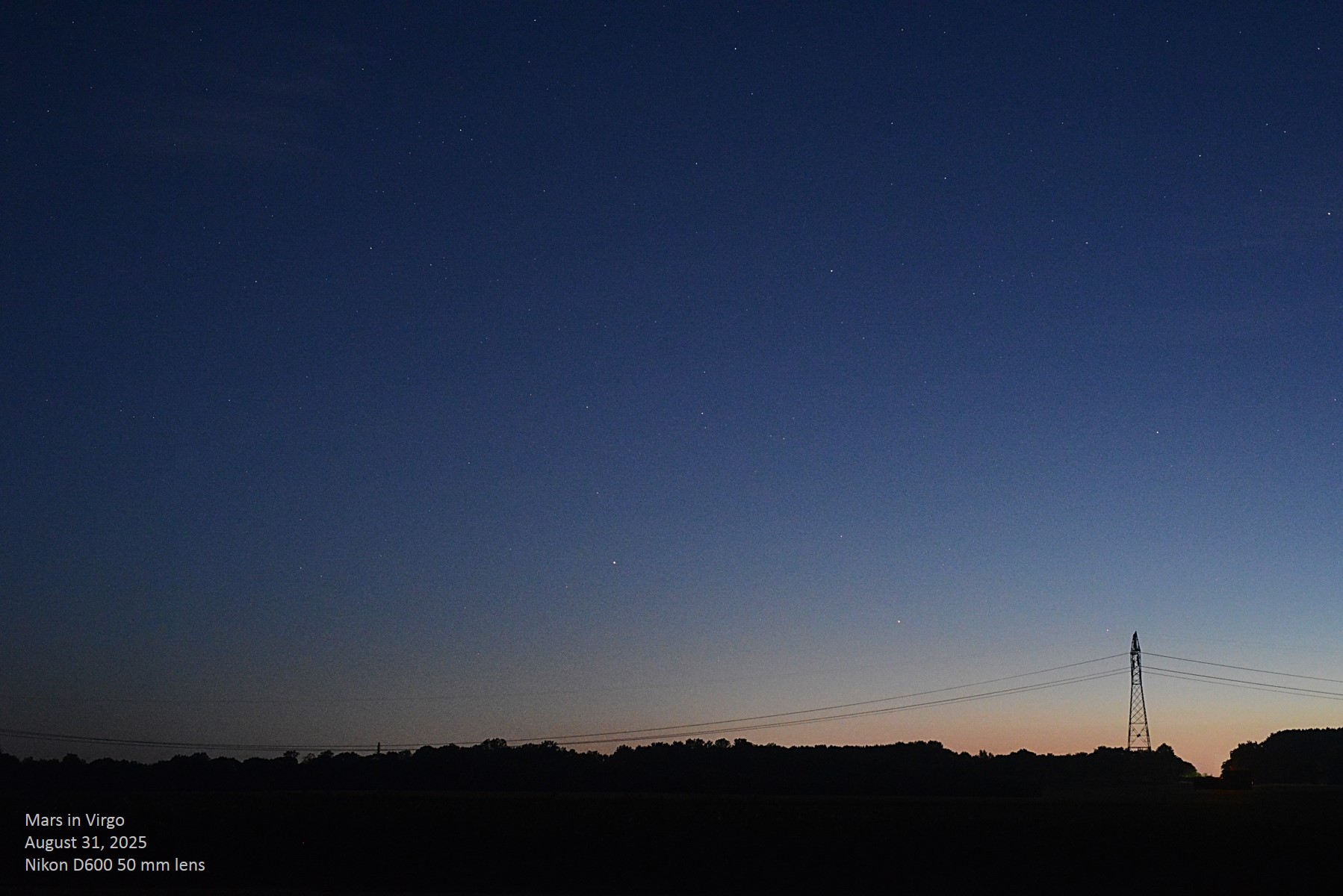
August 31: Mars in Virgo Mars is still racing eastward along the ecliptic in Virgo, closing in on Spica, which it will pass on September 13. They will be pretty close to the Sun then, so it might be tricky getting a picture of that! |
||
|
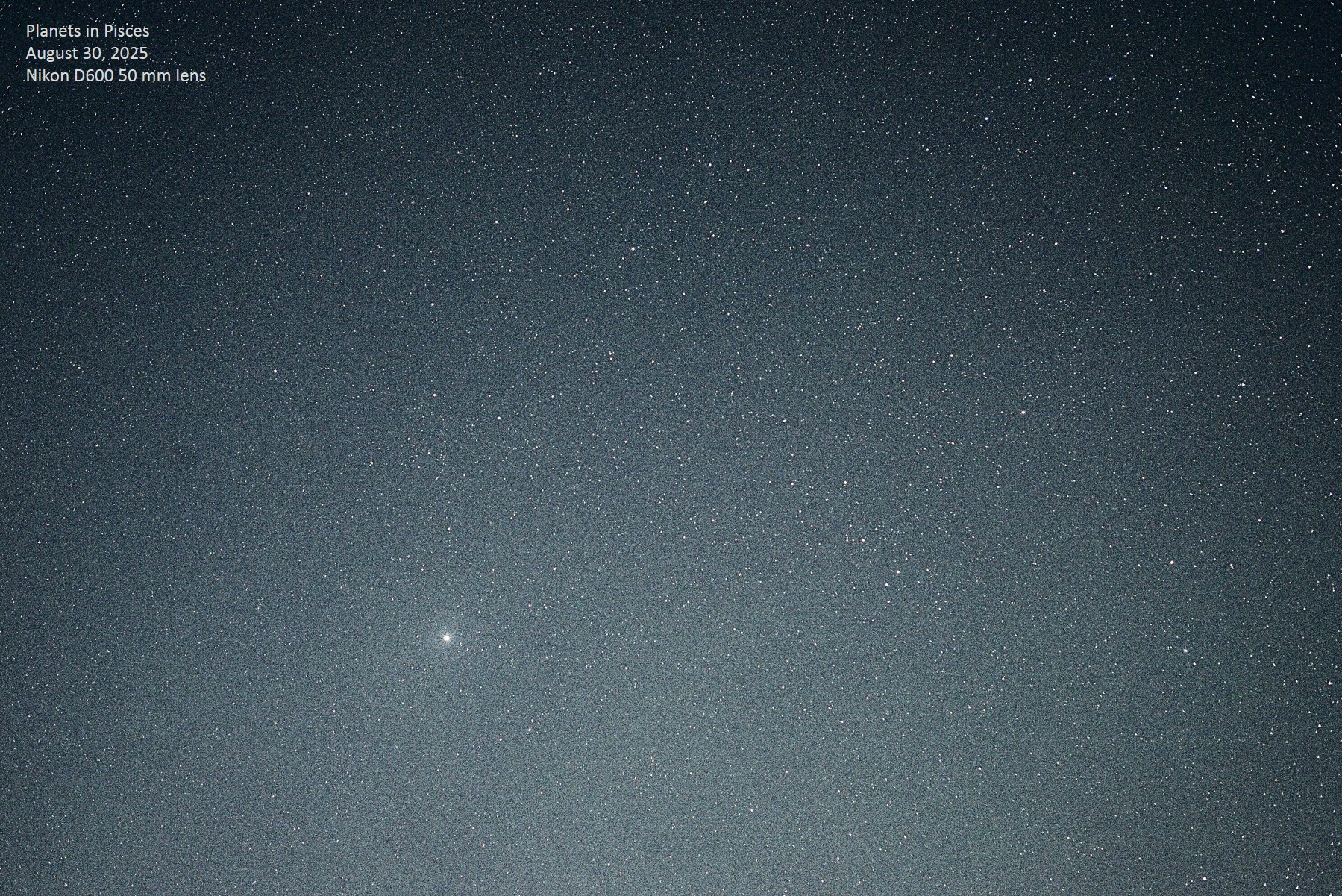
August 30: Saturn and Neptune Saturn and Neptune are in southwestern Pisces, to the lower left of the Circlet and just above the parallelogram of stars in the nook of Pisces between Aquarius and Cetus. |
||
|
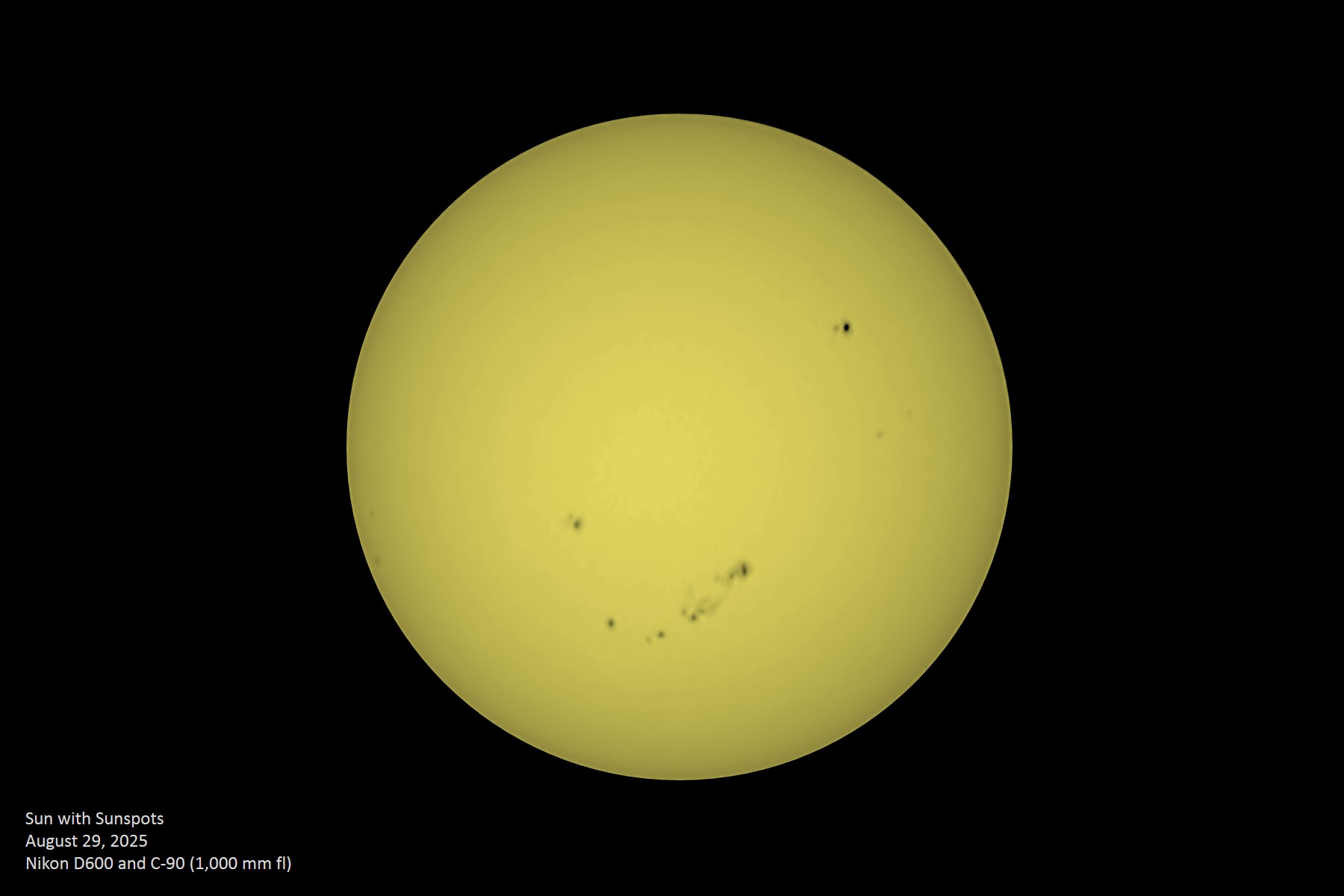
August 29: Sun and Sunspots Too many amazing pictures of the Sun are being posted, so I couldn't resist trying to get a better image than the one from the previous evening. I acquired this image midday on Friday, August 29, using my 1980's vintage black-body Celestron C-90 Mak, which has a focal length of 1,000 mm. In this image, solar north is just about straight up. |
||
|
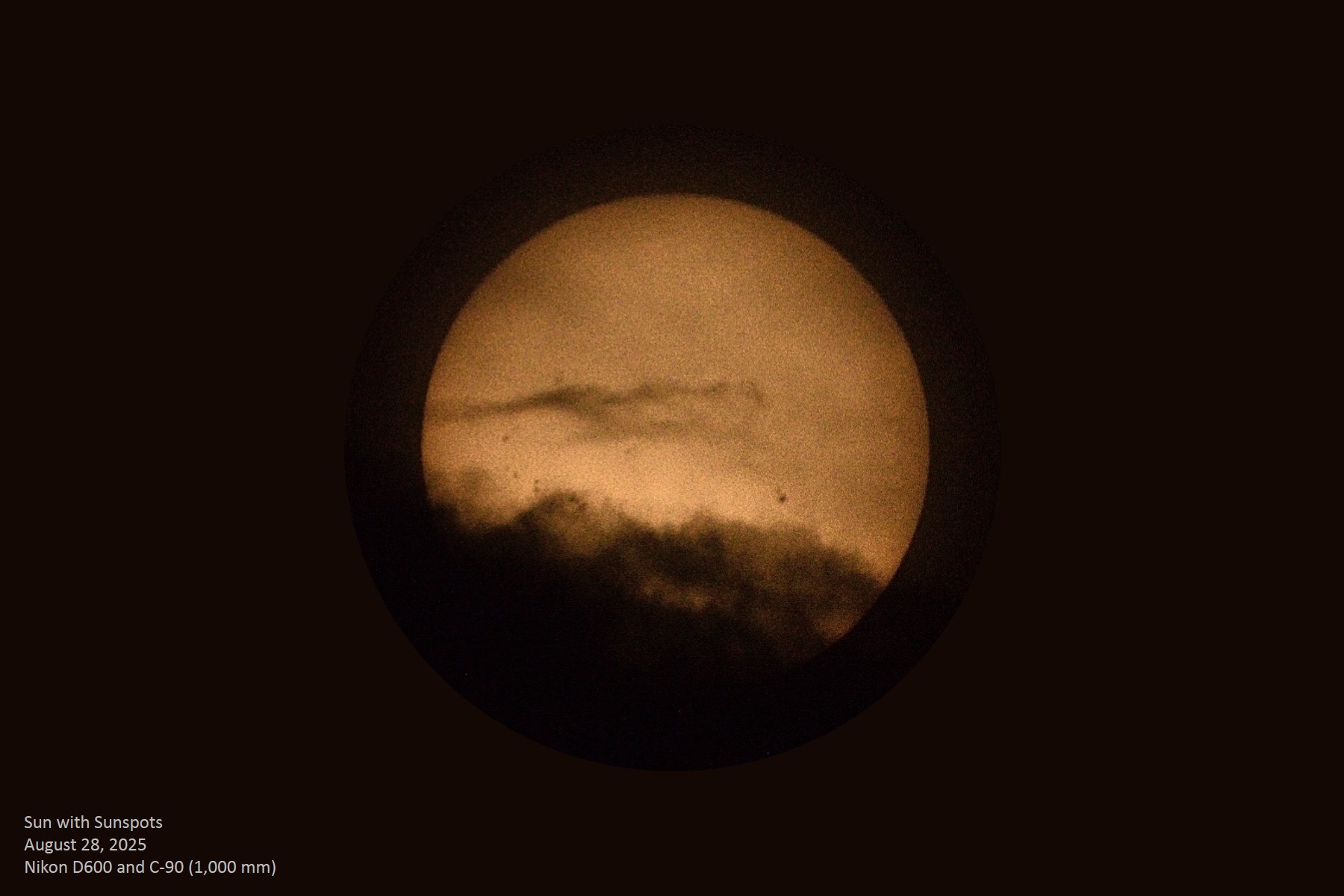
August 28: Sun and Sunspots The face of the Sun is once again filled with interesting and fairly large sunspot groups. I acquired this image in the early evening of Thursday, August 28, using my 1980's vintage black-body Celestron C-90 Mak, which has a focal length of 1,000 mm. In this image, solar north is pointing approximately in the 2:00 clock position. |
||
|
|
|
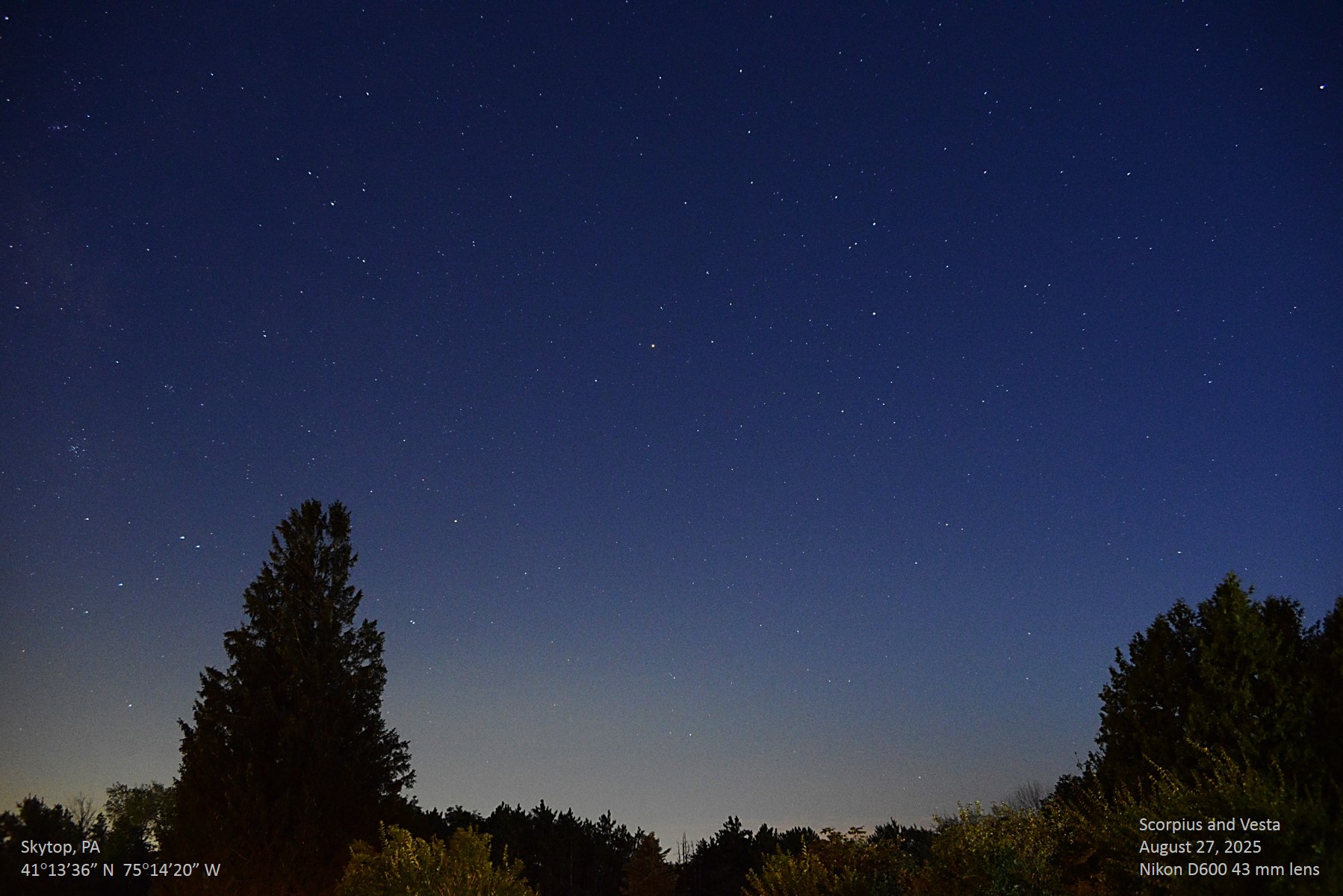
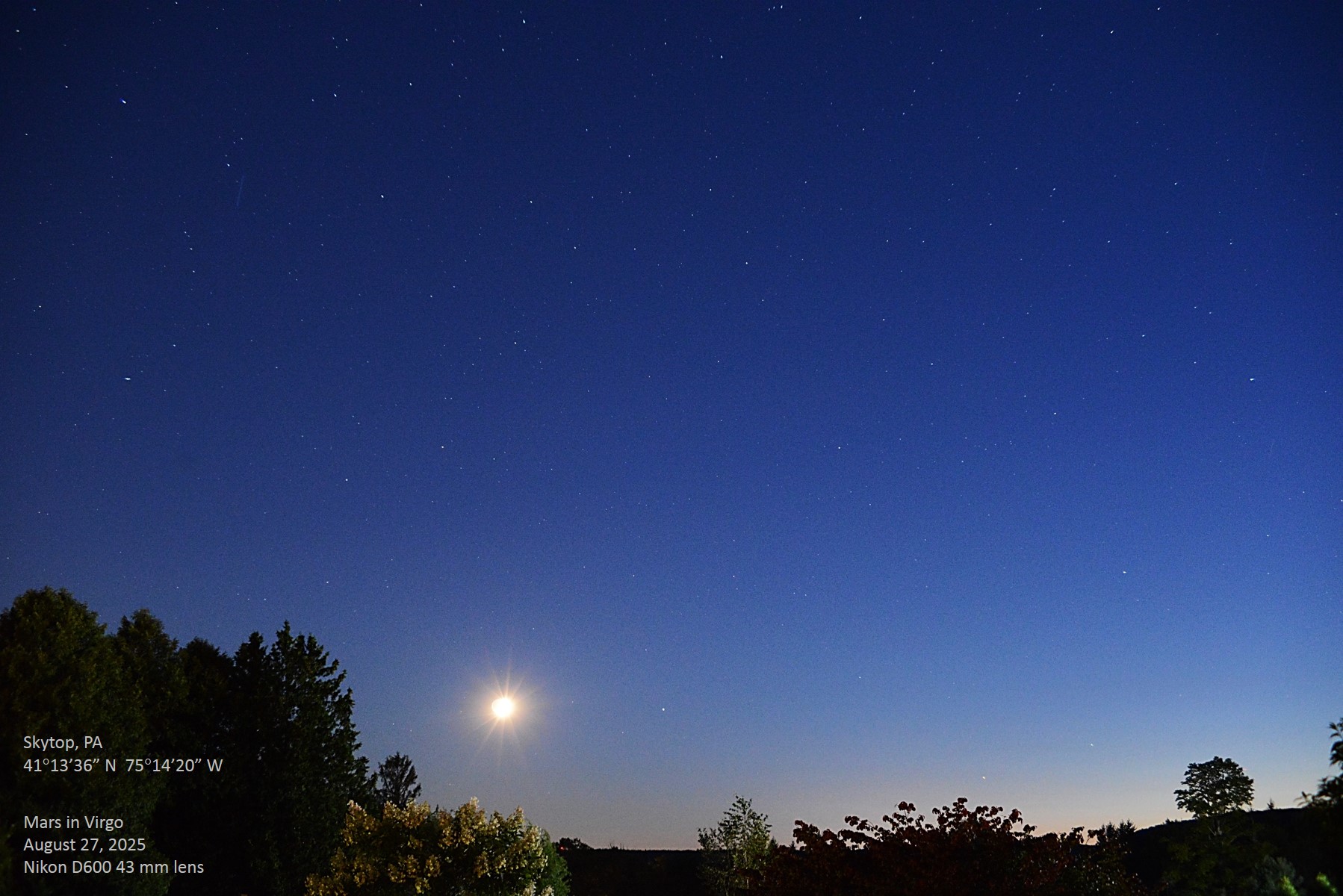
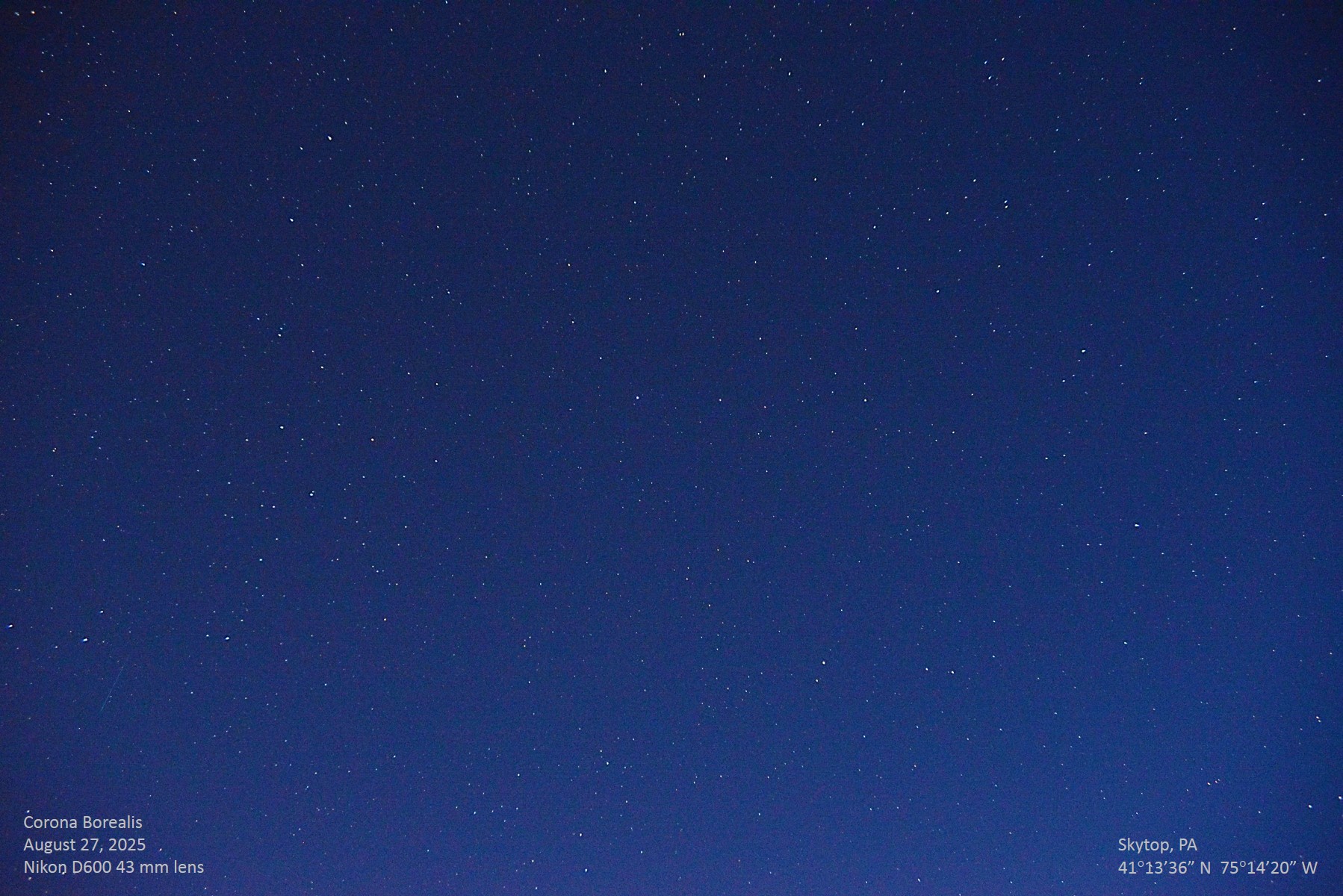
August 27: Mars and Vesta, T Coronae Borealis Mars remains low in the west after sunset, and Vesta shines very dimly in western Libra, in these scenes obtained from a high elevation in the Poconos, Pennsylvania. Because the sky was so clear and nice, I got a shot of Coronae Borealis as well, just in case there was any unusual activity with T that I could get with a wide angle snapshot. |
|
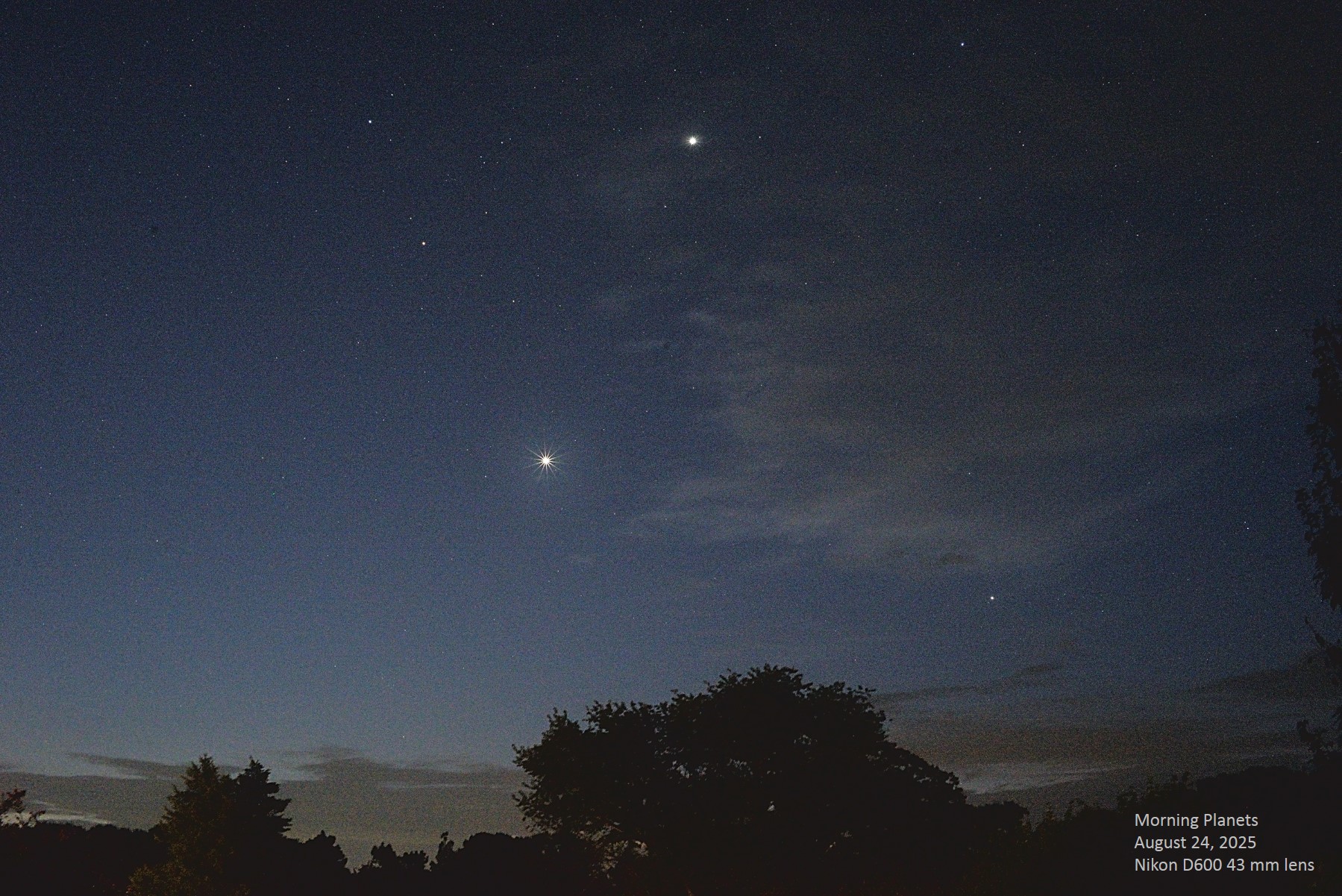
August 24: Venus & Jupiter Venus and Jupiter continue to dominate the morning sky, here seen about one hour ten minutes prior to sunrise on a humid and partly cloudy morning. Mercury unfortunately is just below the Beehive cluster, M44, in the cloud bank at the bottom of the image, so we just barely missed catching it in addition to the king and queen of the solar system. |
||
|
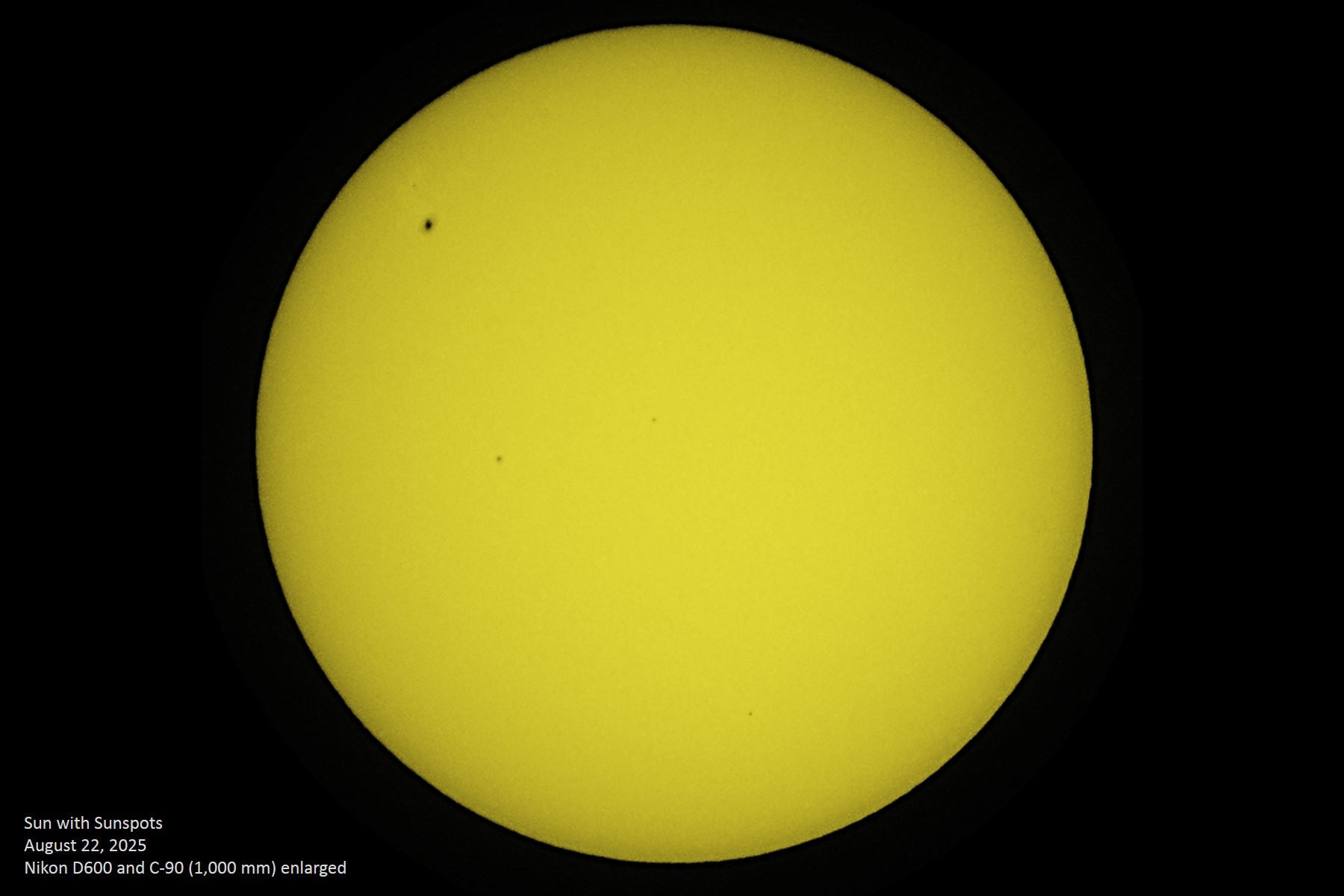
August 22: Sun and Sunspots A large and well-formed sunspot group has emerged around the east limb of the Sun and begun to move across the Sun's face, finally marking a return of interesting white light activity after several weeks of an almost blank Sun. I acquired this image on the late afternoon of Friday, August 22, using my new 1980's vintage black-body Celestron C-90 Mak, which has a focal length of 1,000 mm. In this image, solar north is pointing approximately in the 1:30 clock position. |
||
|
|
|
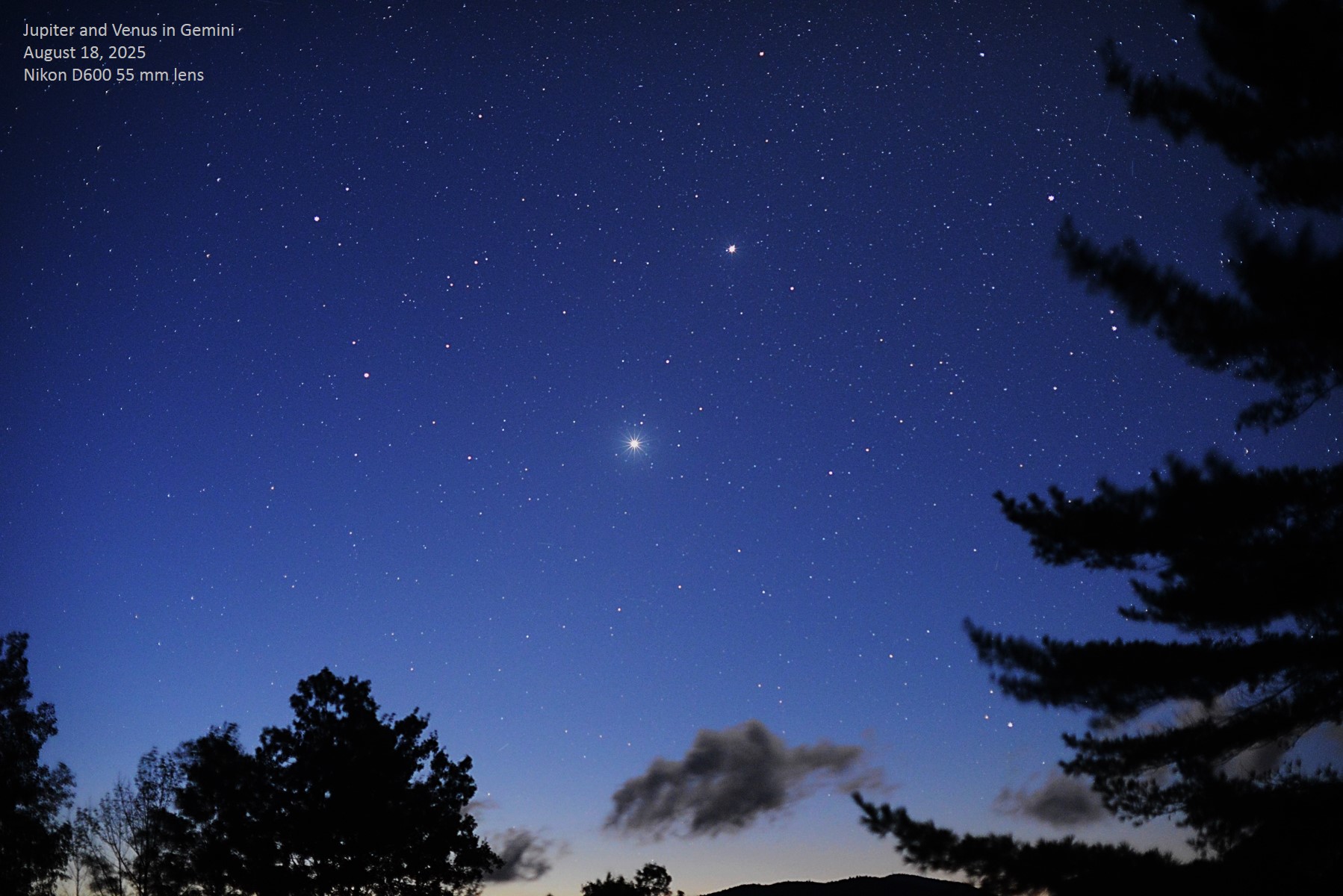
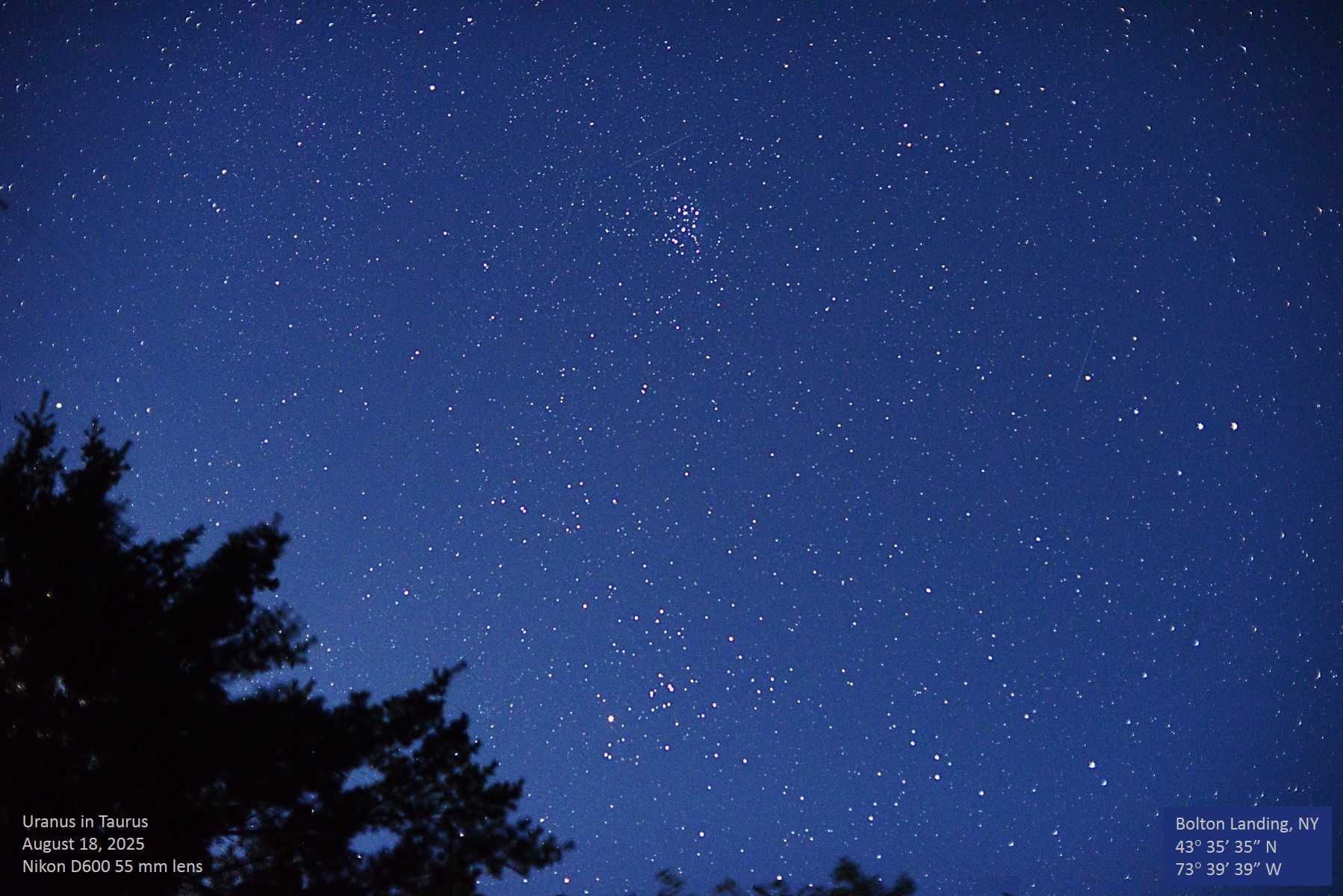
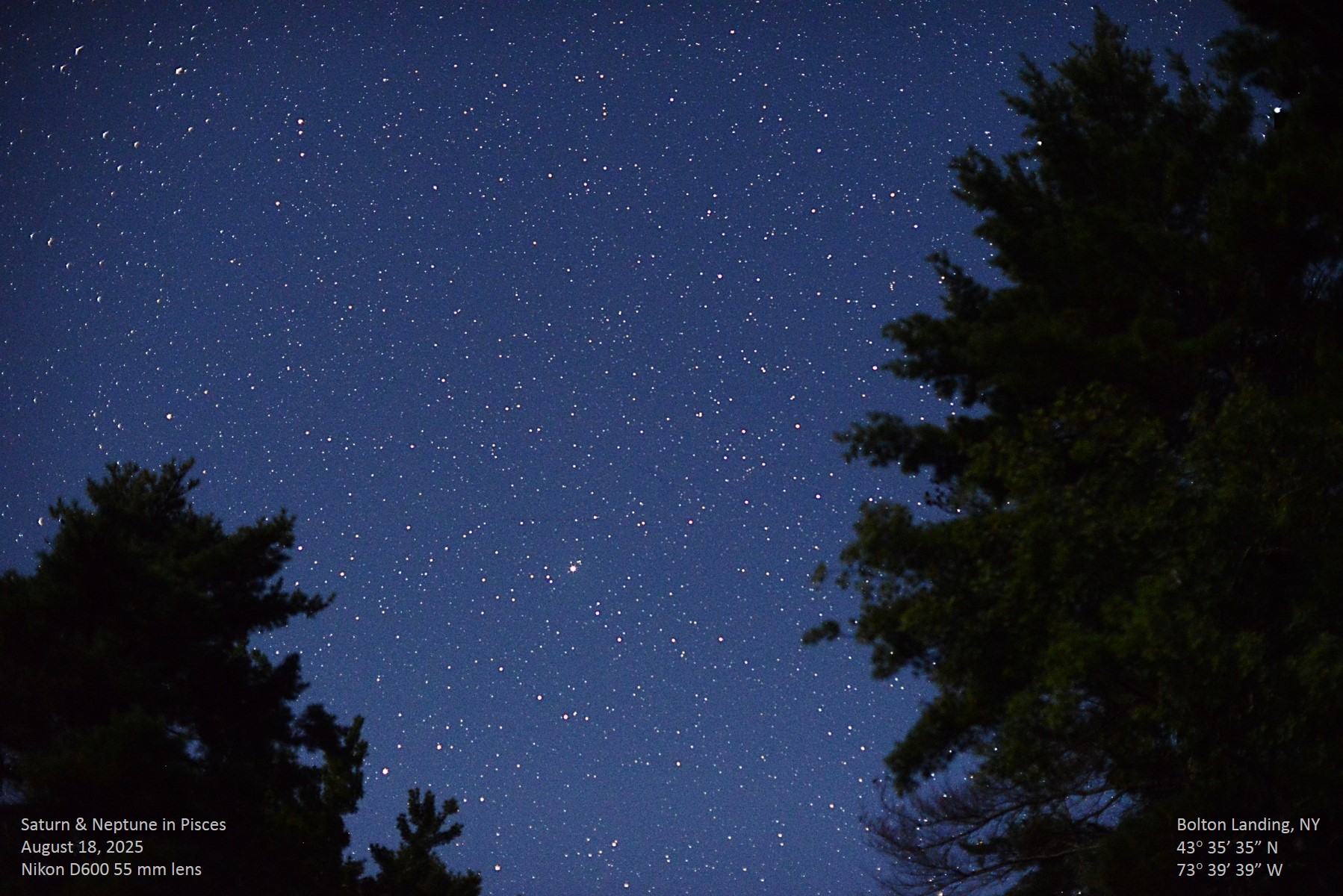
August 18: Venus, Jupiter, Saturn, Uranus & Neptune All the morning planets except Mercury were easily visible on the morning on August 18 during my stay with Laura in Bolton Landing, New York. We captured Saturn and Neptune in Pisces, then Uranus in Taurus, and finally the (separating) pair of Jupiter and Venus in Gemini. |
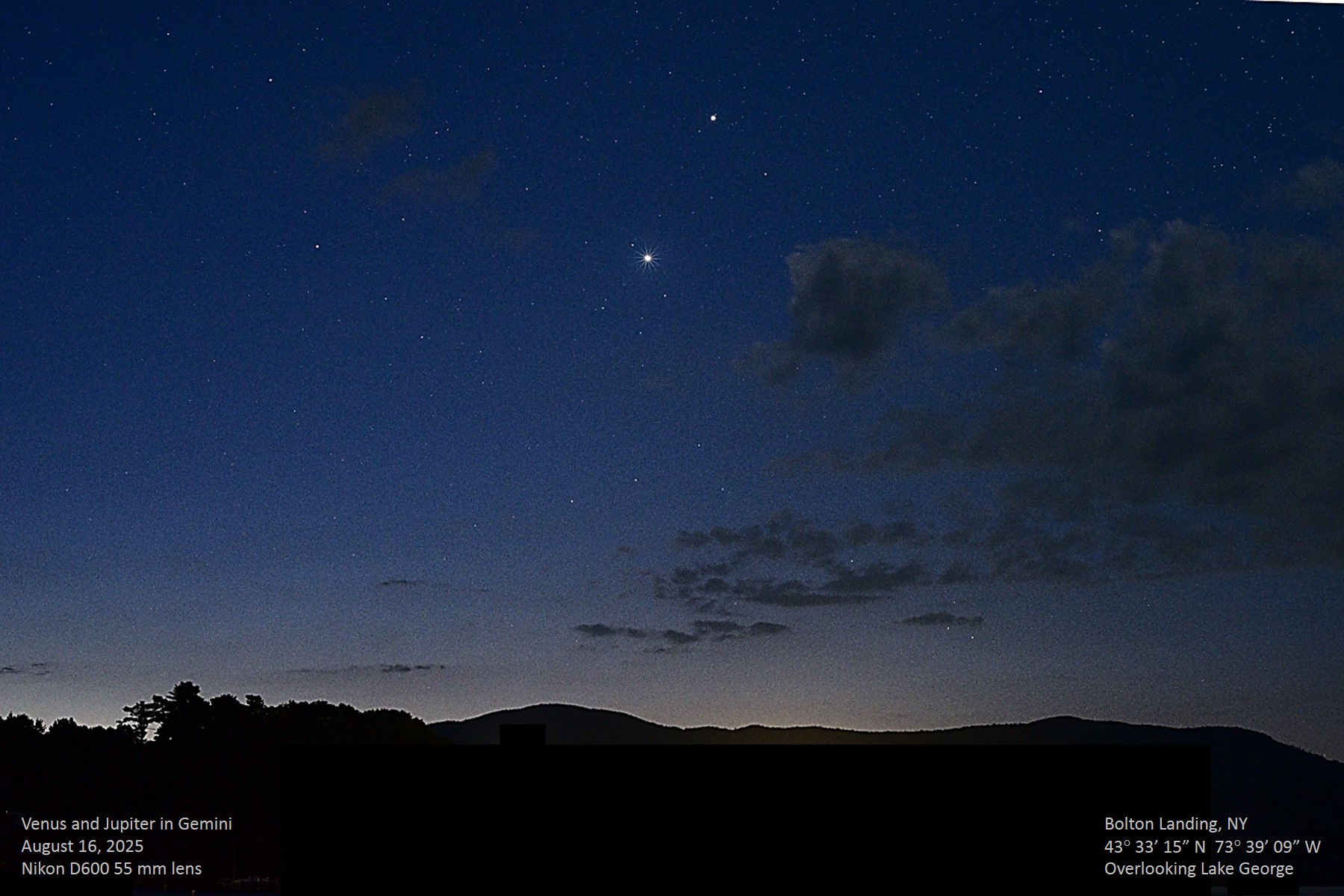
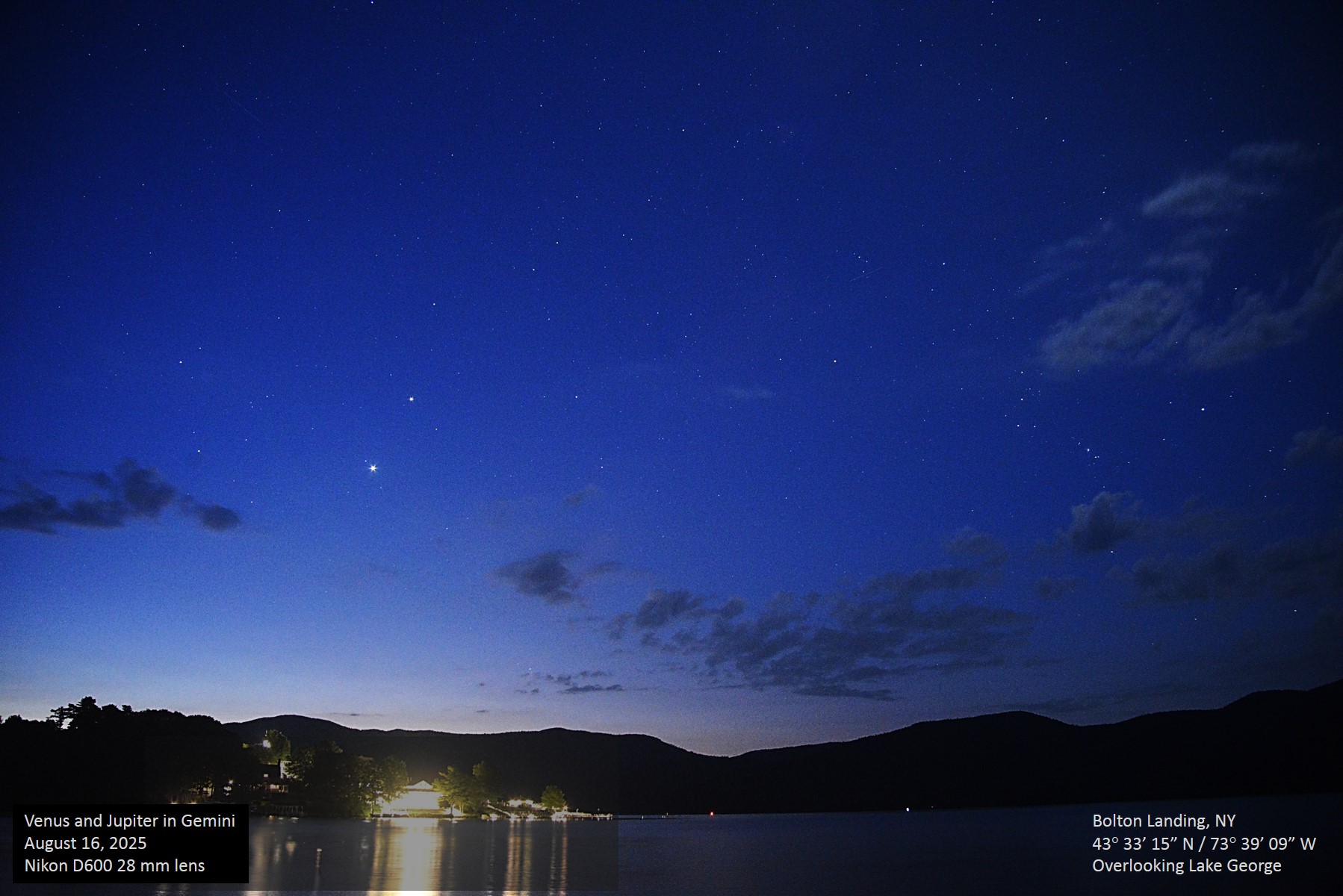
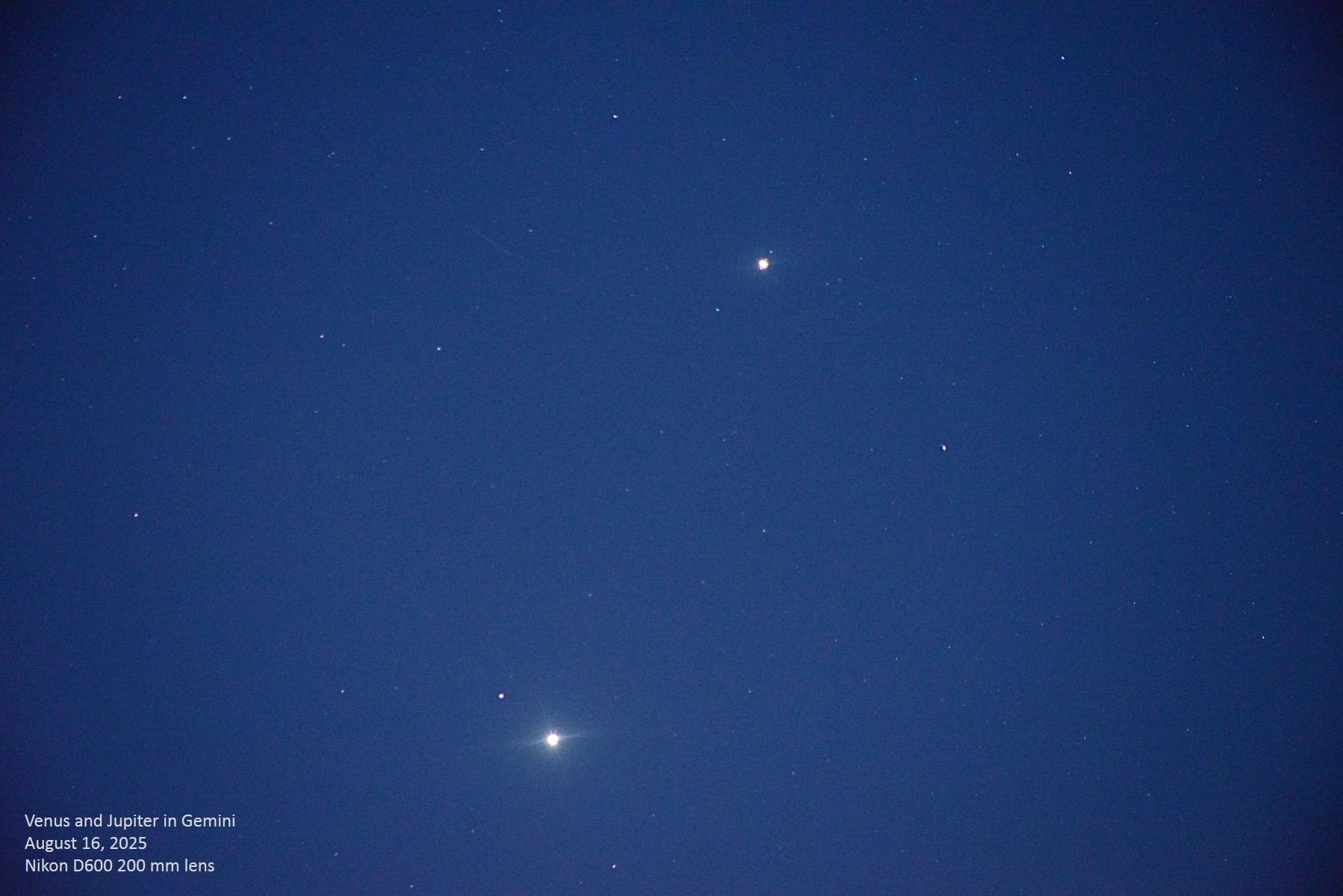
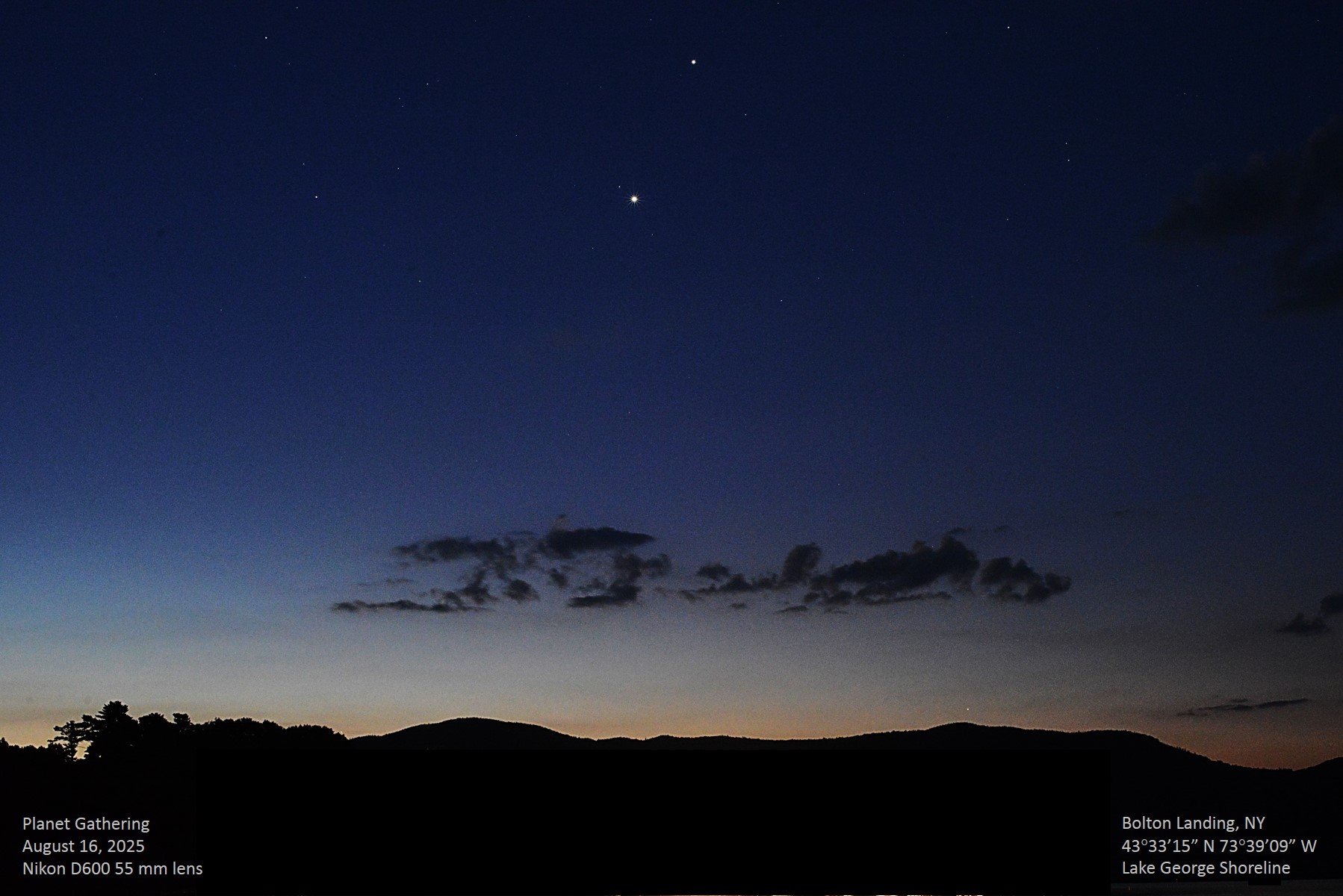
August 16: Venus, Jupiter, and Mercury On a beautifully clear Saturday morning, while on a visit to my lady friend Laura in the Lake George area of New York, I managed to capture several views of Venus and Jupiter rising over the mountains on the east shore of the lake, as well as one shot of them along with Mercury just barely peeking over the ridgeline. These images were obtained from the pier at Rogers Park in Bolton Landing, looking across the lake, over the Sagamore Resort, toward the northeast. The still-bright waning Moon illuminated the scene and the sky, so the colors are still a little washed out. In a week or so, I should be able to get a nice picture of the three planets in a dark sky after the Moon slips down into the sunrise glare. |
|||
|
|
|
|
|
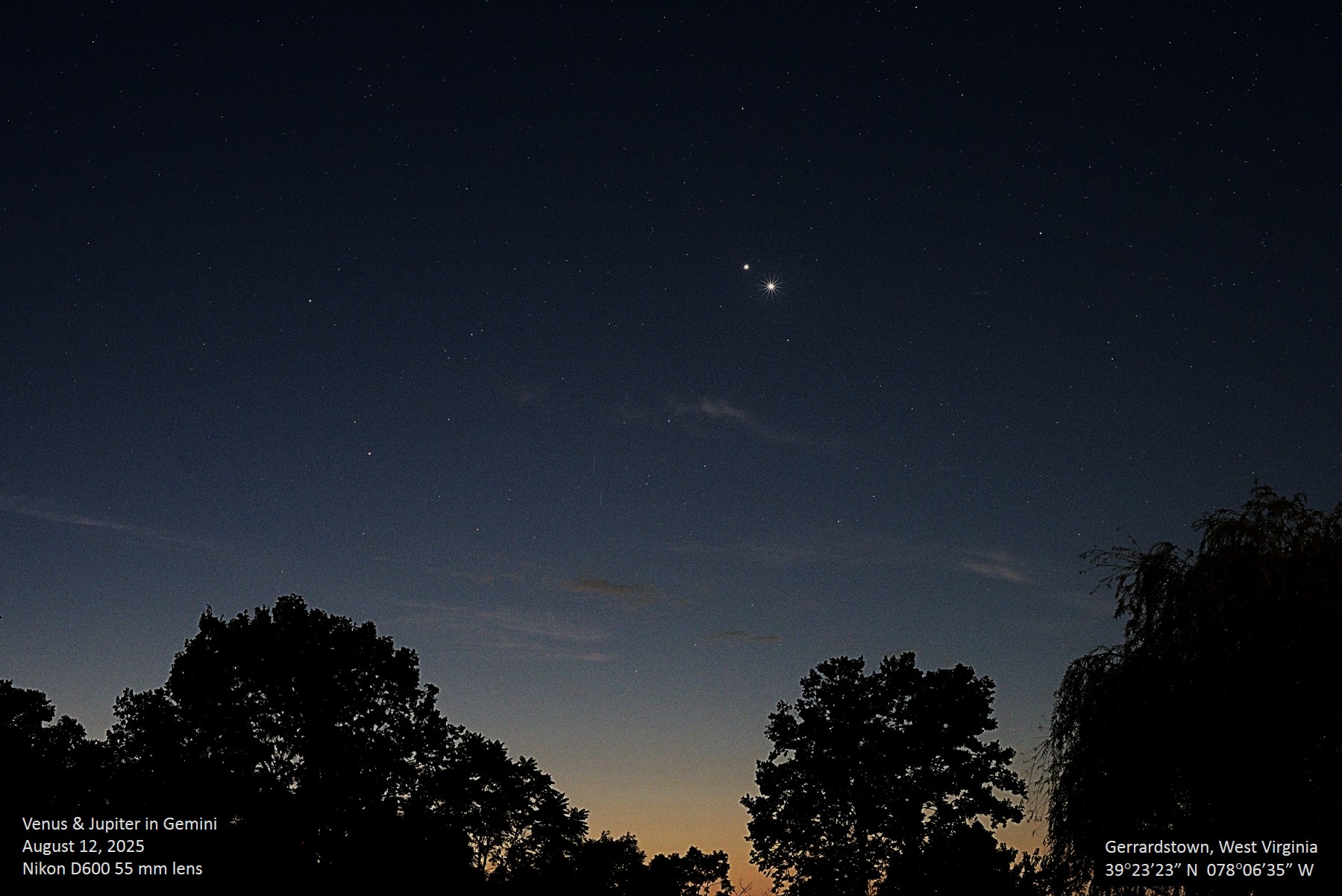
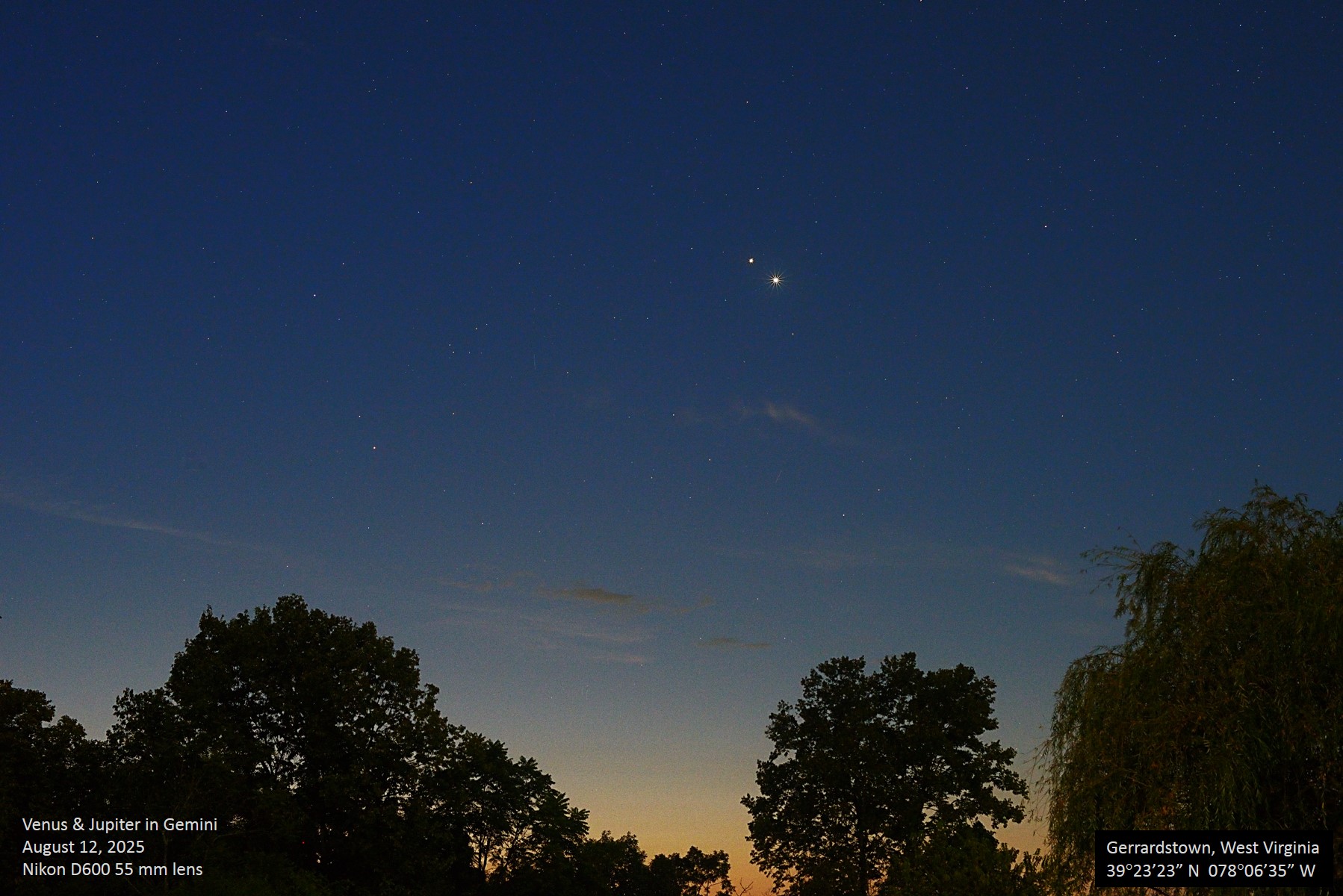
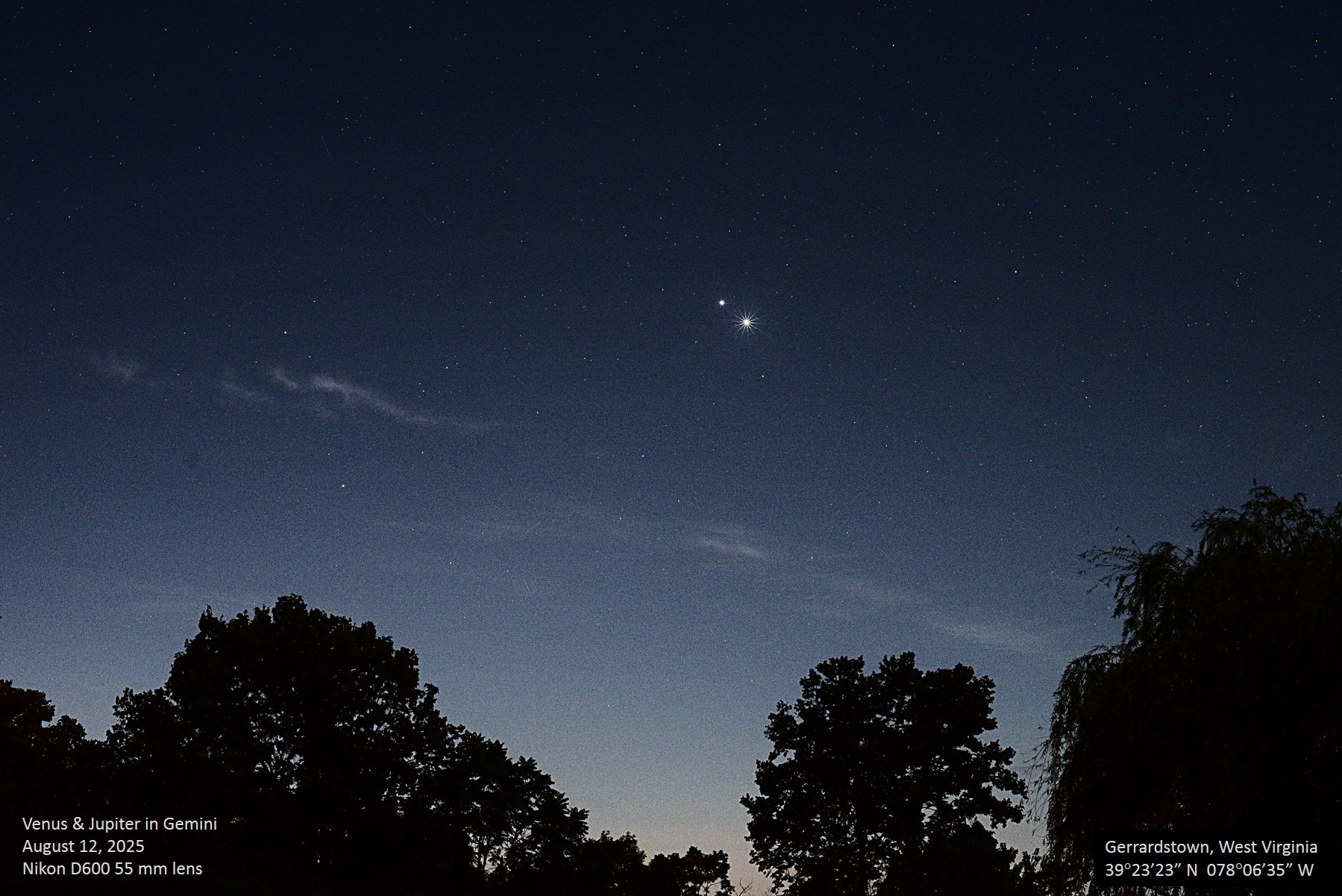
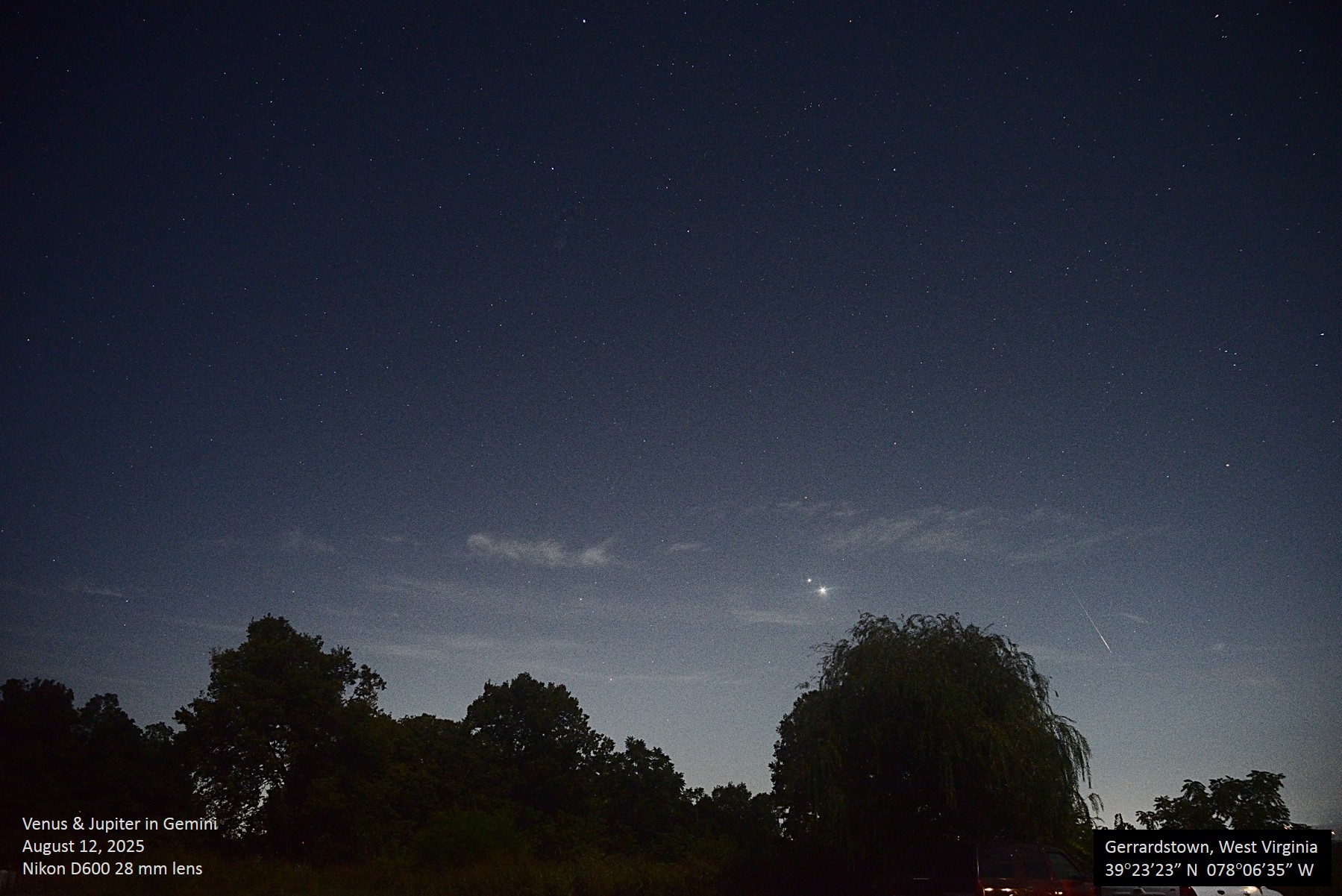
August 12: More Venus and Jupiter One more image of the conjunction scene in Gemini between Venus and Jupiter. This series of conjunctions repeats on an almost-24-year cycle, which results from Venus' 8-year repeating cycle and Jupiter's almost 12-year repeating cycle (3 and 2 times, respectively). They are getting later by about a week each repetition, so they occur farther east along the ecliptic each time, and because of Venus' orbit, that means they are getting closer each time as well. On July 30, 1977 they were 1°33'05" apart; on August 5, 2001, they were 1°11'41" apart; this year they were 51'44" apart at their closest; and on August 18, 2049 they will be 33'44" apart at their closest. If I'm still alive, I hope to see that event! |
||
|
|
|
August 12: Venus and Jupiter Venus and Jupiter finally arrived at their conjunction, happily coinciding with the peak of the Perseid meteor shower. Poor weather forecast for Fredericksburg, VA forced me to drive to West Virginia for the nearest spot with clear weather prospects, and I ended up observing the event from a road intersection at the crest of a long ridgeline west of Gerrardstown, West Virginia. |
|
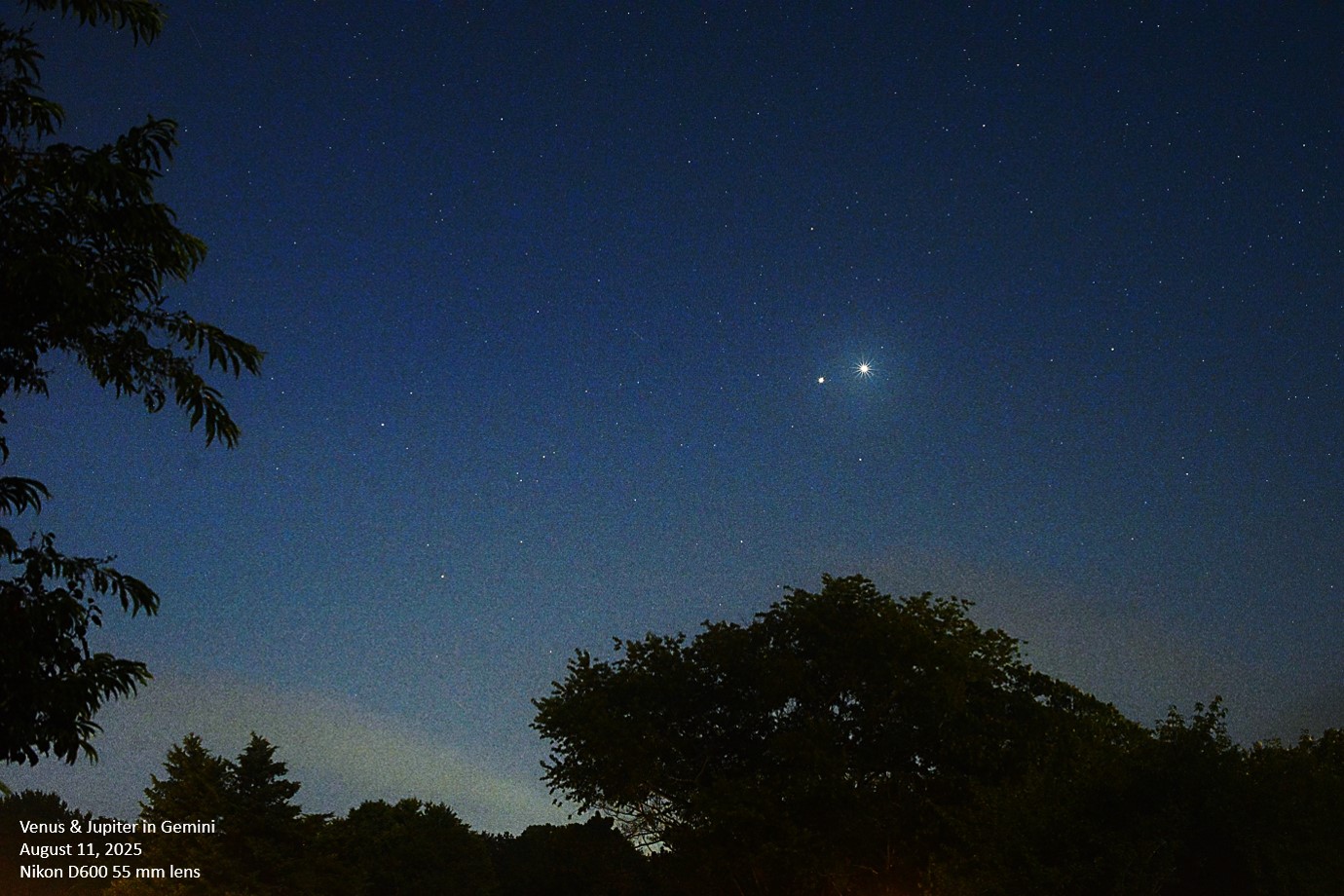
August 11: Venus and Jupiter Venus and Jupiter are now just over 1° apart as they approach their August 12 conjunction. Despite a forecast of clouds, we were granted an exemption to give us an opportunity to admire the pairing of the two brightest planets one more time LOL. We hope tomorrow morning is the same! |
||
|
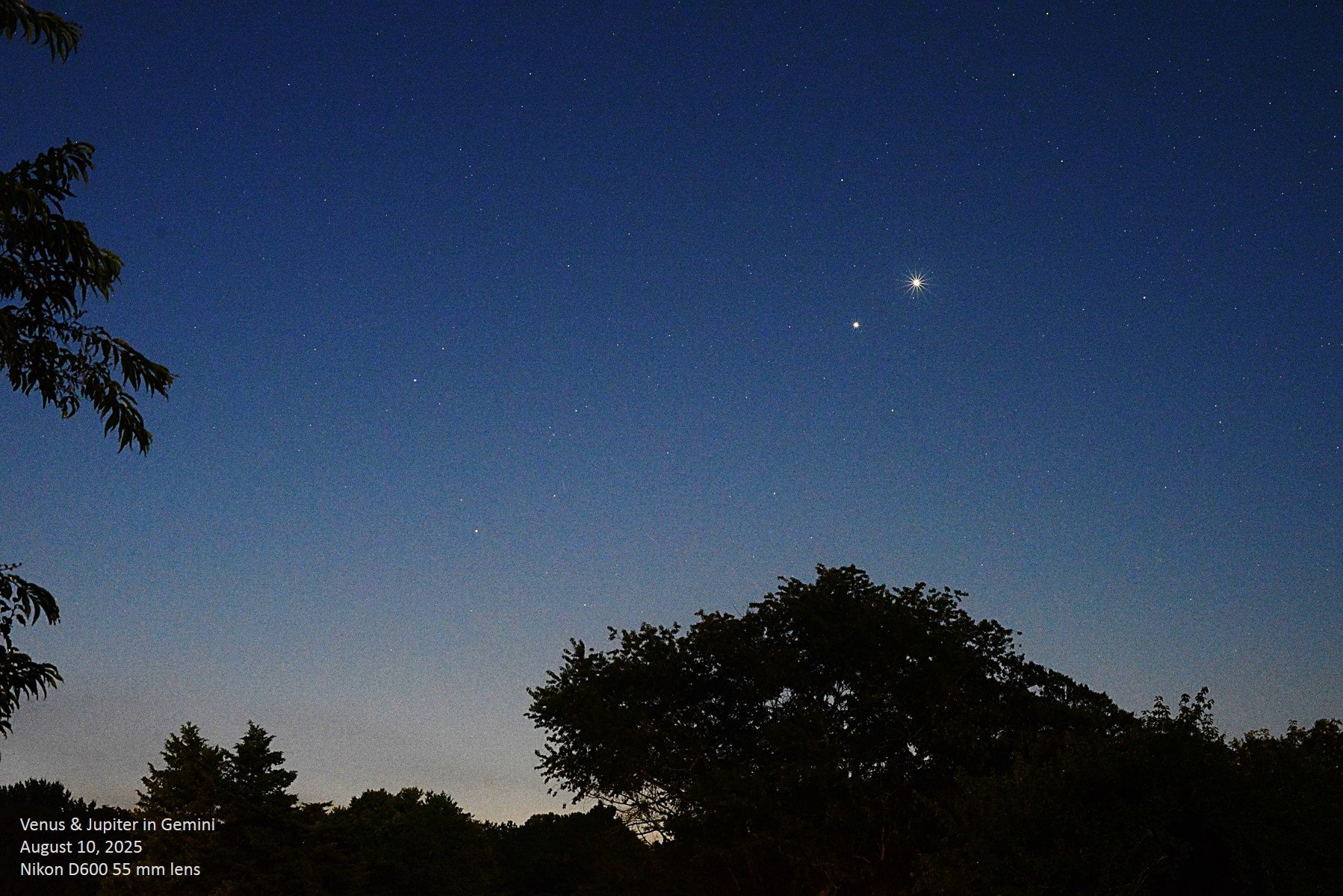
August 10: Venus and Jupiter Venus and Jupiter are now just over 2° apart as they approach their August 12 conjunction. Although the actual motion against the stars has Venus moving rapidly eastward along the ecliptic and Jupiter moving slowly eastward, the apparent motion from one morning to the next is that Jupiter and the stars of Gemini are rising each day to meet stationary Venus. Everything's relative! I hope our clear weather of the last 3 days continues for at least two days more! |
||
|
|
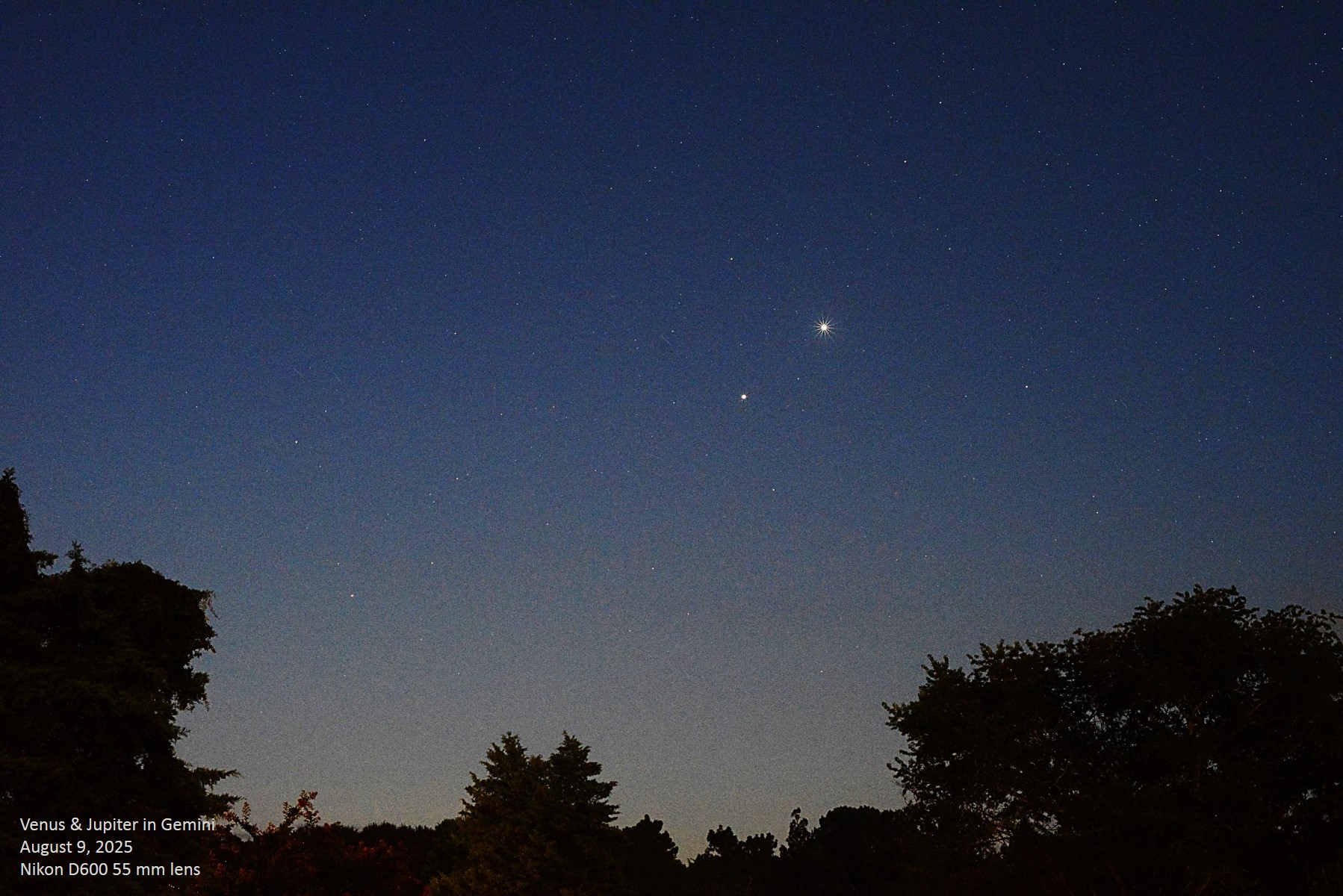
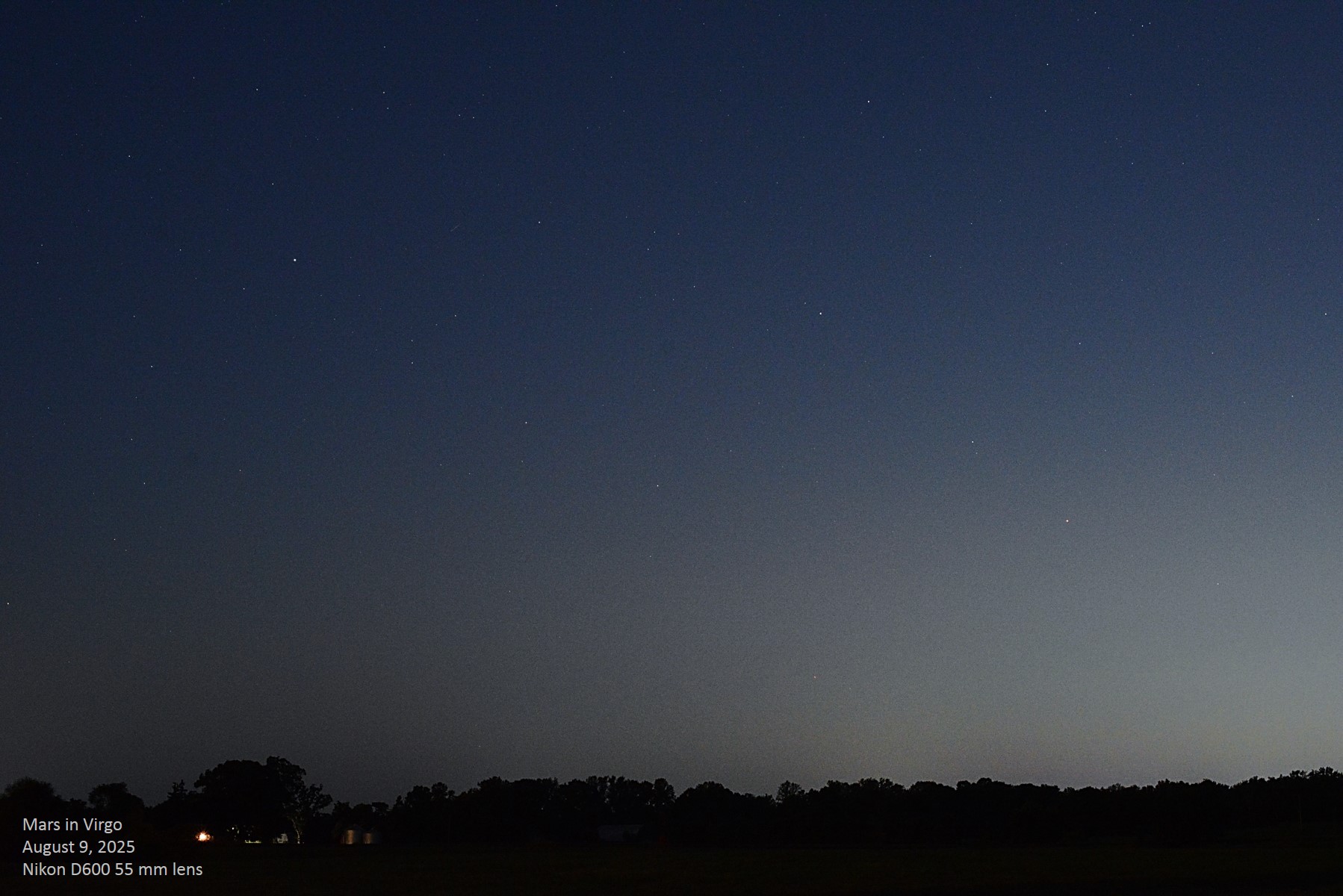
August 9: Venus & Jupiter, and also Mars Venus and Jupiter are only three days away from their conjunction, which repeats to within a week or so of their conjunction in August 2001. In the evening on the 9th, we see Mars for the first time in the same field as Spica. |
|
|
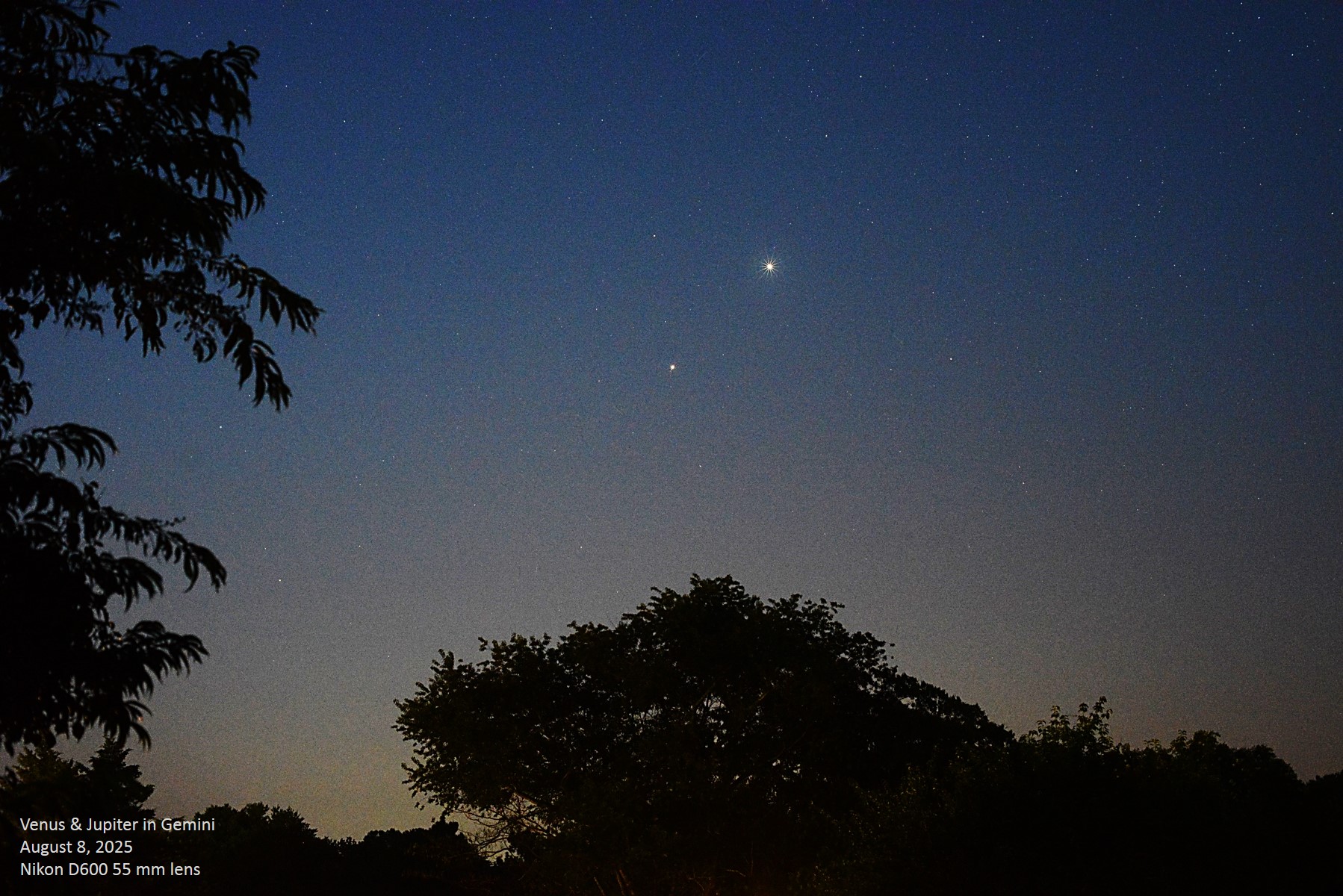
August 8: Venus and Jupiter Venus continues to move eastward in Gemini, closing in on Jupiter's position in anticipation of their conjunction on the 12th. An almost full Moon setting in the west caused me to delay taking this shot until twilight was already underway, resulting in a brighter scene than I would have liked. |
||
|
|
|
|
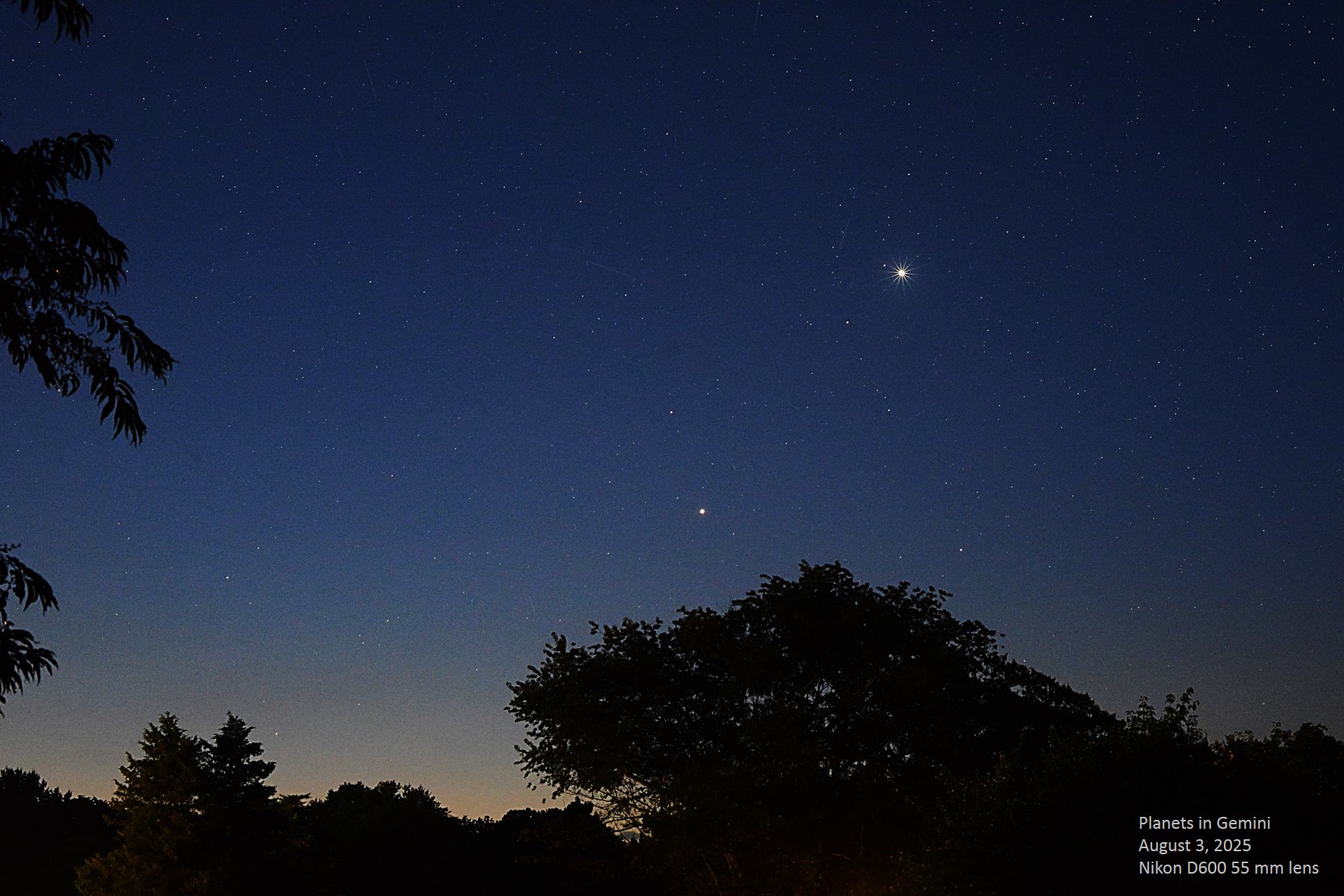
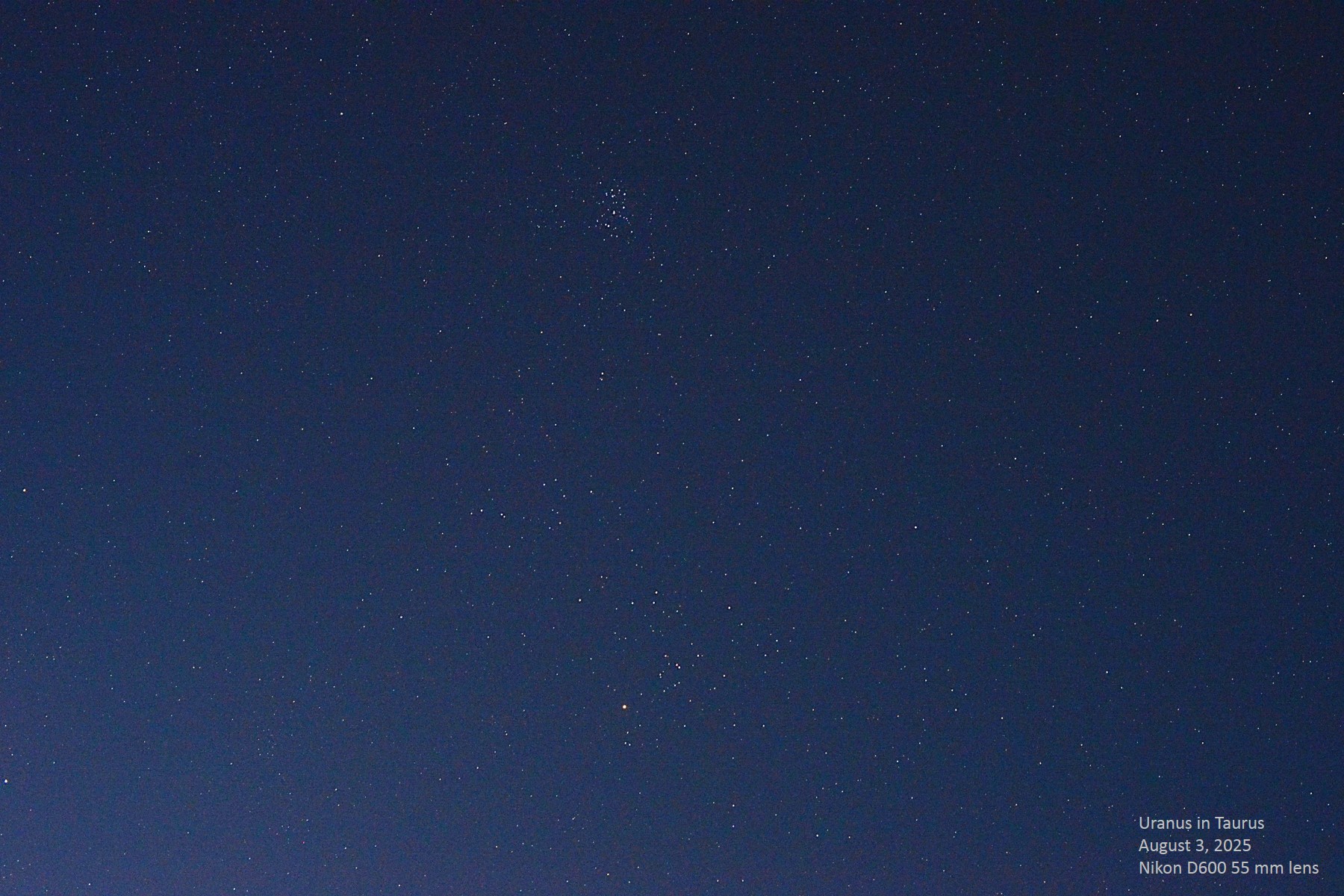
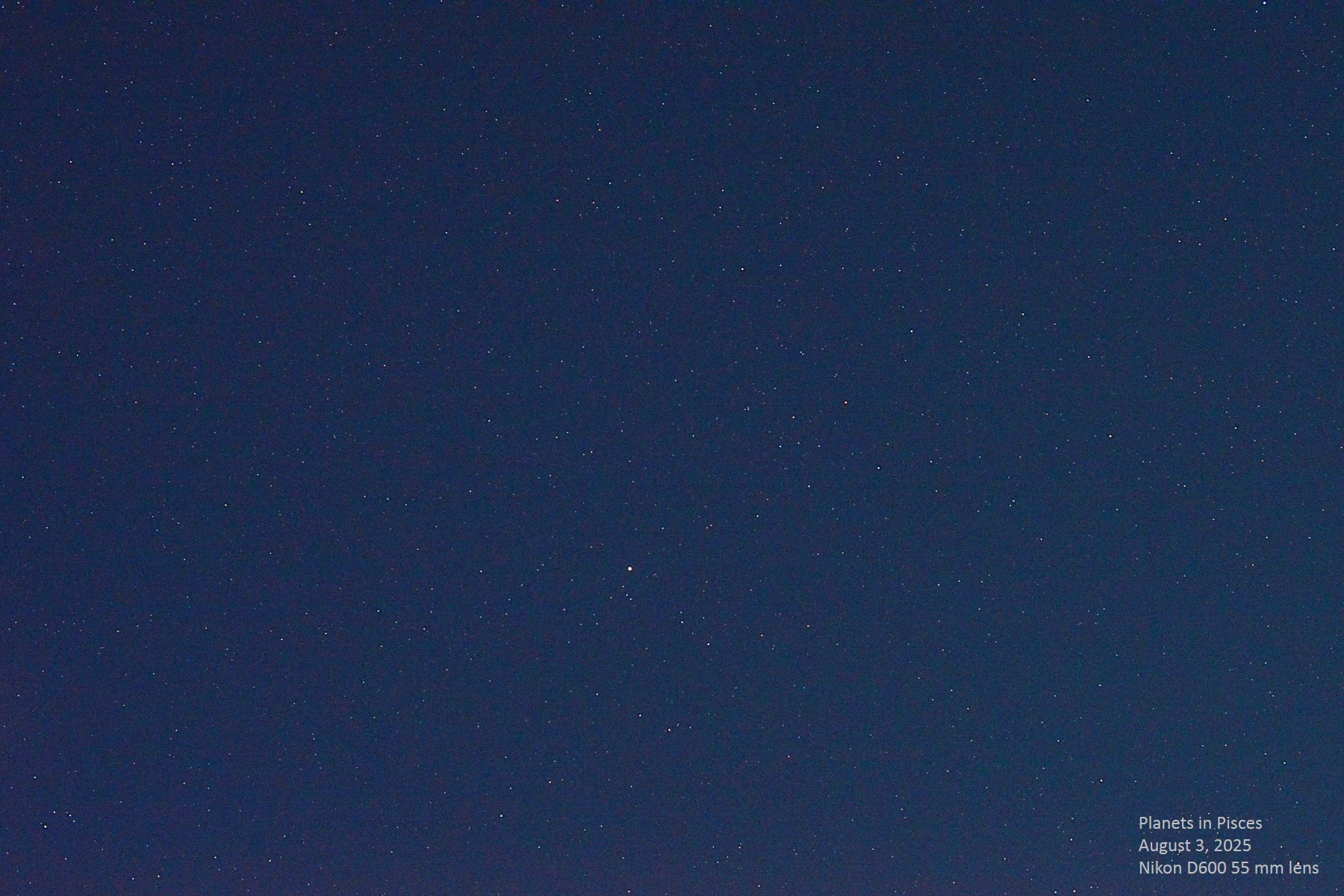
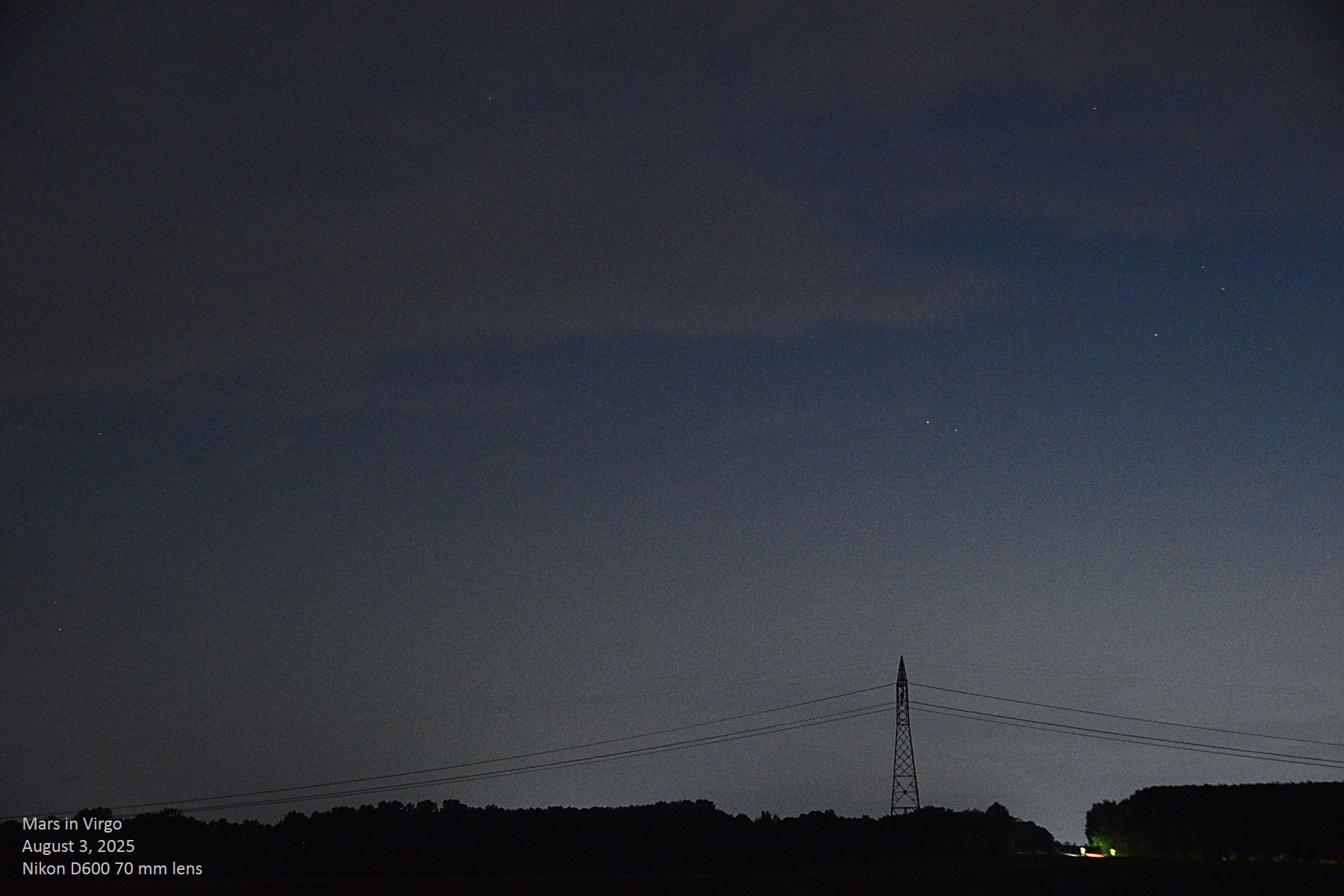
August 3: Almost all the Planets! The first few days of August coincided with a change in the weather for the eastern United States, ushering in cooler temperatures and clearer skies, so on a beautiful morning we were able to catch all the morning planets strung out from east to south. Venus and Jupiter are closing in the east, Uranus is half-way up the sky in Taurus, while Saturn and Neptune remain close in Pisces. The lone evening planet at this time is Mars, currently racing along the ecliptic in Virgo, after having just passed β Virginis yesterday. |
|||