Constellation Views: 2019 - 2025
 |
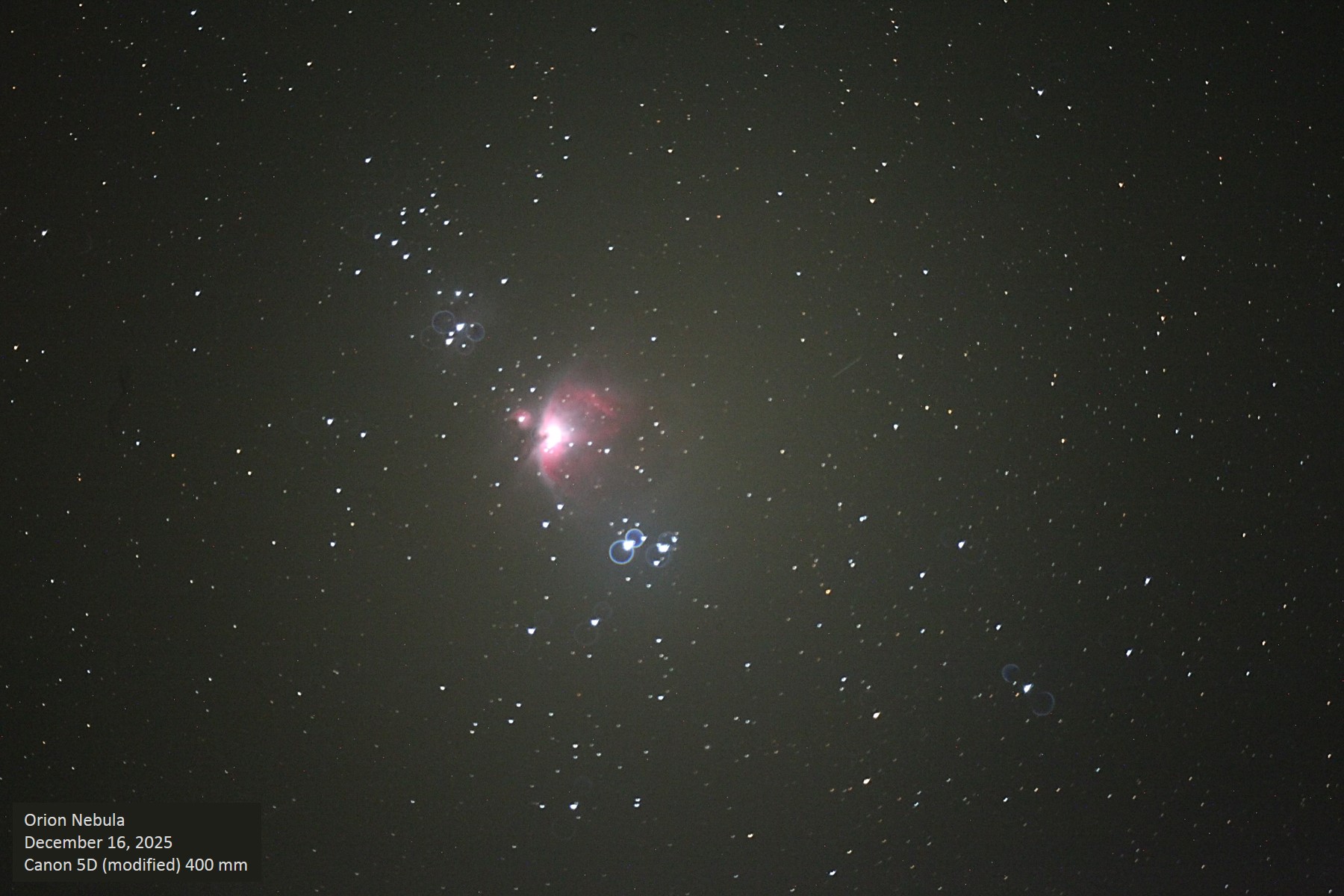 |
December 16, 2025: King George County A nice night, not too cold, with no Moon, so hey it's time to get a shot of the belt of Orion with my modified Canon 5D and that 400 mm Sigma reflex lens that I've used on the Sun and the recent comets. How well would it work? Not very well LOL, although in fairness it was only a 30 second exposure. Should probably go back to my 300 mm Nikkor and zoom in some LOL. |
||||
 |
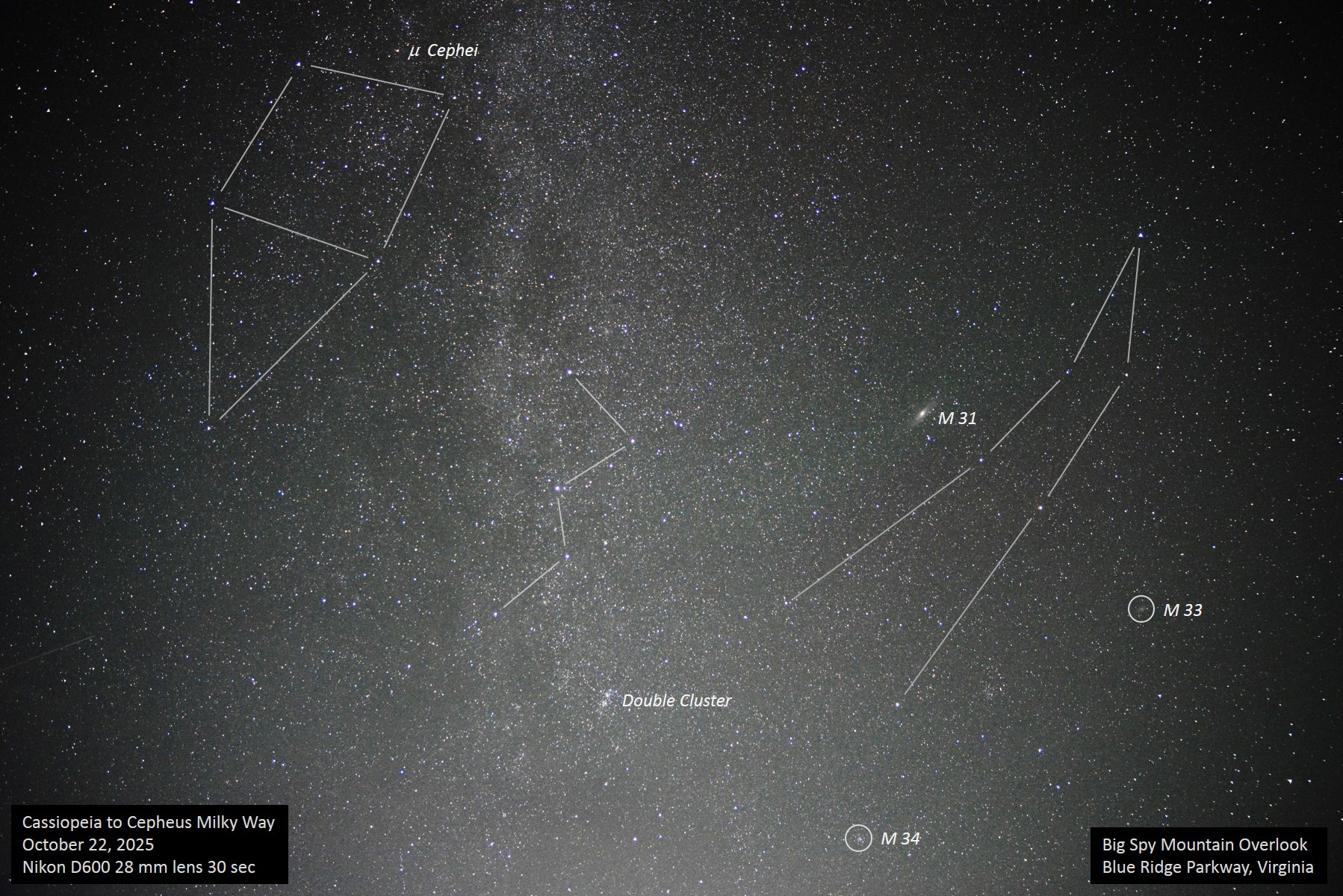 |
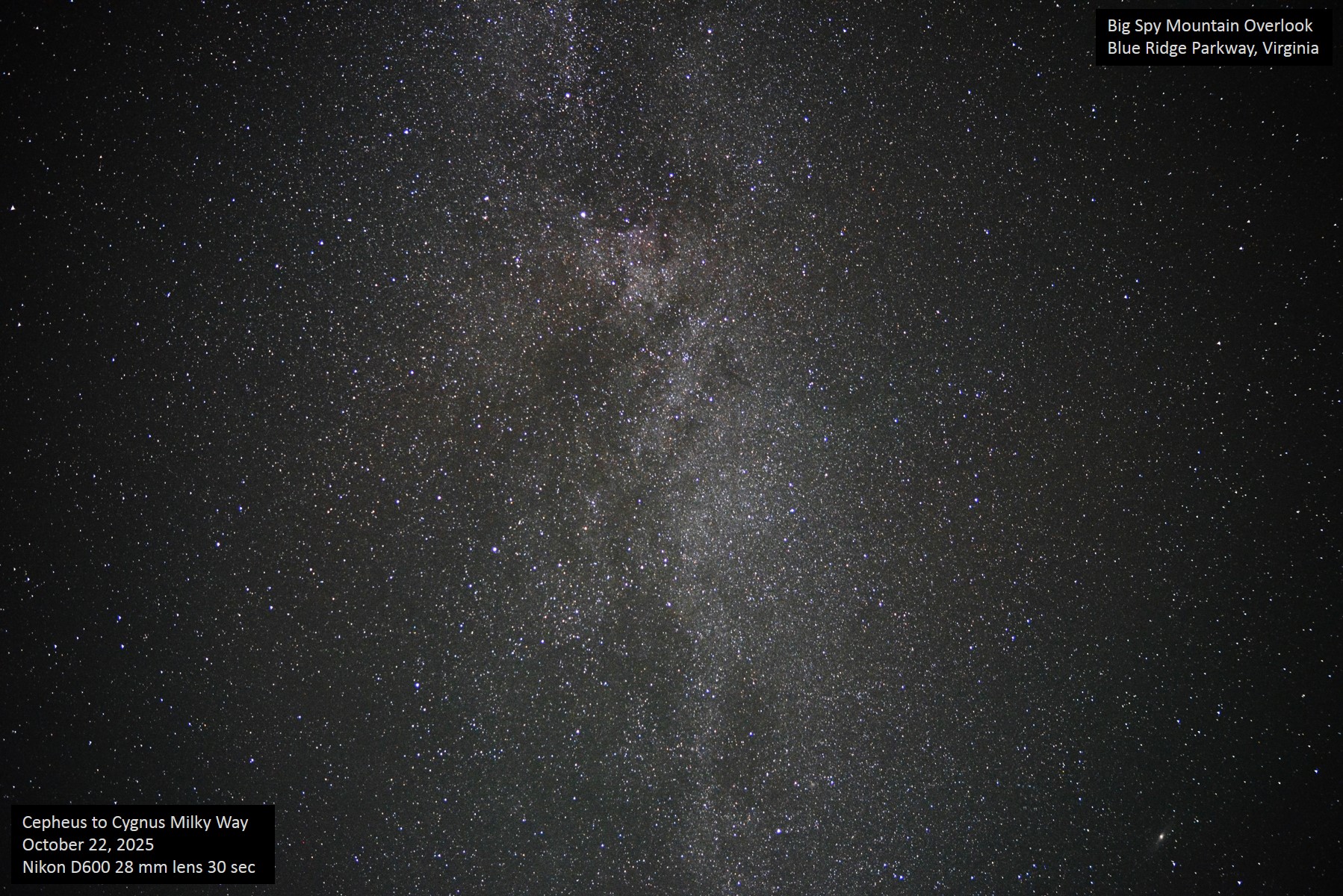
October 22, 2025: Blue Ridge Parkway I traveled again to Big Spy Mountain overlook on the Blue Ridge Parkway to image the two comets and took advantage of the nice skies to get a few wide angle shots of the Milky Way. The first shows our galaxy from central Cygnus to Cassiopeia, and the second shifts down toward the horizon to cover the Milky Way from Cepheus to Perseus. |
|||
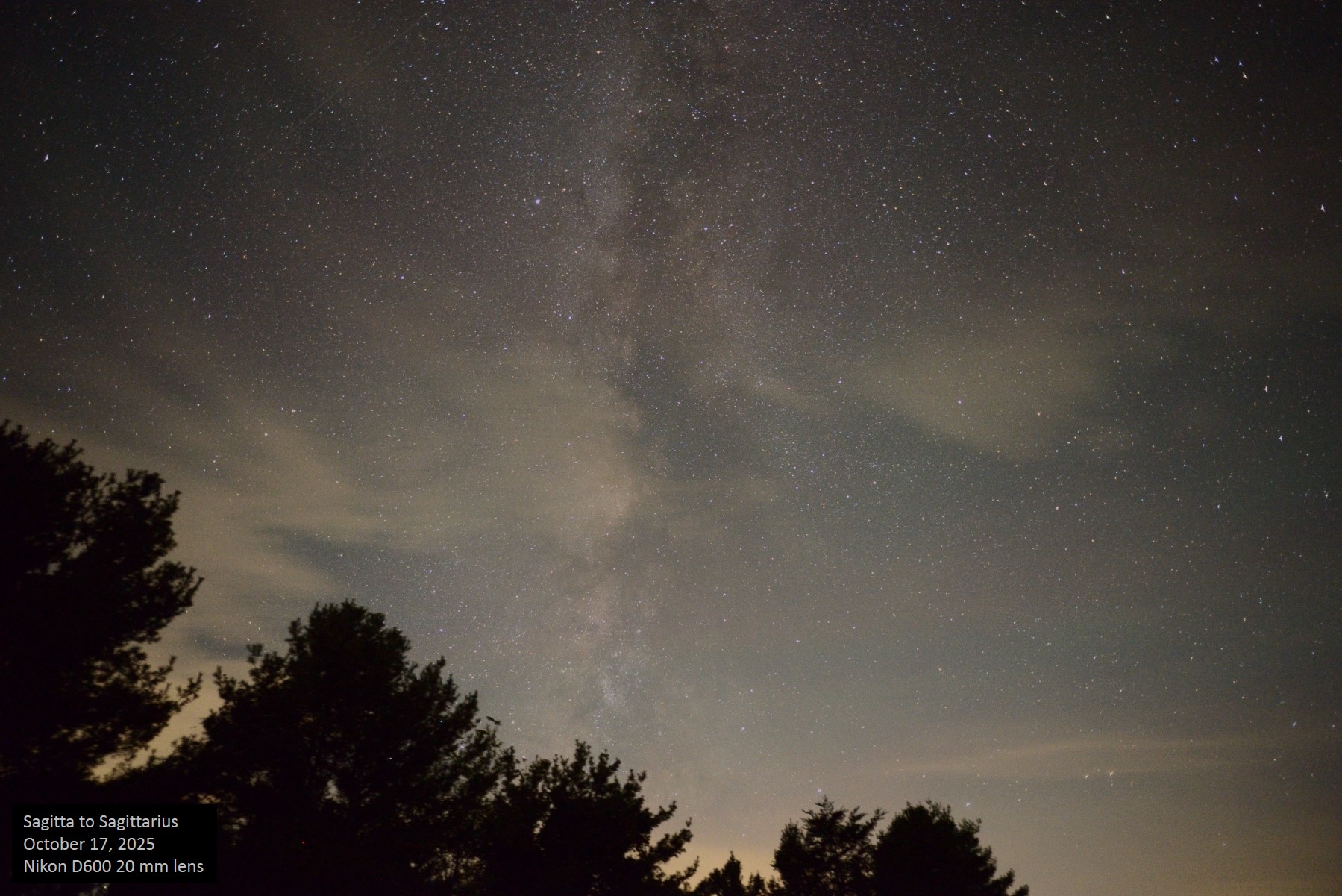
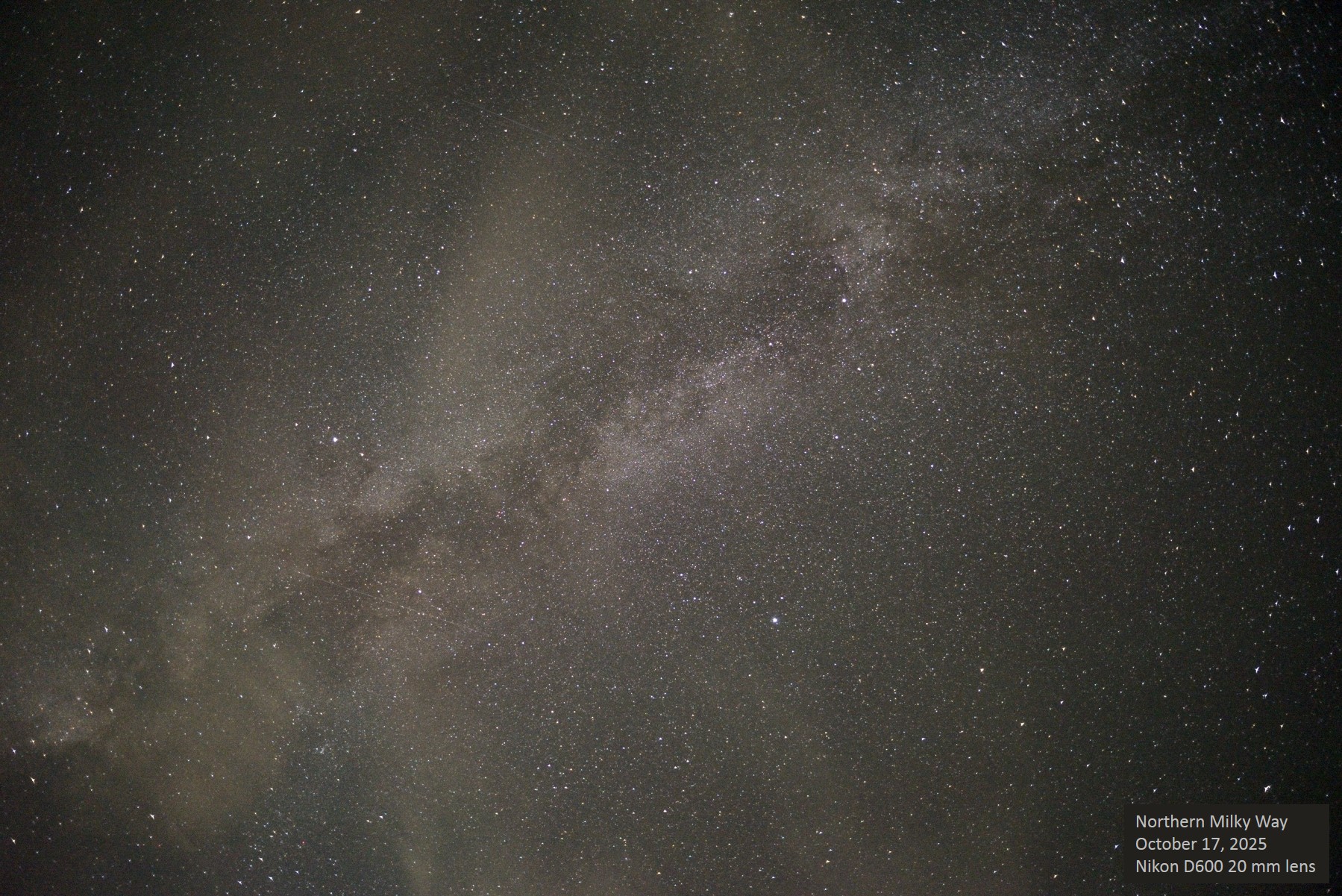
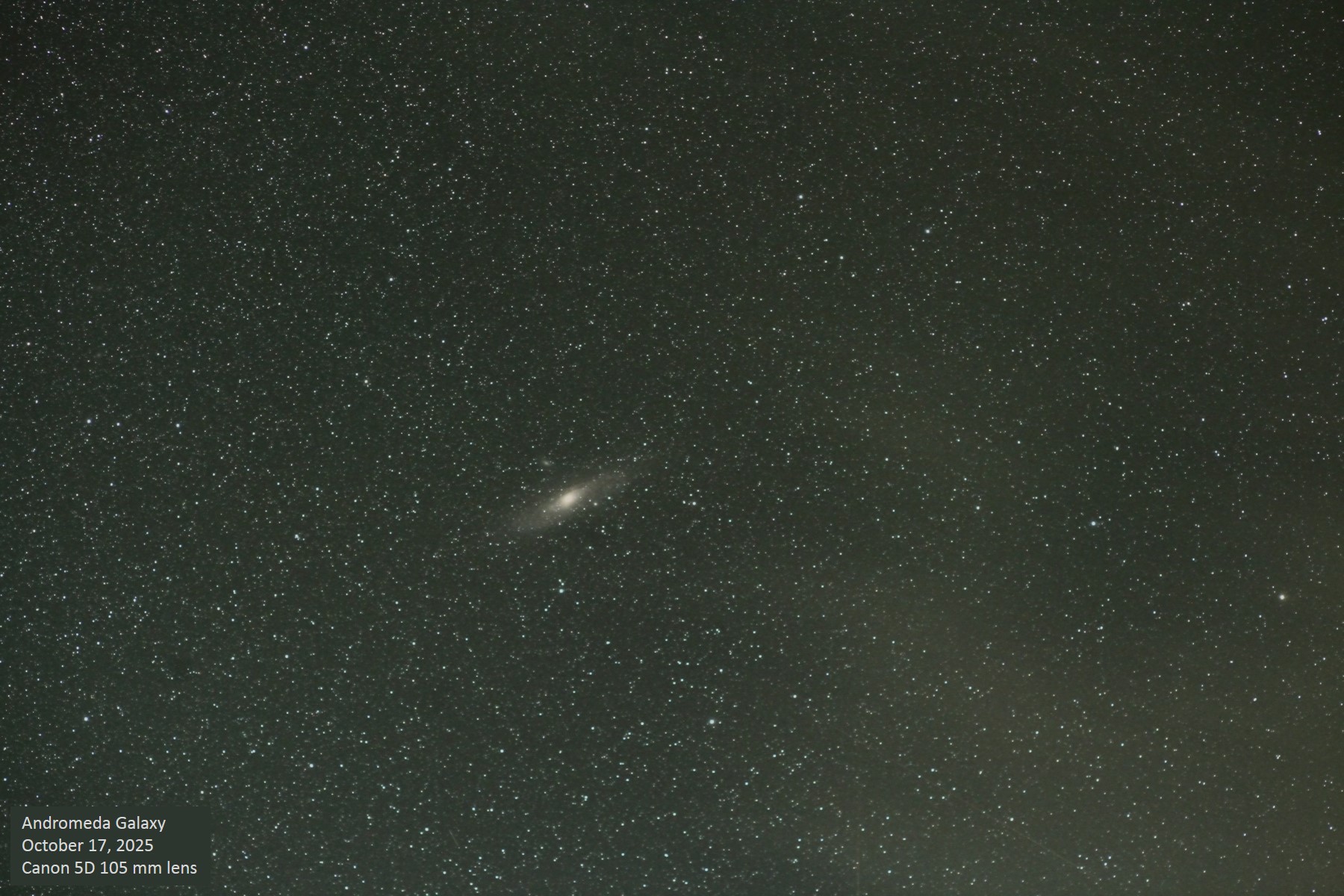
| October 17, 2025: Blue Ridge Parkway These images were obtained from the Big Spy Mountain overlook at mile marker 25 of the Blue Ridge Parkway in the mountains of Virginia. The two wide-angle views of the Milky Way were obtained using my Nikon D600 (unmodified) DSLR with a 20 mm Nikkor lens. The images of the Cassiopeia/Perseus area and the Andromeda Galaxy were taken with my modified Canon 5D which records H-α emissions. The part of the image of to the left of the Double Cluster just barely shows the Heart and Soul nebulae, which are in Cassiopeia. The wide angle Milky Way pictures are marred by high clouds but one can also see the green skyglow caused by ionization in the upper atmosphere. All of the images are 30 second exposures. |
|||||
 |
 |
 |
 |
||
 |
 |
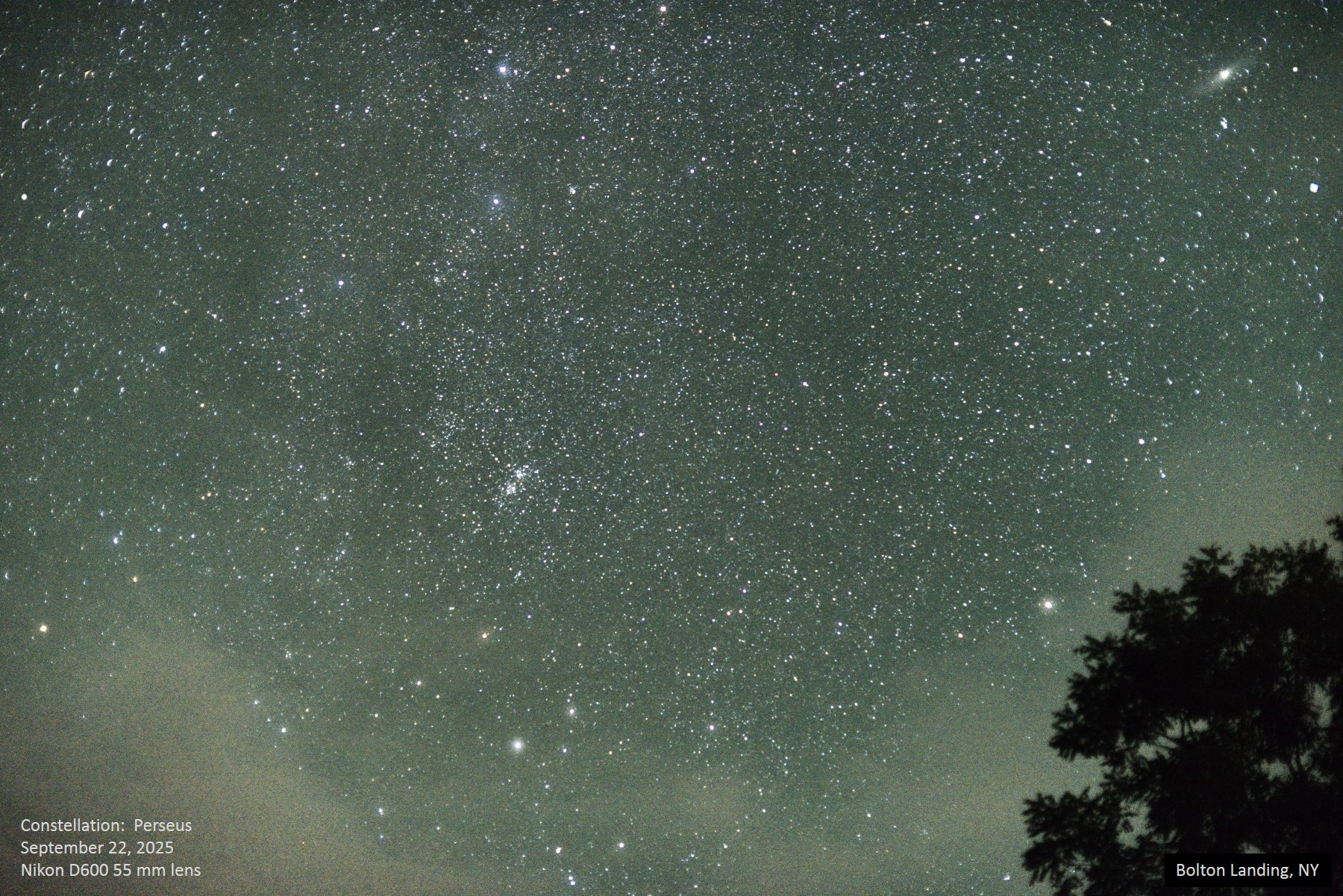 |
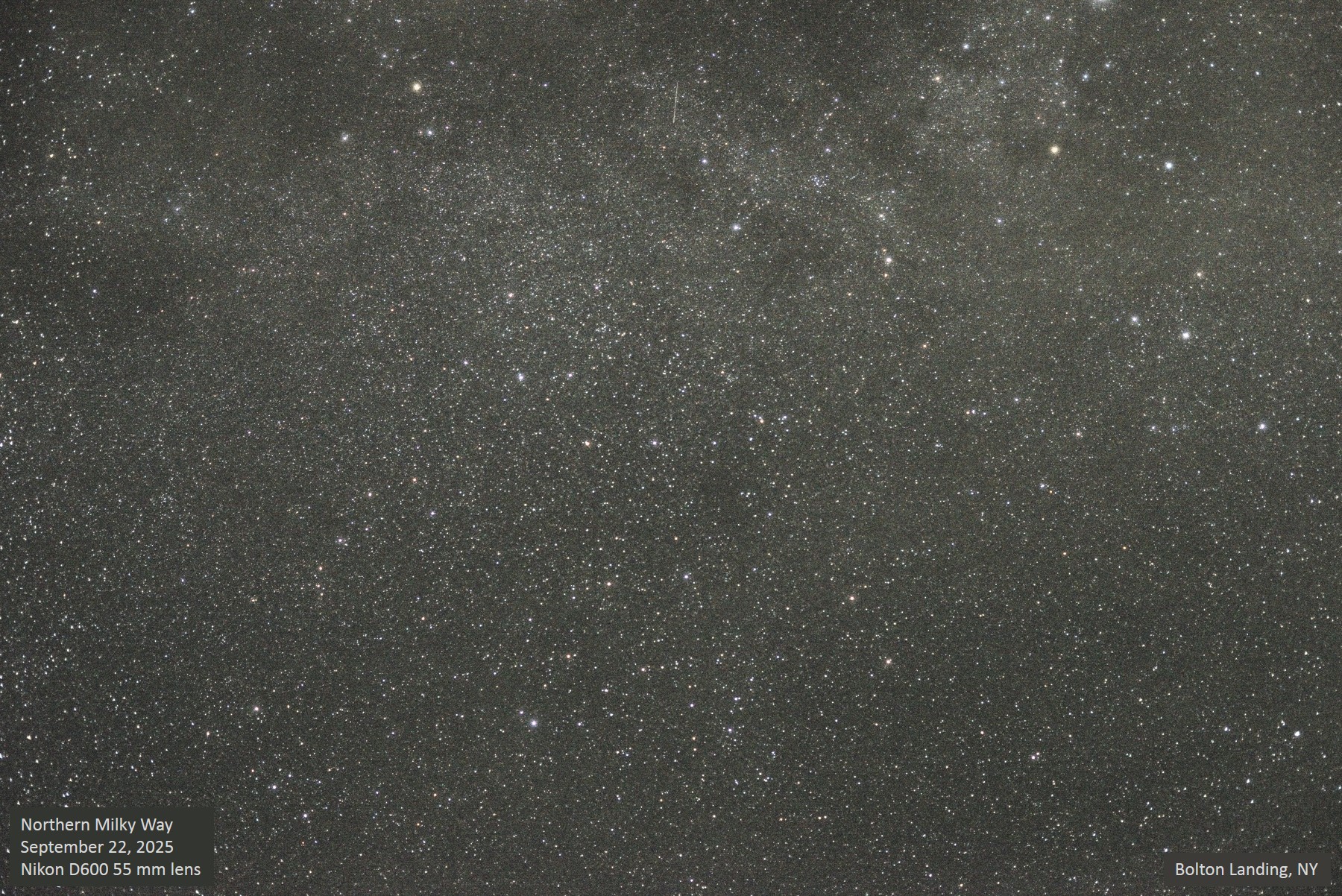
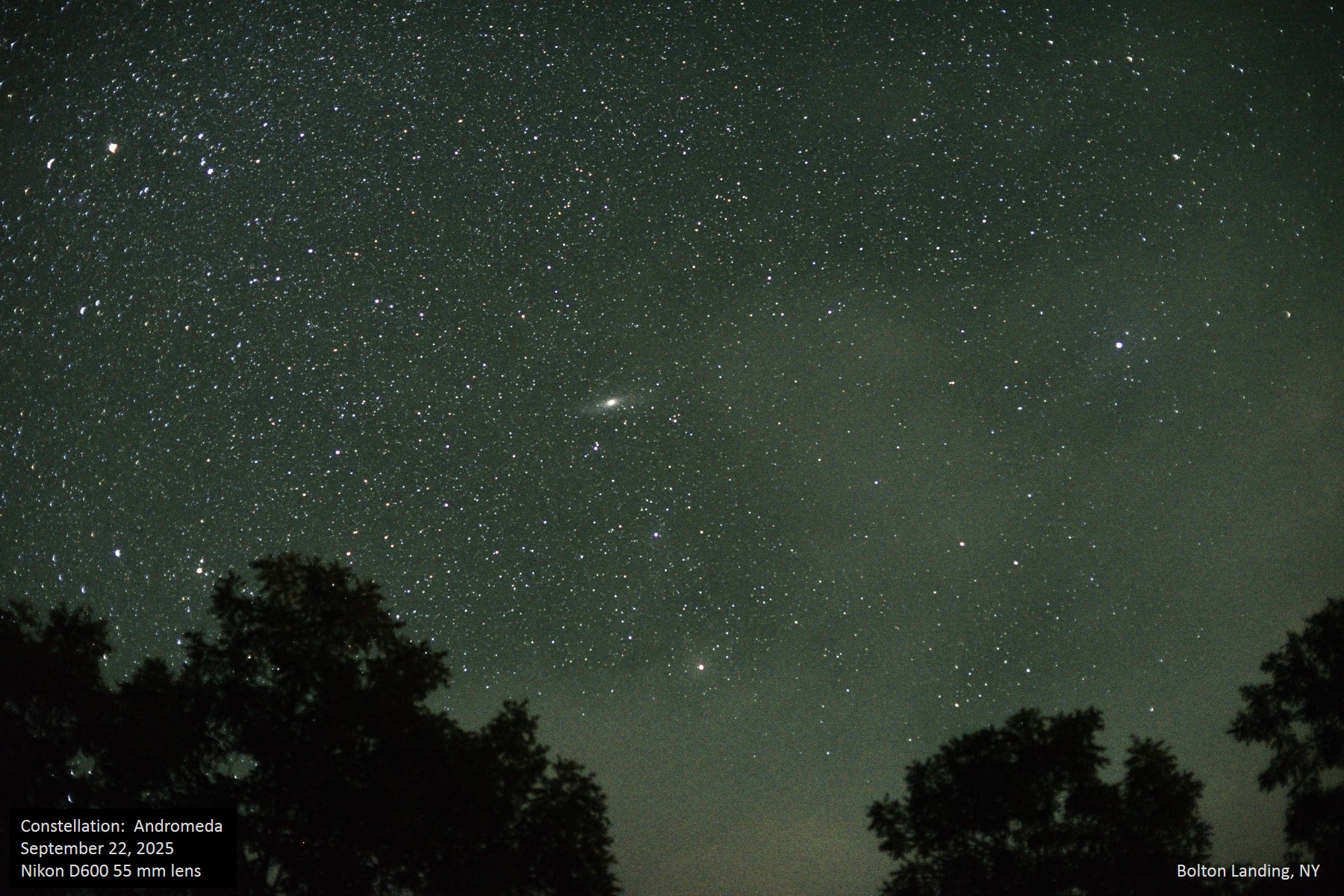
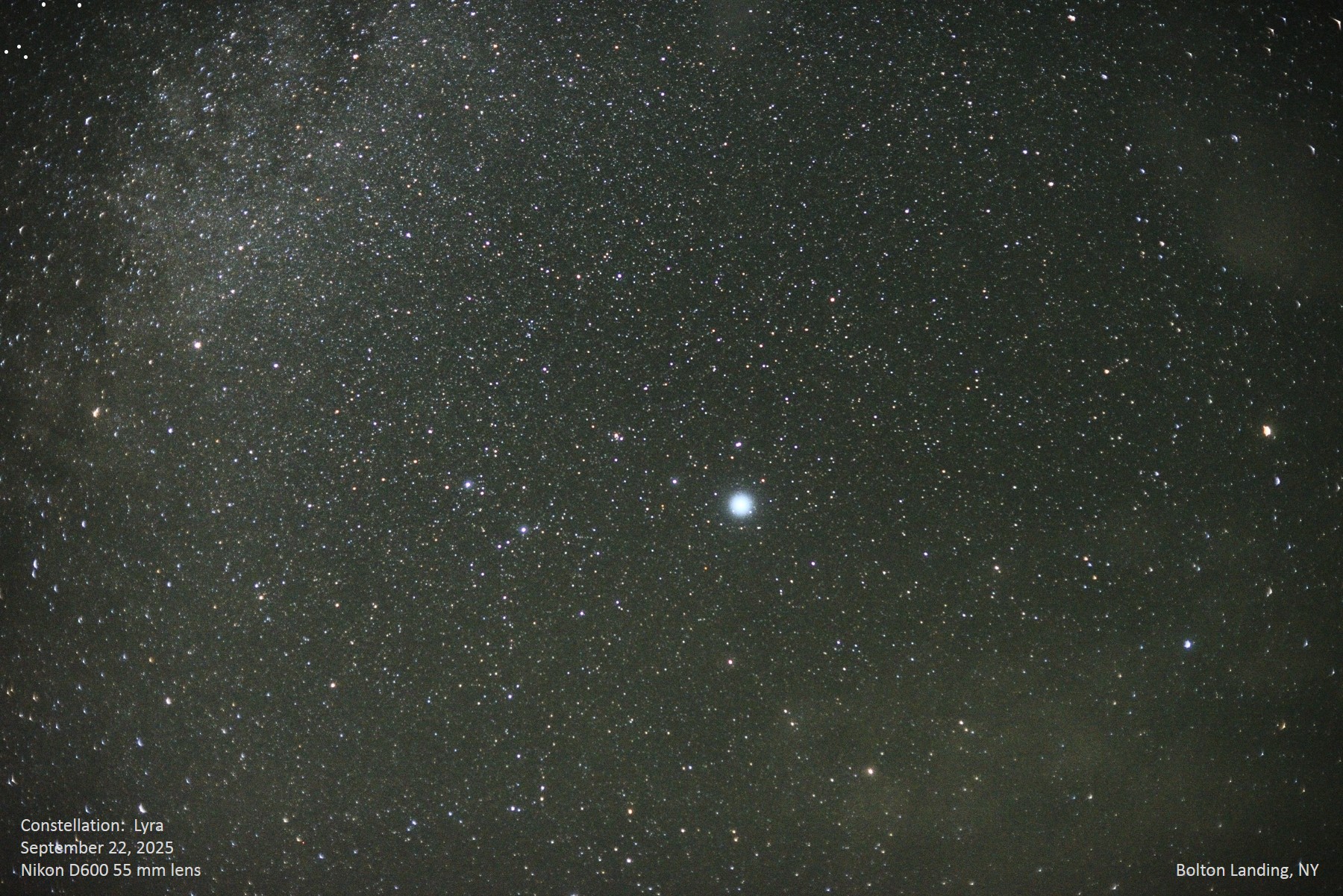
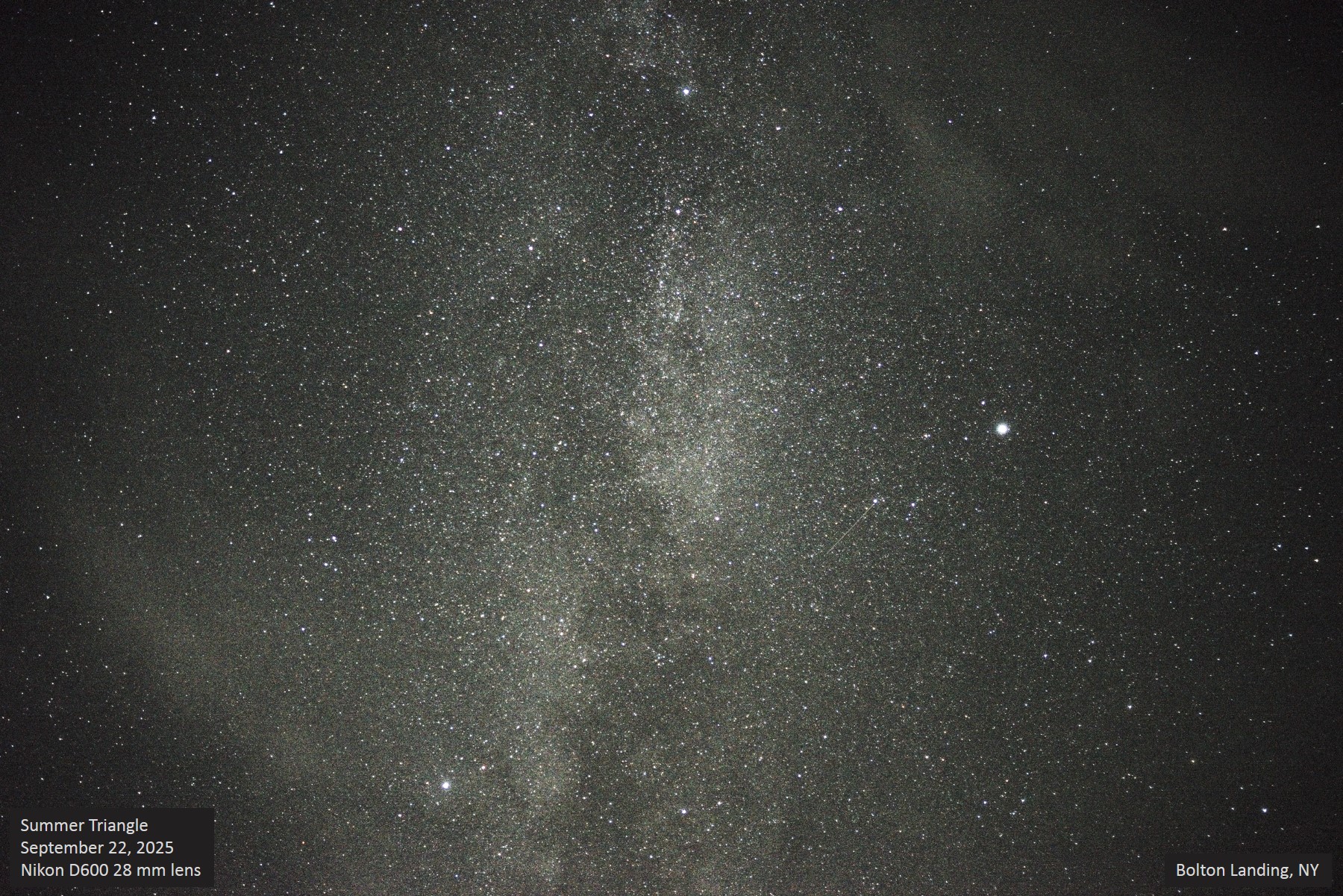
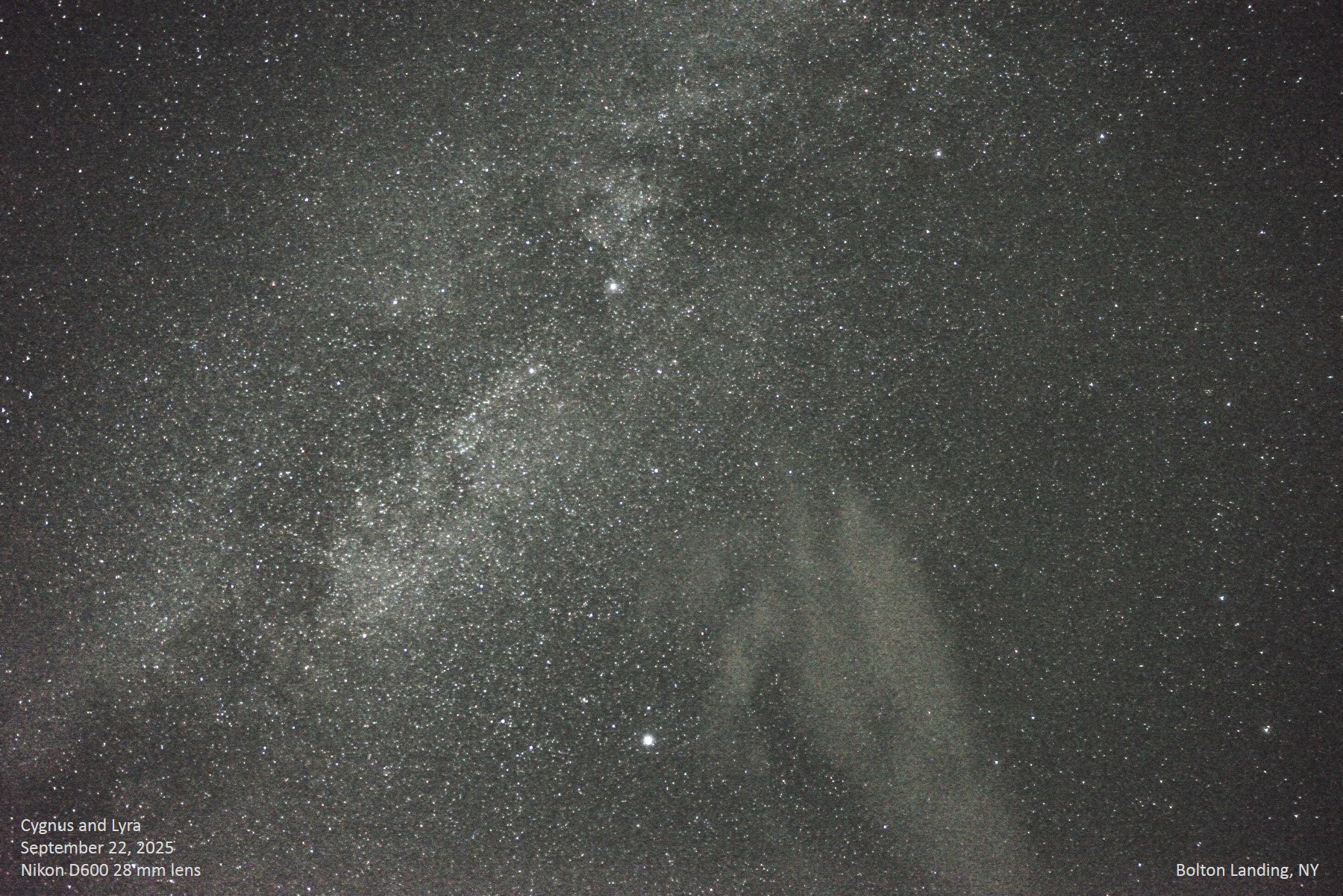
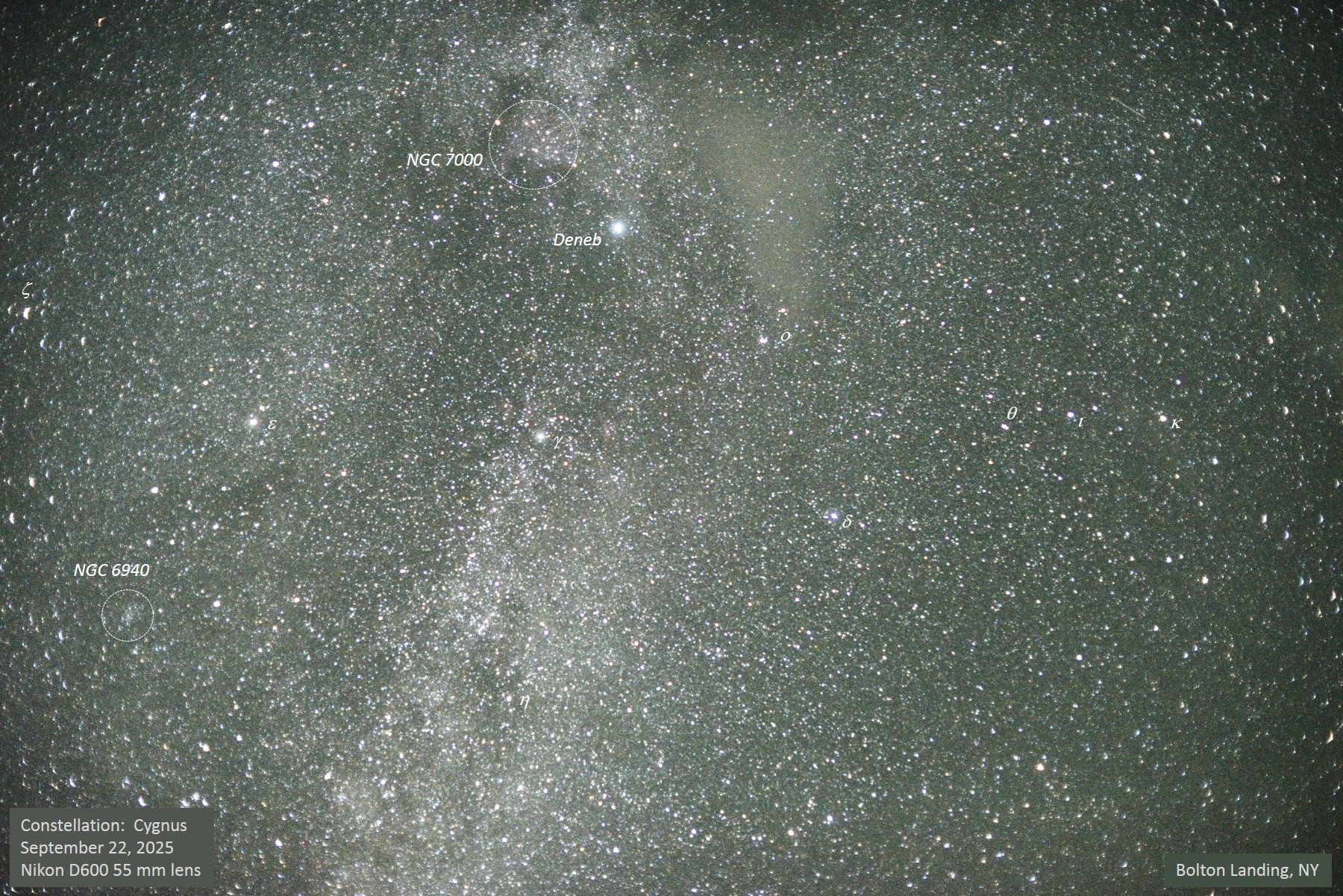
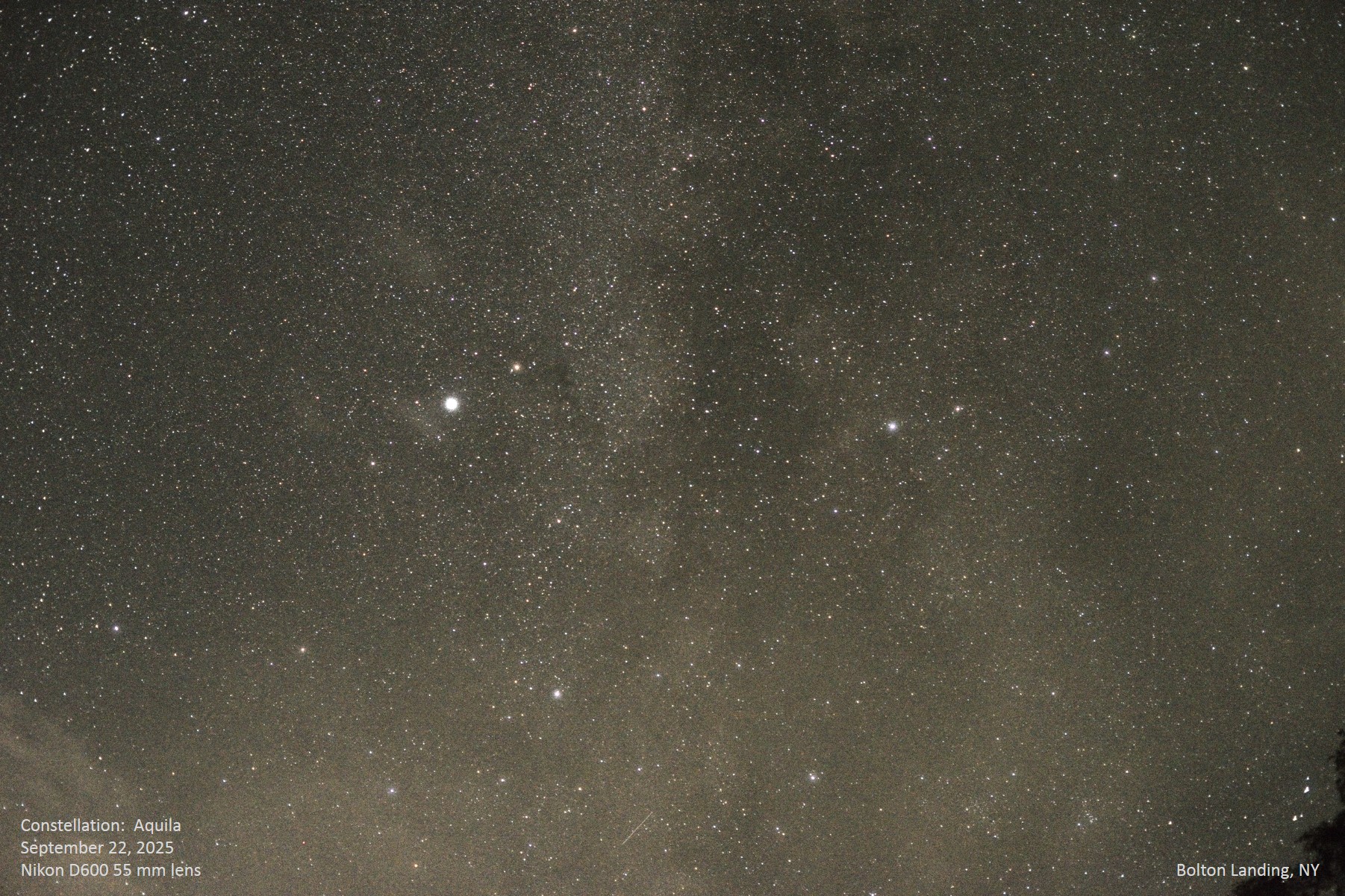
September 2025: Constellations from Bolton Landing, NY I took advantage of the exceptionally dark skies at my lady-friend Laura's house in September 2025 to get some untracked constellation snapshots of no more than ten seconds duration (for the wide angle pictures). The evening sky featured the northern Milky Way from Aquila through Cygnus to Cassiopeia and Perseus. |
||
 |
 |
 |
 |
 |
|
 |
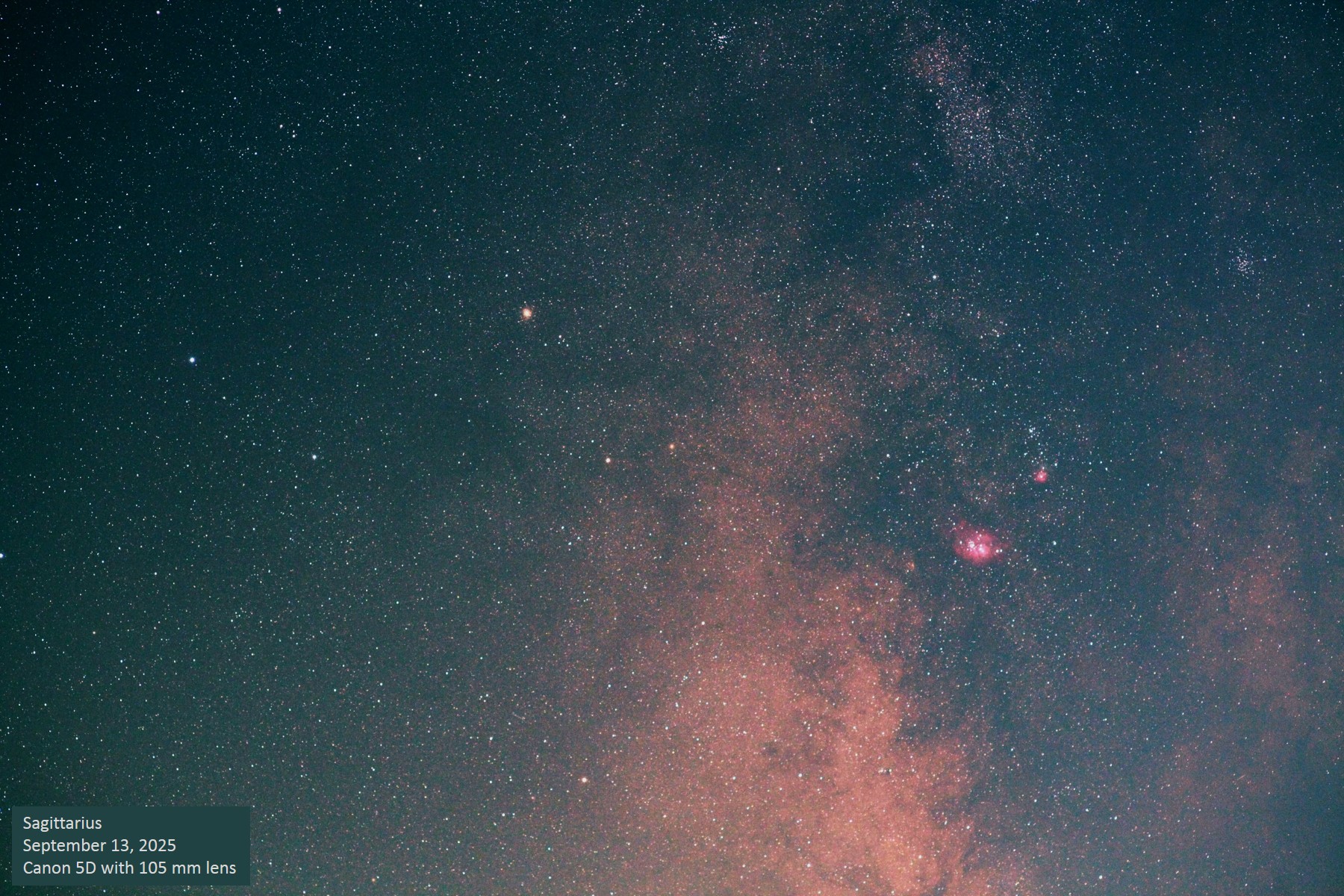 |
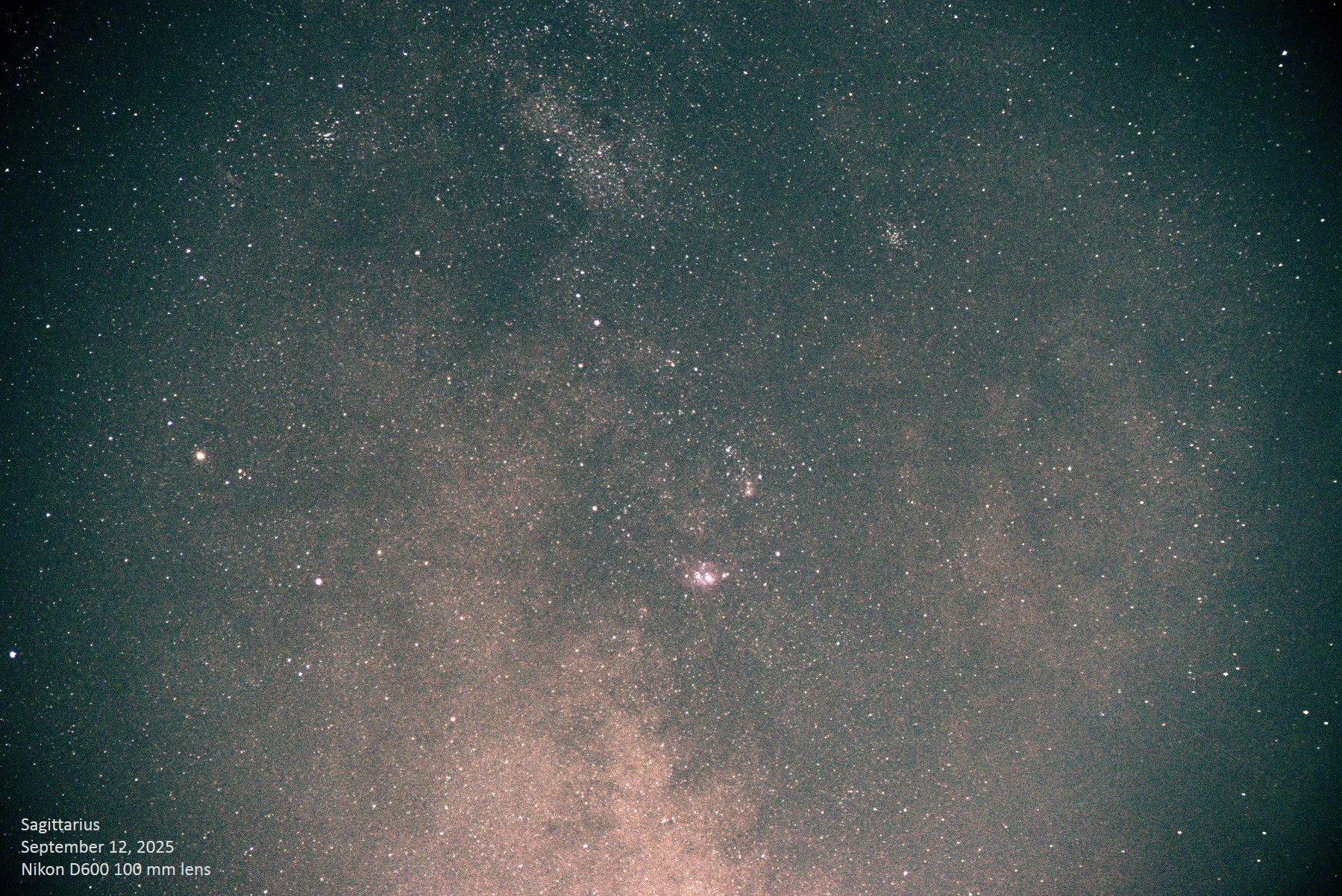
September 2025: Sagittarius Here are two quickie shots of the main Messier grouping in northwestern Sagittarius (minus M17). The first image was using an old 1980's vintage Vivitar 28-200 mm zoom lens set to about 100 mm, and shot wide open at f/3.5 with my Nikon D600. The exposure was for 15 seconds on a tracking platform. Note the purplish color of the Lagoon Nebula (M8), a result of the electron transitions in 4000 Angstrom range. The second image was using a 105 mm lens and my modified Canon 5D, which unlike the Nikon, records the red nebulosity around 7000 Angstroms. |
|||
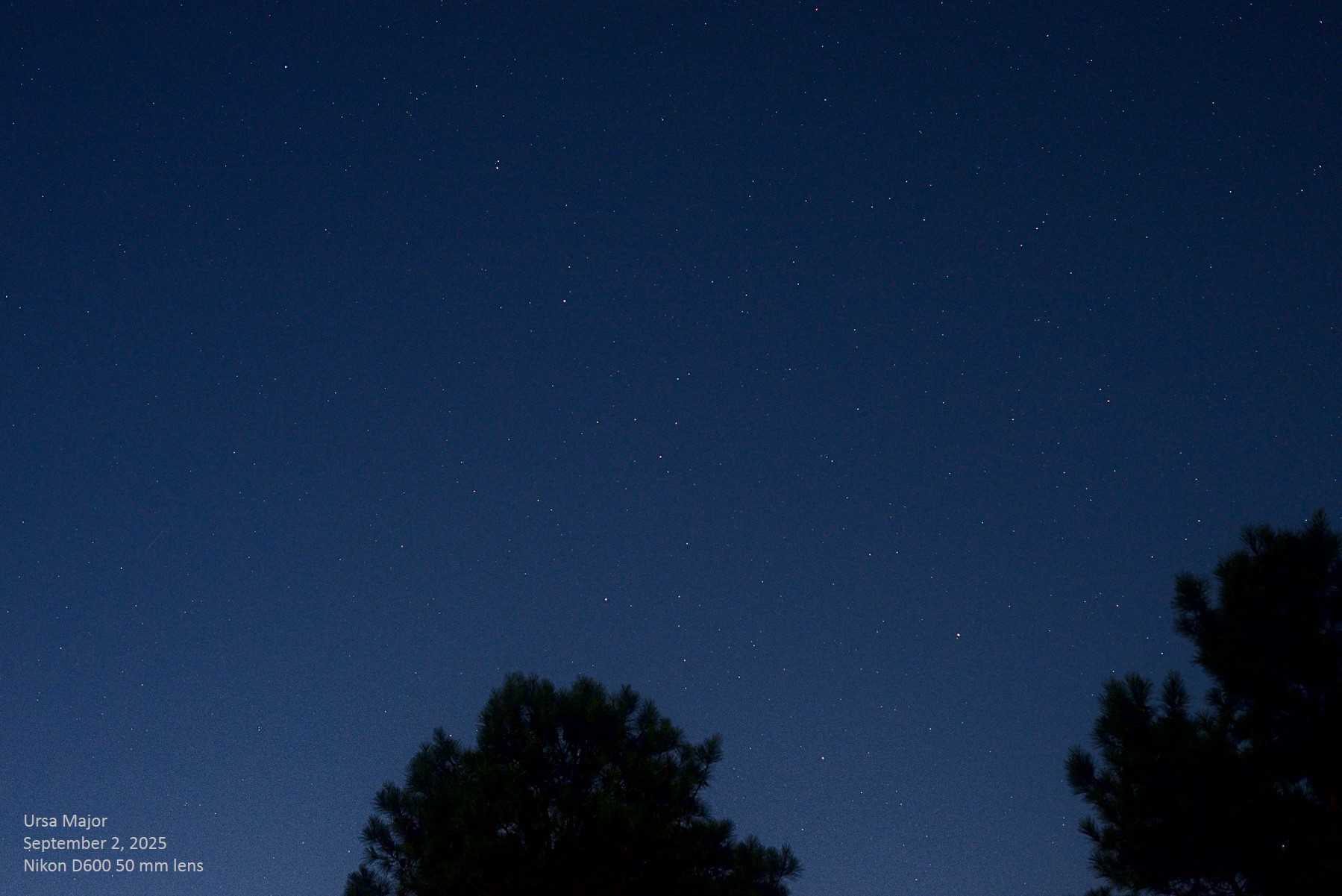 |
September 2025: Ursa Major The Big Dipper asterism of Ursa Major hangs low in the northwest between pines in King George County, Virginia in late twilight of an early September evening. |
||||
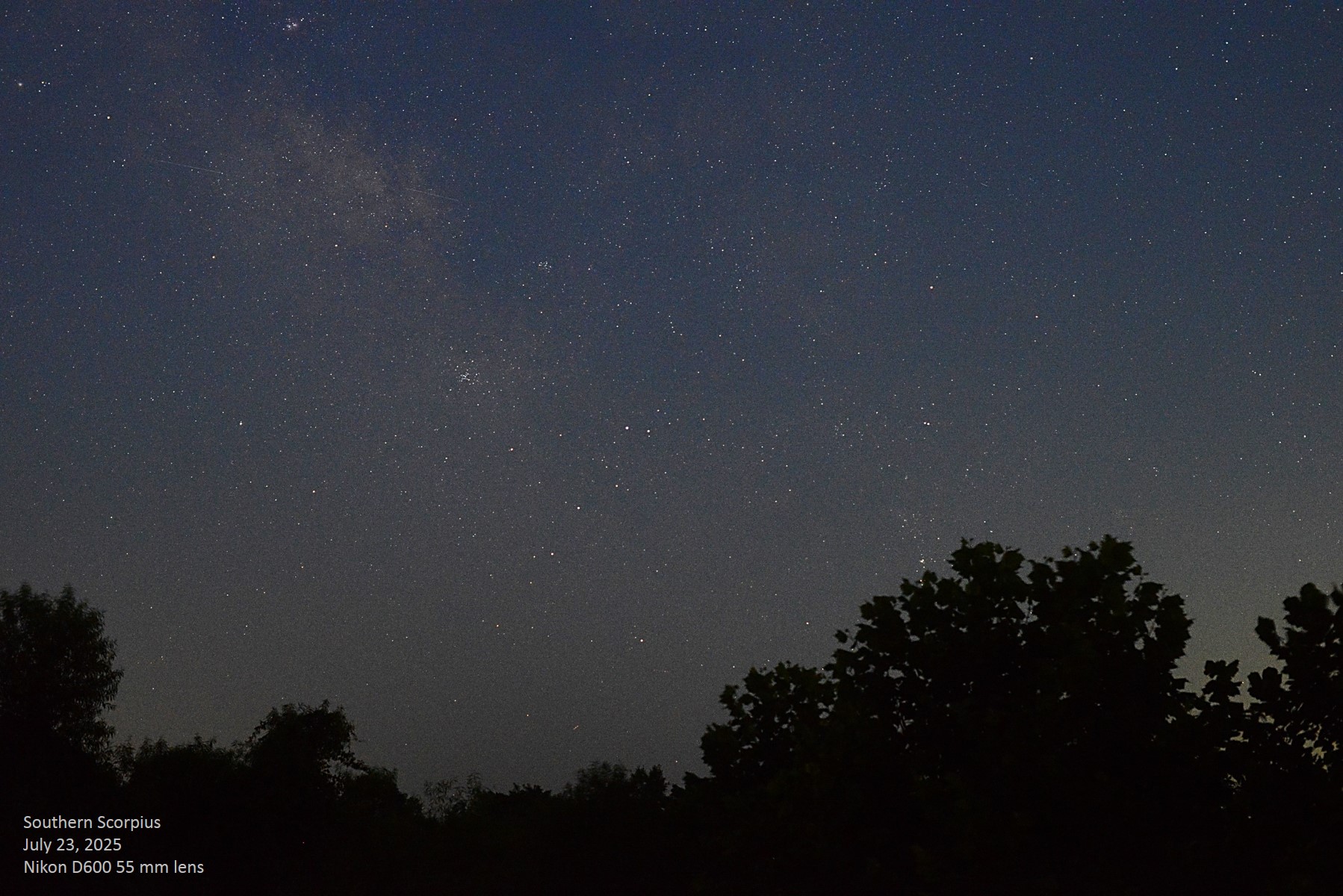 |
July 2025: Scorpius Southern Scorpius and Sagittarius were nicely visible from King George County in the Northern Neck portion of Virginia in late twilight. |
||||
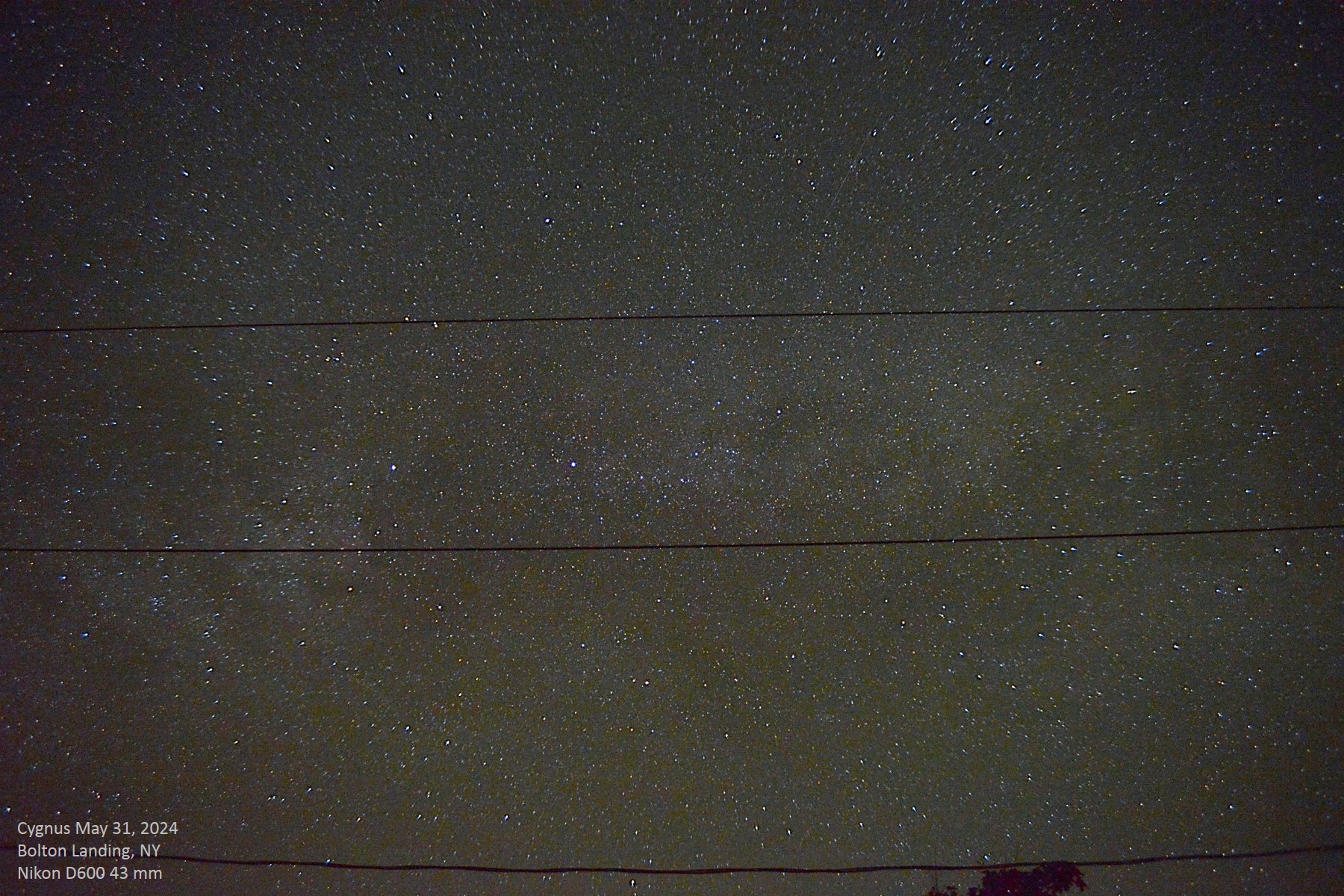 |
May 2024: Upstate New York I visited my lady friend Laura at the end of May 2024 and since the first night was clear and moonless, I took a few snapshots of her night sky just to see what it looks like from 43°46' North latitude. |
||||
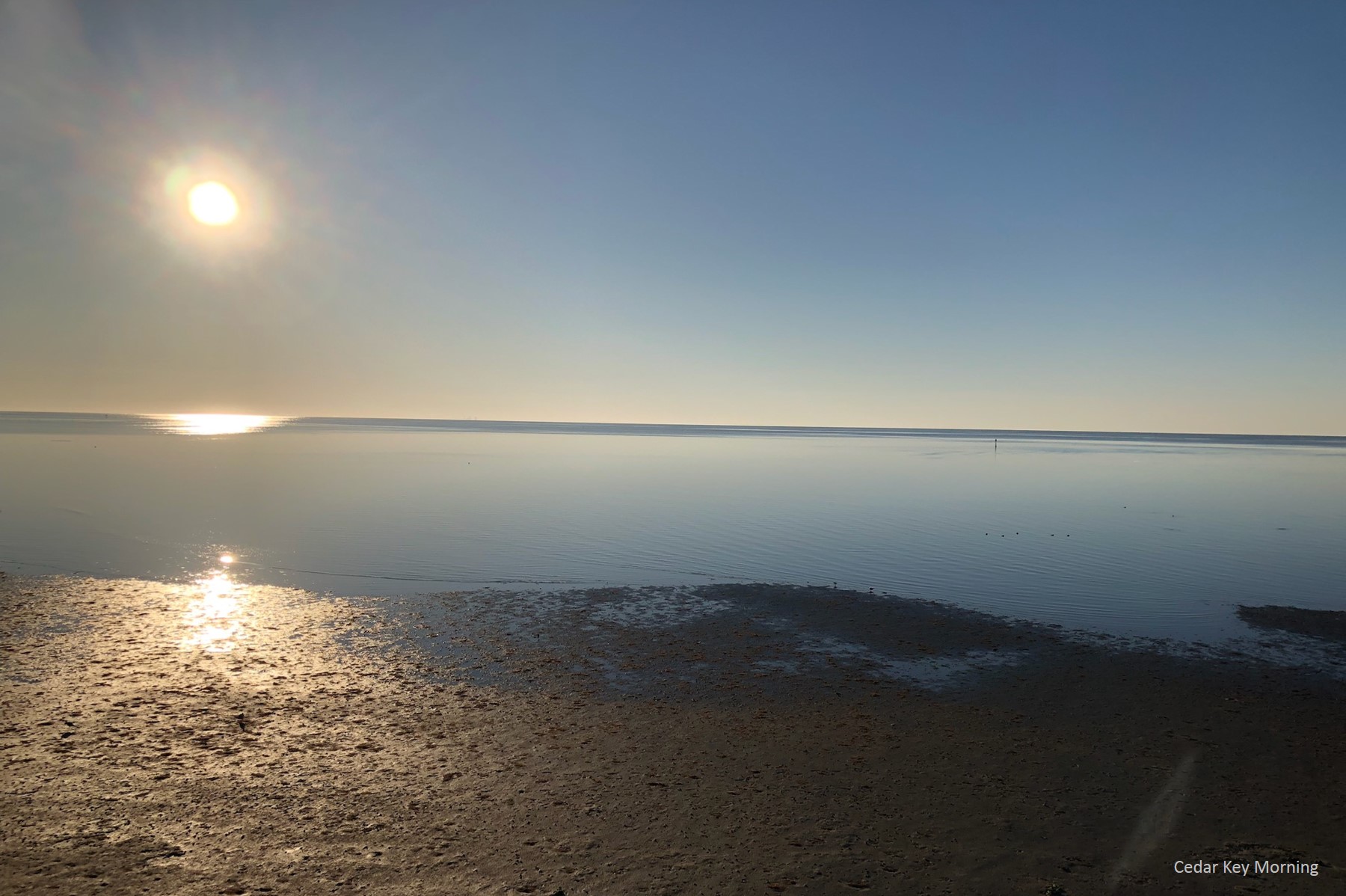 |
February 2024: Cedar Key, Florida In February 2024 we spent a week in Cedar Key, Florida and from our apartment balcony looking out over the shallow waters around the Keys, I took some pictures of the later winter and early spring constellations that we can't see very well from Virginia. |
||||
 |
October 2020: Ophiuchus On this evening of October 8, 2020, I took a shot of the three large open clusters in the Ophiuchus-Serpens area, between β Ophiuchi and the great double star Alya, or θ Serpentis. These clusters are best observed a low power or even with big binoculars. They look great in a small refractor! |
||||
 |
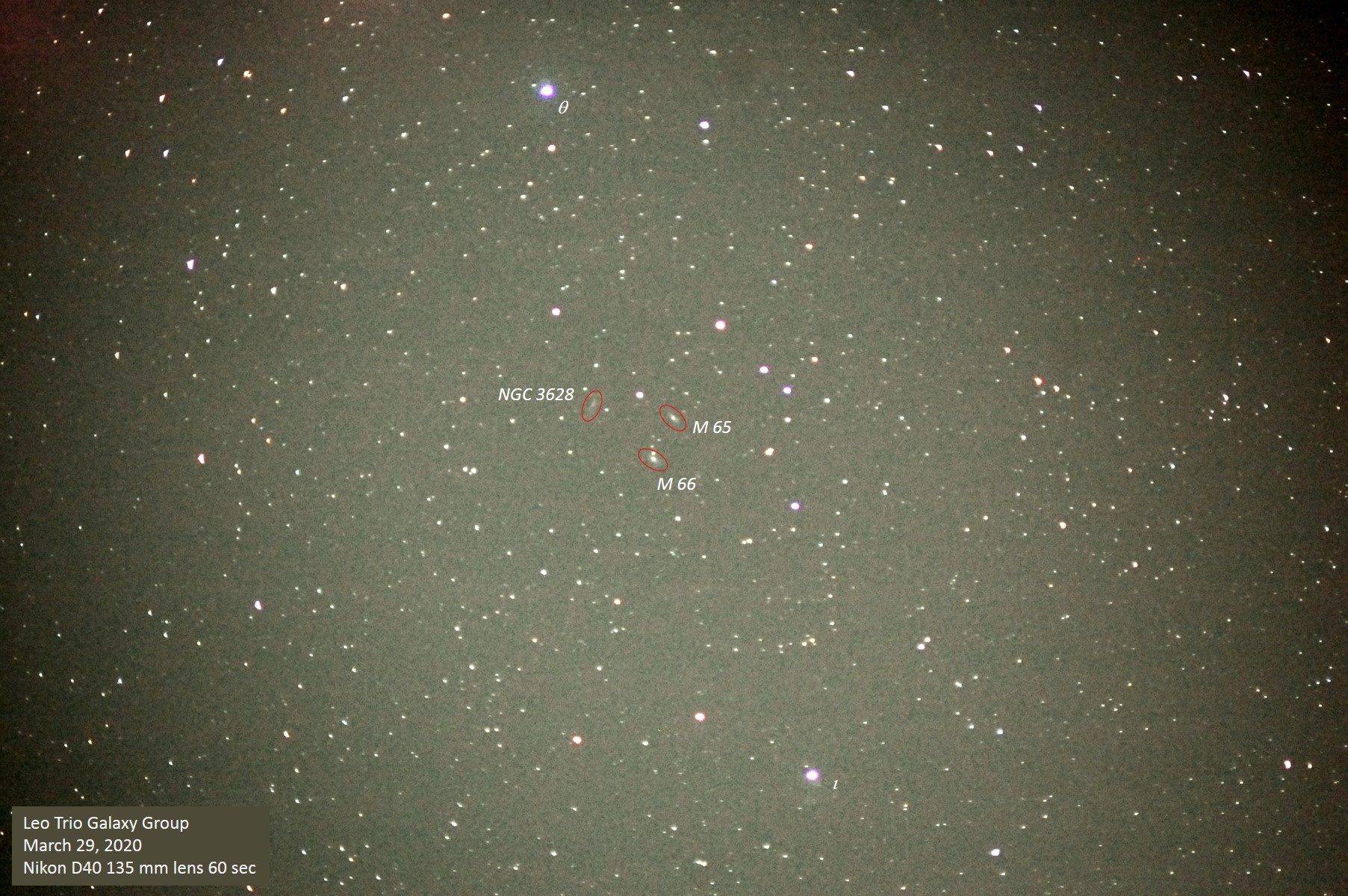 |
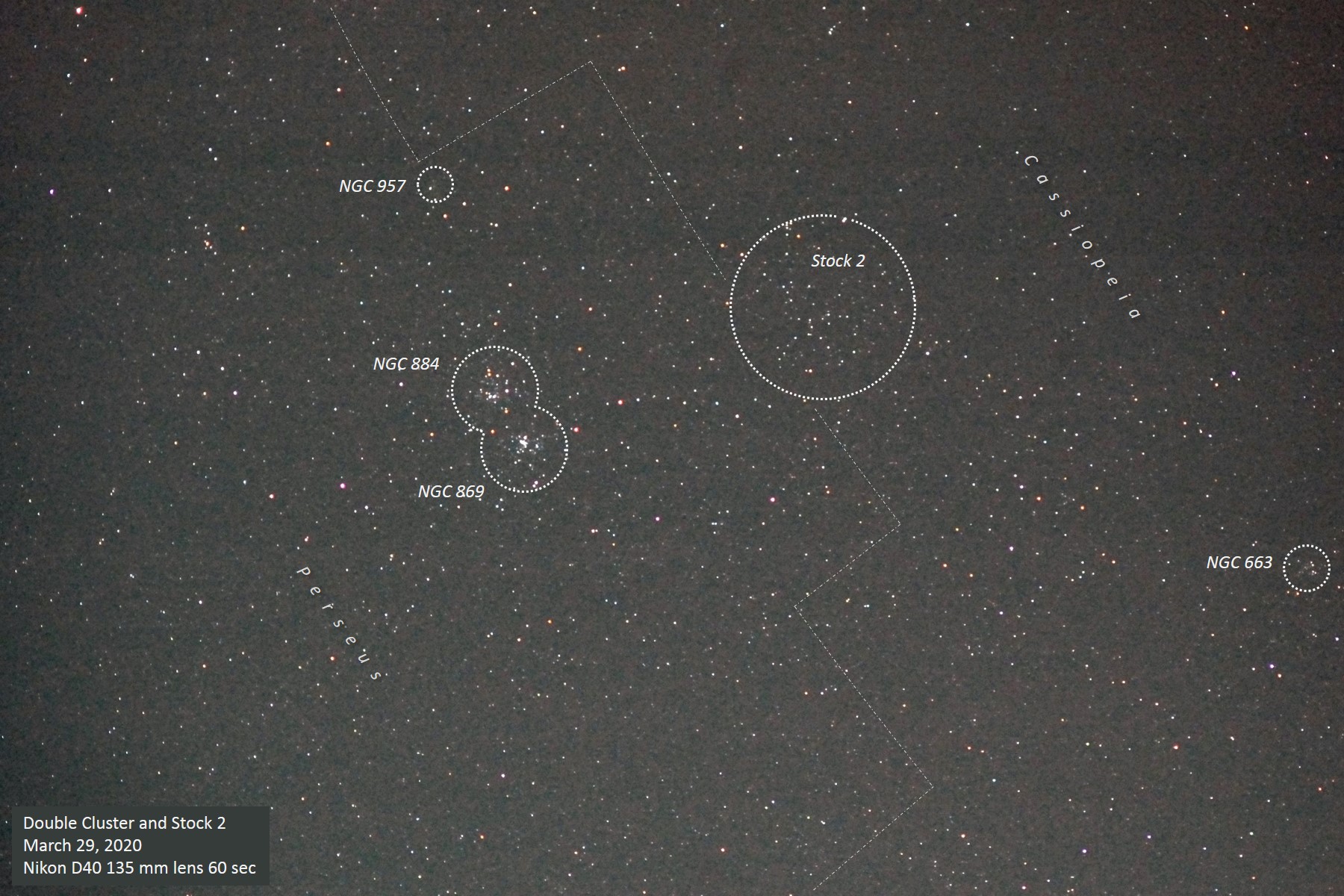
March 2020: h & χ Persei and a Leo Trio On this evening of March 29, 2020, the 4-day old Moon was out and so the sky was kind of bright for getting a constellation snapshot, but I took one anyway of the Double Cluster in Perseus; the field included an ob- ject that I've read about but never observed with binoculars or telescope, the large open cluster Stock 2, named after Jürgen Stock, the German astronomer who was the driving force behind the establishment of obser- vatories in Chile, and who served as the first director of the Cerro Tololo Interamerican Observatory. The eastern Leo Trio of M65, M66, and NGC 3628 comprise a great target for users of small or medium sized tele- scopes. |
|||
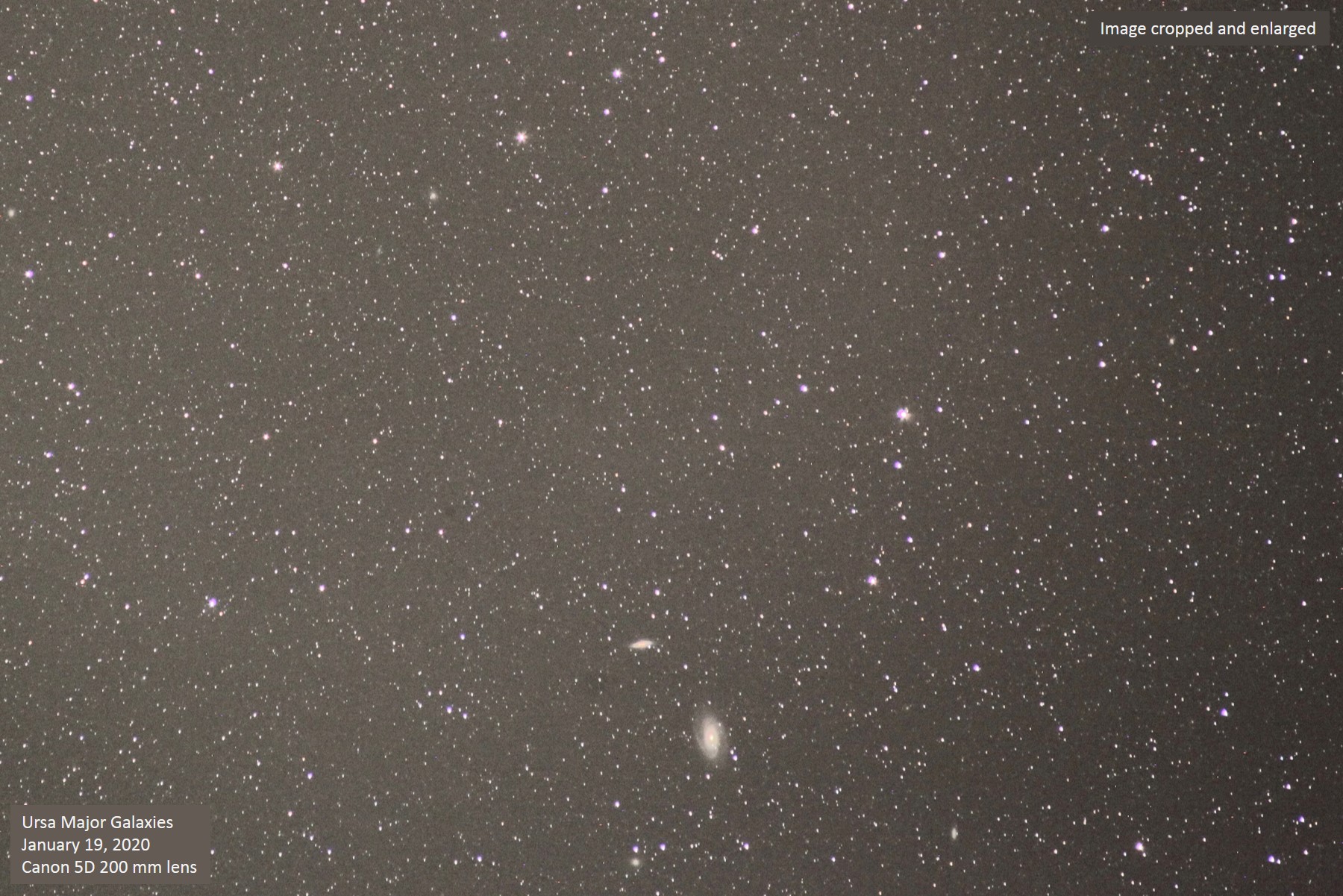 |
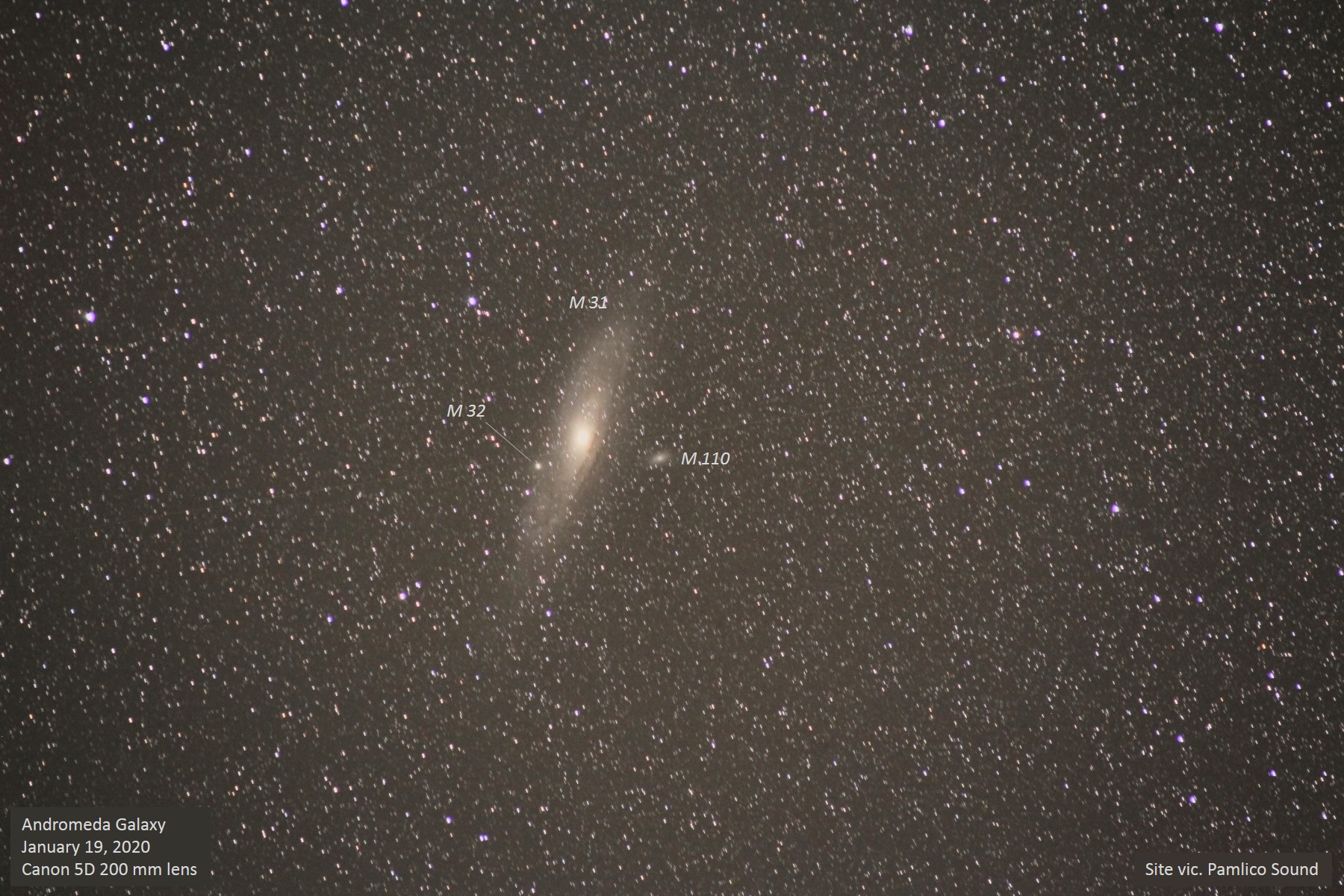
January 2020: Pamlico Sound, NC This field in Ursa Major was captured in a remote dark location in eastern North Carolina, on the Pamlico Sound. I didn't get it centered on M81 and M82, even with just a 2 minute exposure was able to capture a few additional galaxies, some of which are on the Herschel 400 list. Other objects I imaged with my modified Canon 5D are shown below: the Andromeda Galaxy, IC 1396 in Cepheus, nebulosity in the vicinity of the Double Cluster in Perseus, and the Rosette Nebula in Monoceros. |
||||
 Andromeda |
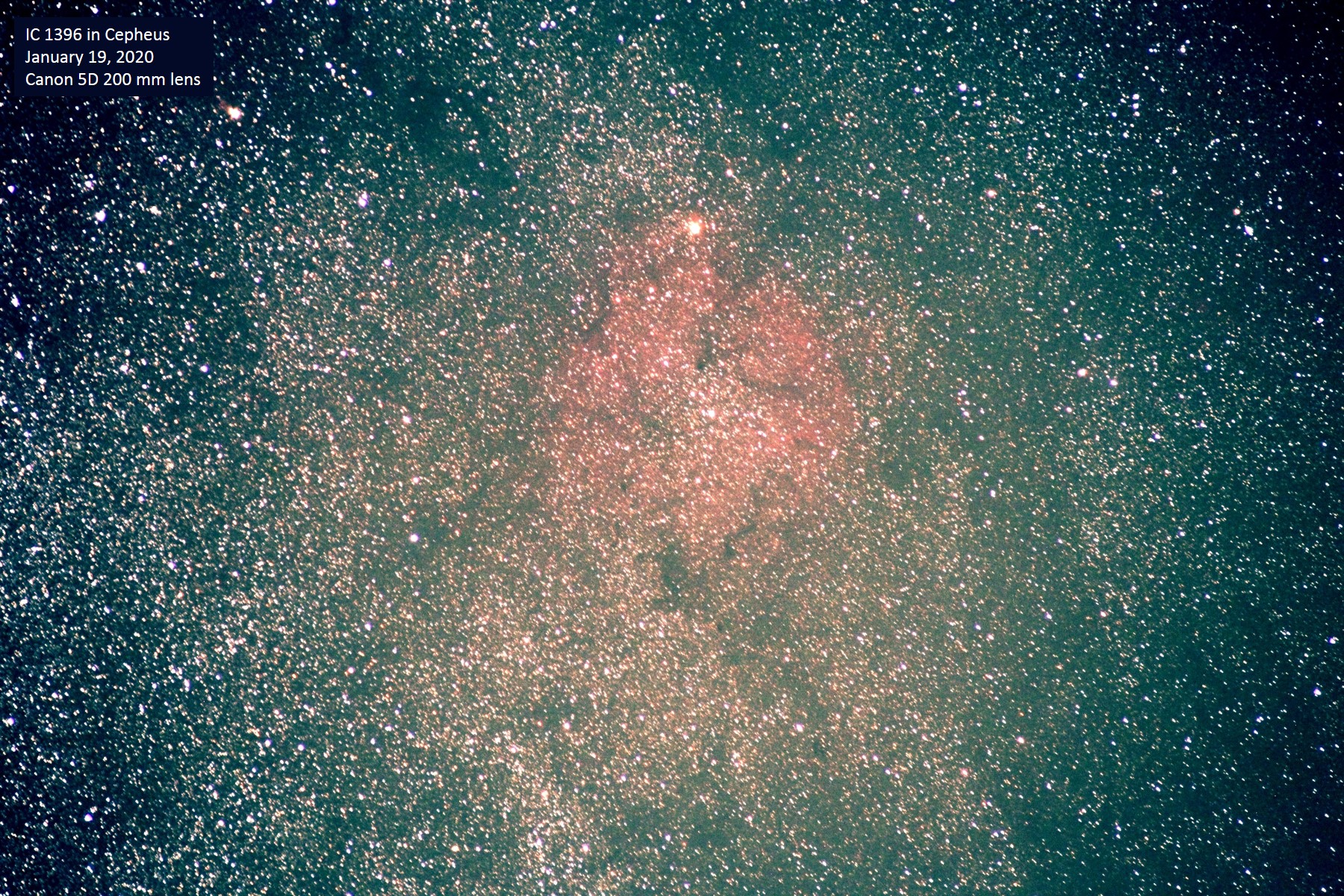 Cepheus |
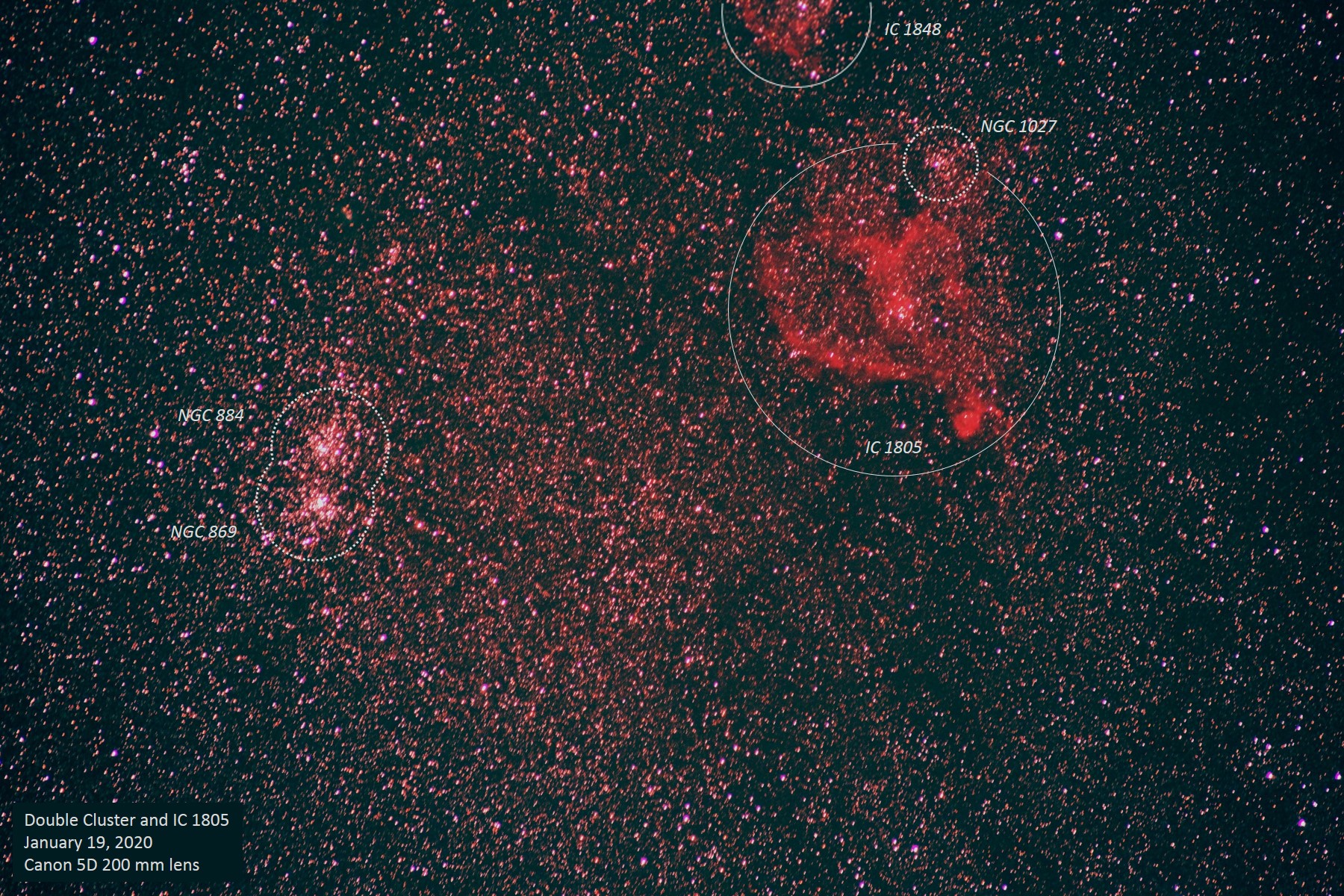 Perseus |
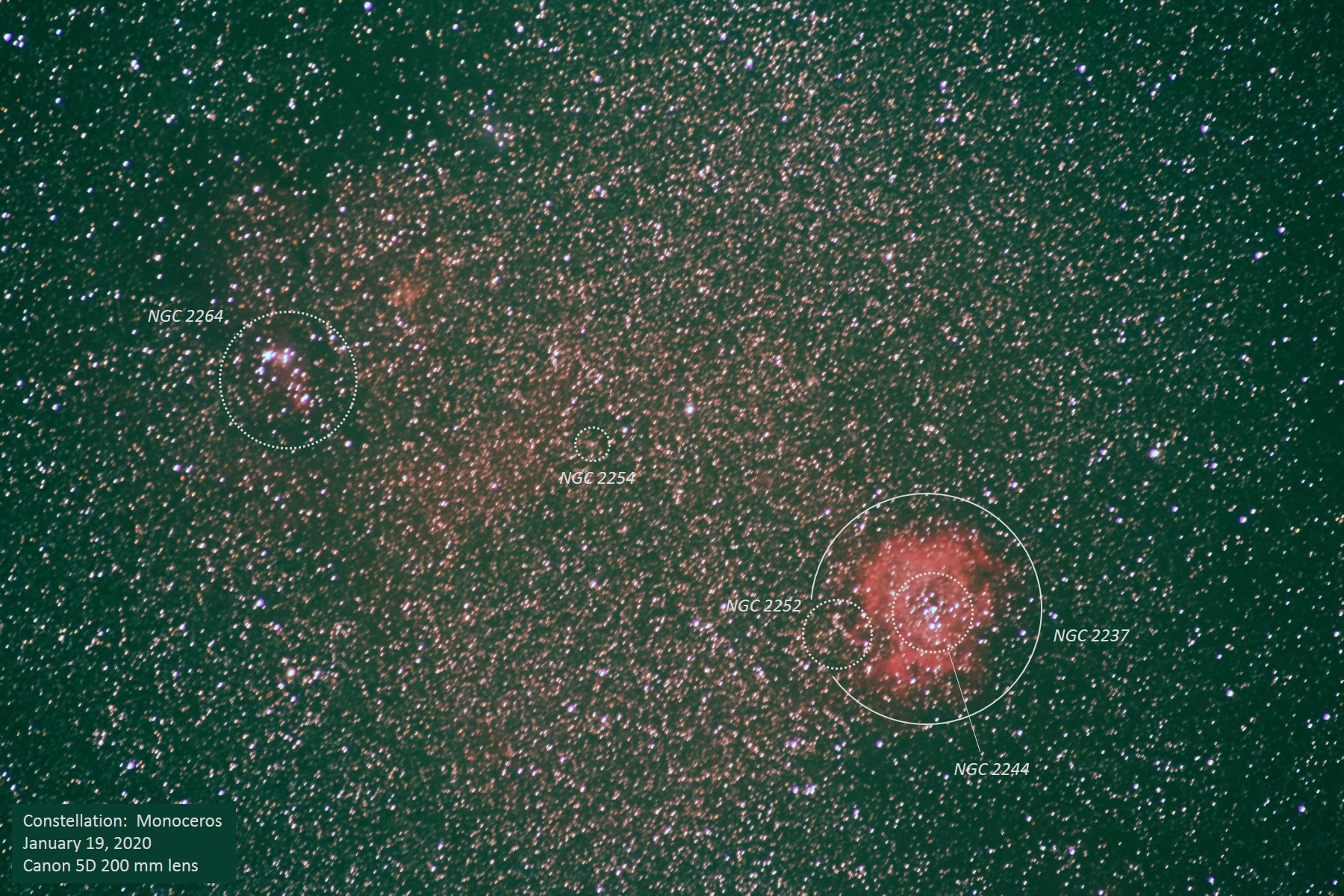 Rosette Nebula |
||
 |
On the last night of 2019, December 31, I got a few images of the winter sky. Here is Canis Major and northern Puppis, on which I've annotated some of the larger open clusters along the winter Milky Way. The Collinder clusters stand out better because they are so large and sprawling, but they get lost easily when you pan over them with a telescope. | ||||
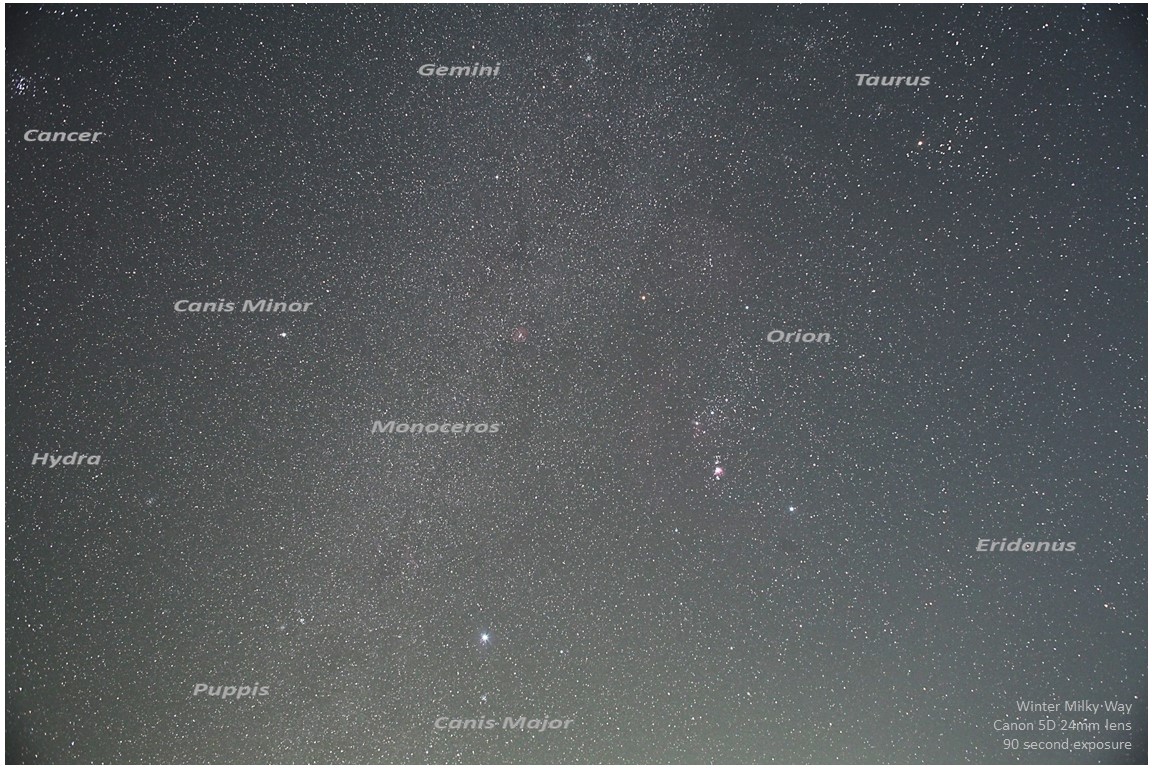 |
On the last night of 2019, December 31, I got a few images of the winter sky. This is the first time I've managed to capture the breadth of the main part of the winter Milky Way that shows a little bit of the star clouds and darker patches through Gemini, Monoceros, and Puppis. The nebulas and clusters that stand out in this image, besides the Orion Nebula, are the Rosette, M48 in Hydra, M35 in Gemini, M44 up at the extreme upper left, the twin clusters in Puppis, M46 and M47, and M41 in Canis Major. | ||||
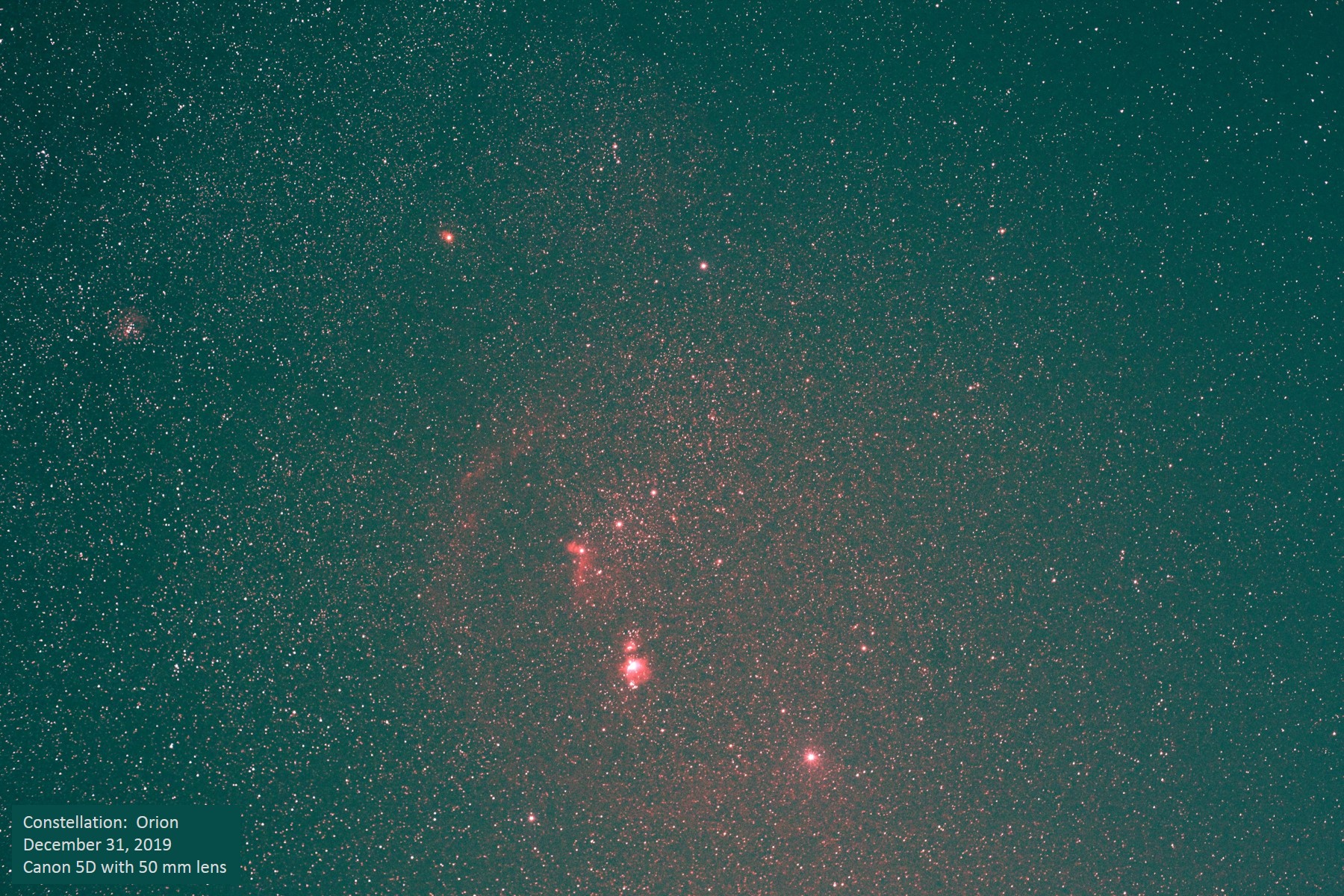 |
This image of Orion with a 50mm lens shows the major nebulas and clusters, as well as the current brightness of Betelgeuse relative to Rigel and other stars. It is currently at an historic low in brightness, prompting speculation about the star's near-term evolution. The Rosette Nebula shows faintly in this image to the upper middle left. | ||||
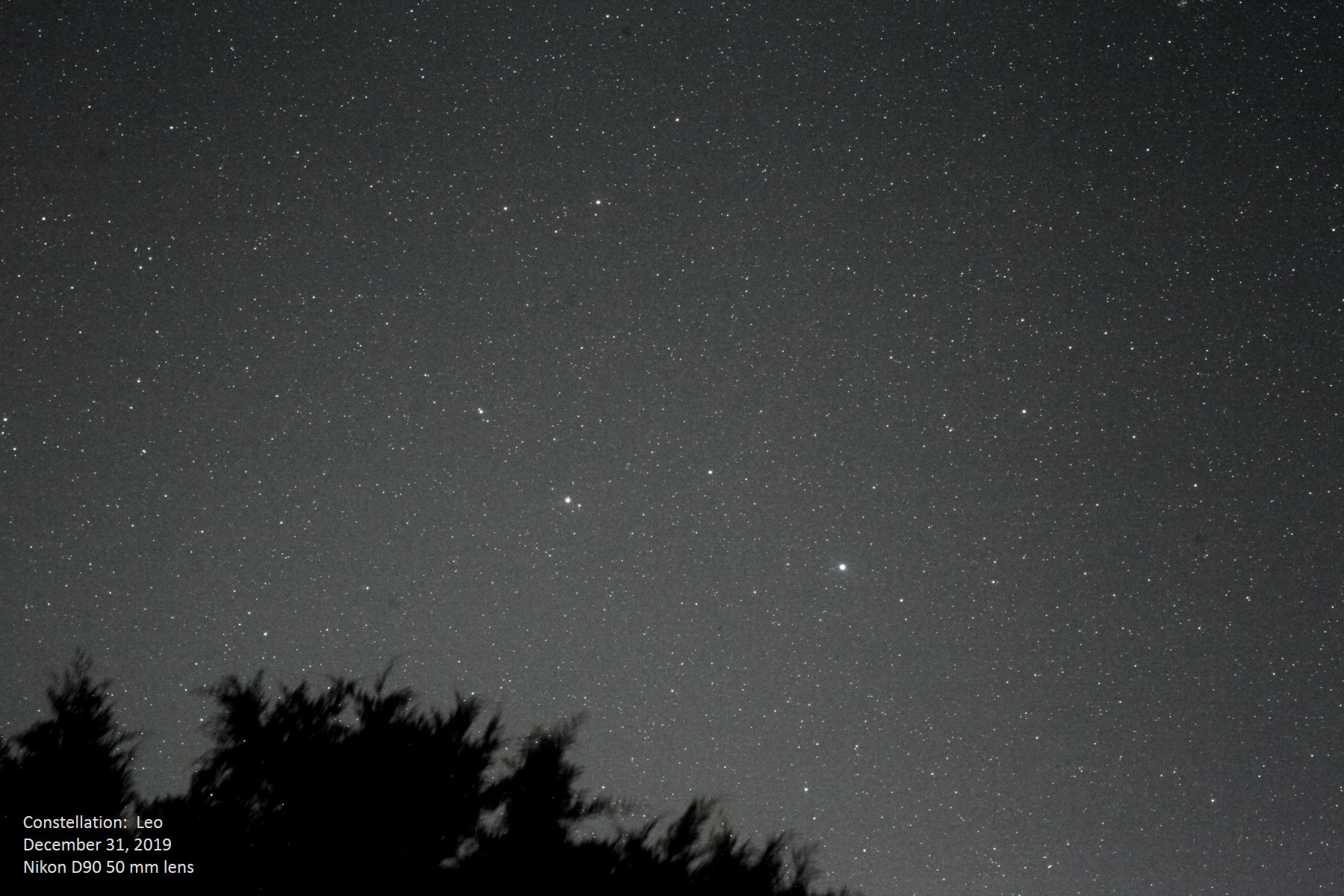 |
December 31, 2019: Leo Rising A quick shot of Leo rising over the treeline to my east ~ only one deep sky object even detectable on this image, that being NGC 2903, a bright galaxy near the top of the image. |
||||
 |
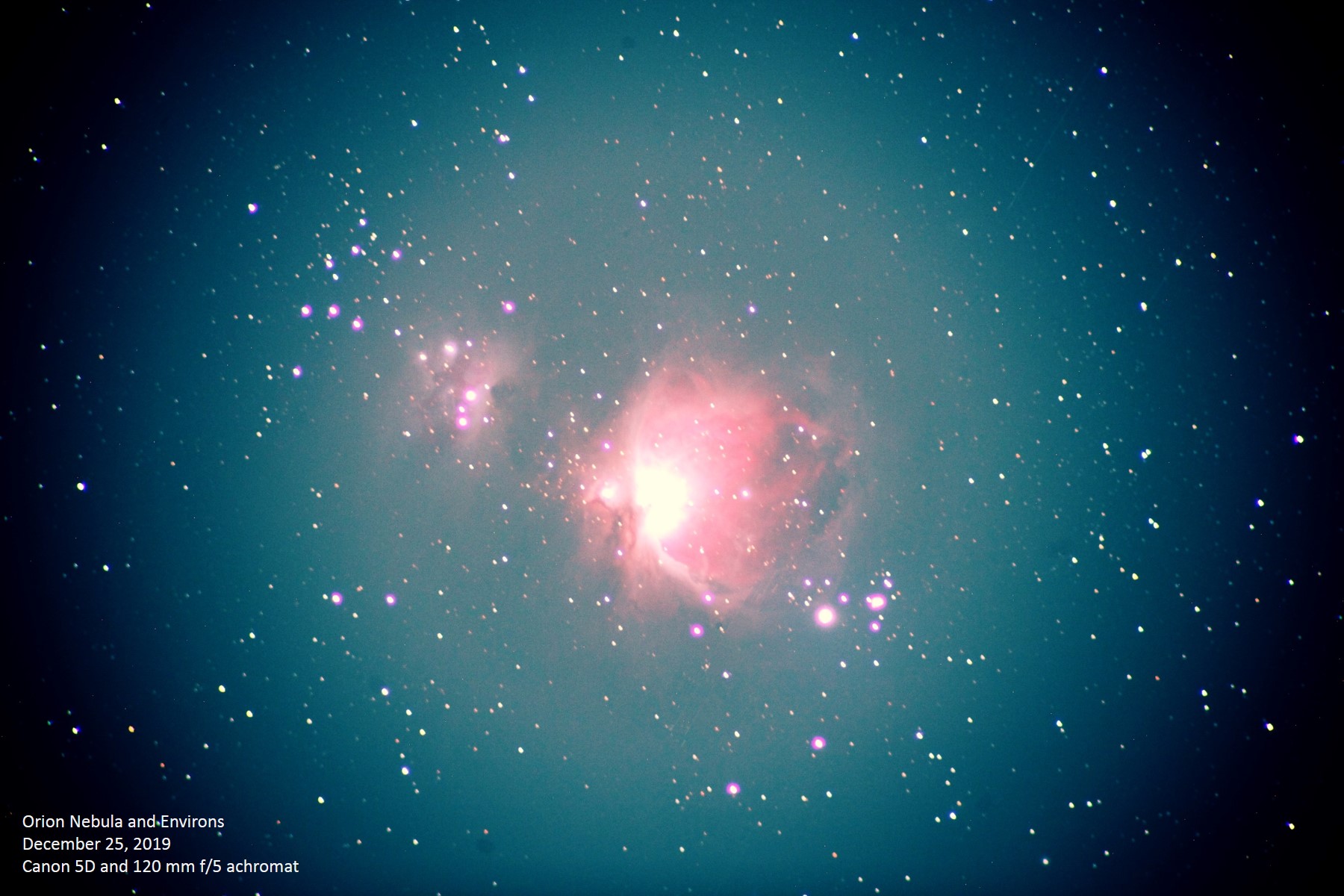 |
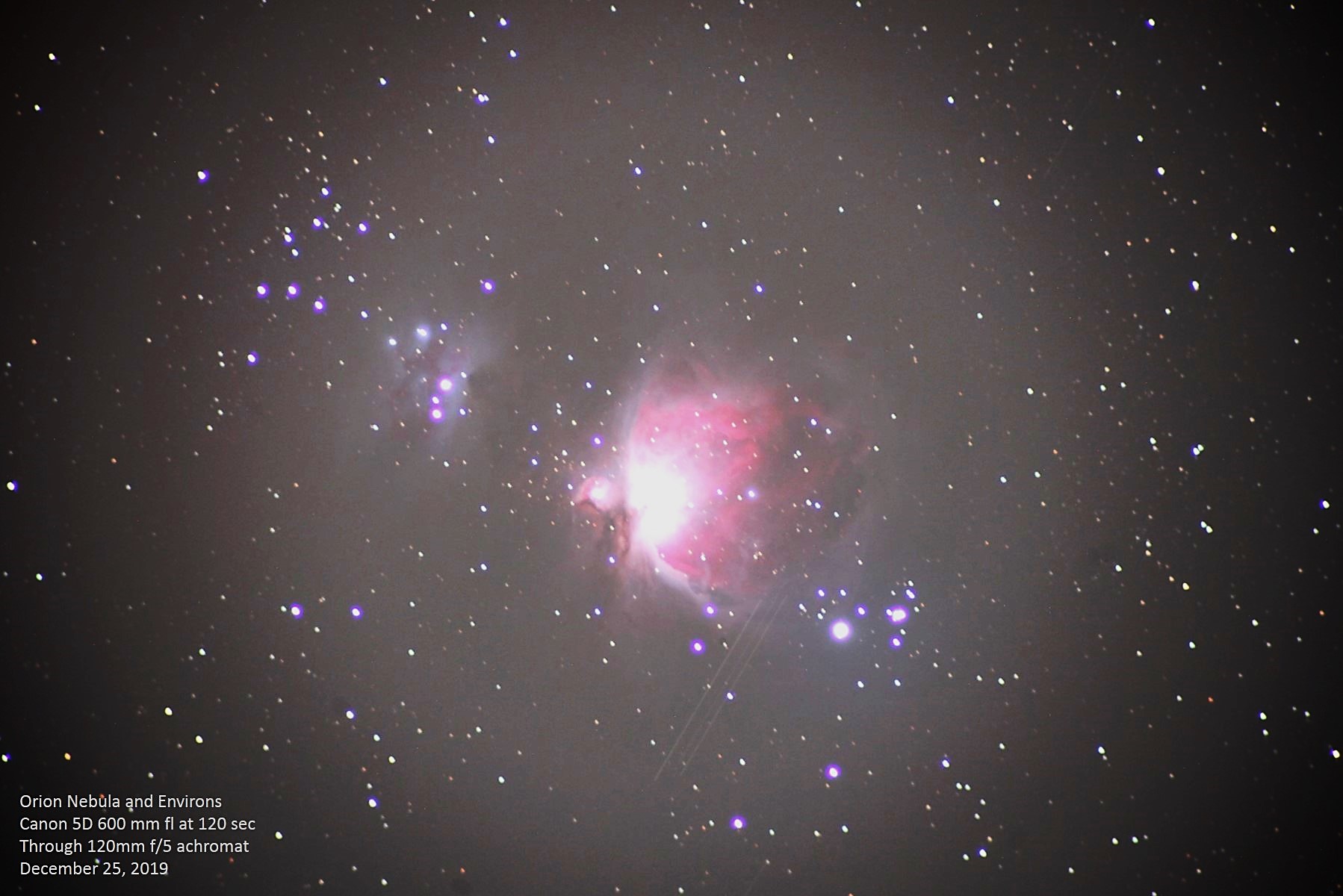
December 25, 2019: Orion Nebula Here is my first attempt at prime focus imaging of a deep sky object, of course what else would it be but M42? There is some trailing and the stars could be focused better but not bad for my first attempt. Orion was still pretty low in the sky so the circumstances were not the best. The first image was taken in the early evening on December 25, 2019, and the second reprocessed in May 2026. |
|||
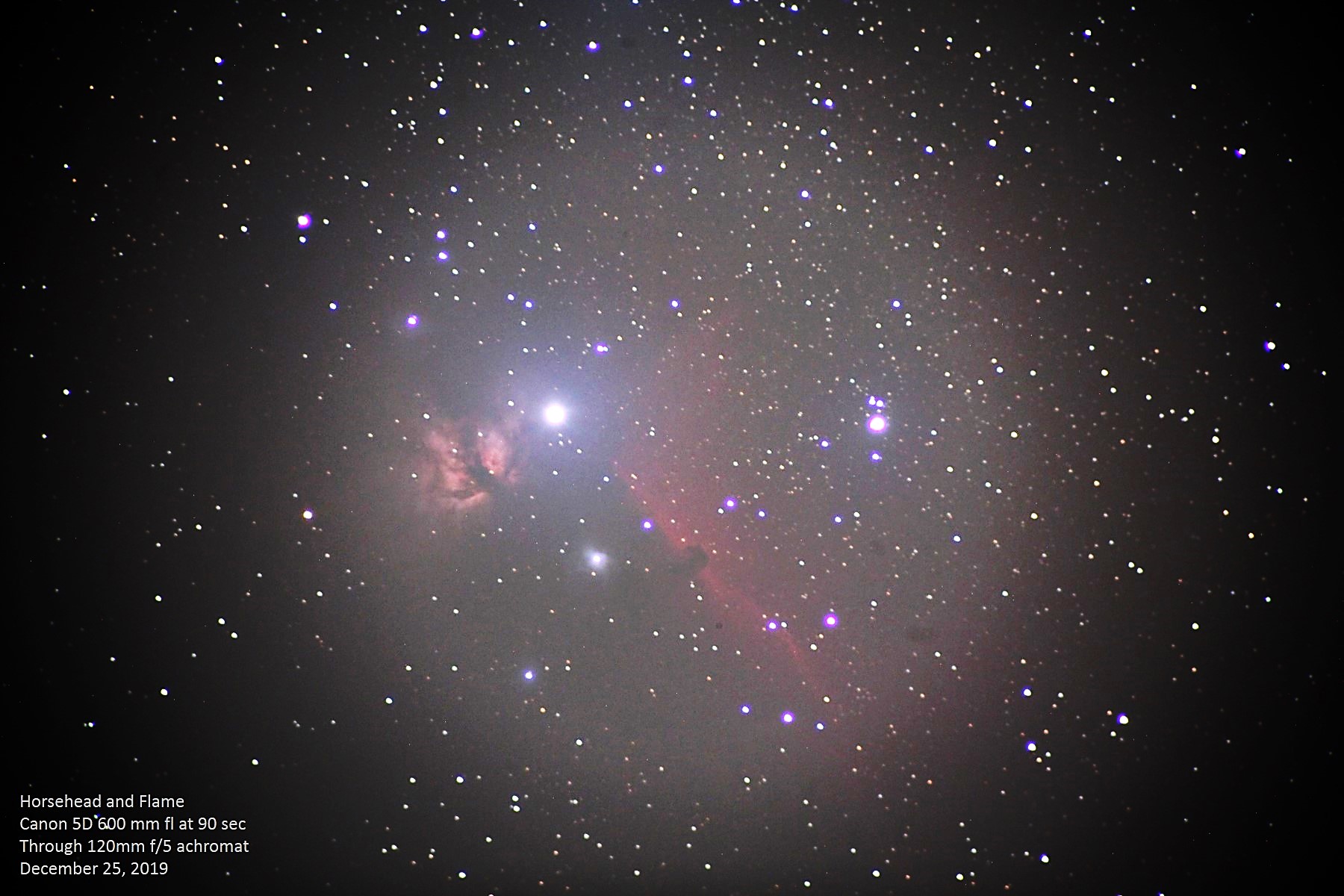 |
December 25, 2019: Horsehead and Flame Nebulas The area around Alnitak, or ζ Orionis, is shown in this image, taken later in the evening than the above image of M42, so it was higher in the sky. I darkened and increased the contrast of the original image to arrive at this one. It was acquired in the late evening on December 25, 2019. The vignetting around the edges only appears worse in this image because I didn't crop it down first! |
||||
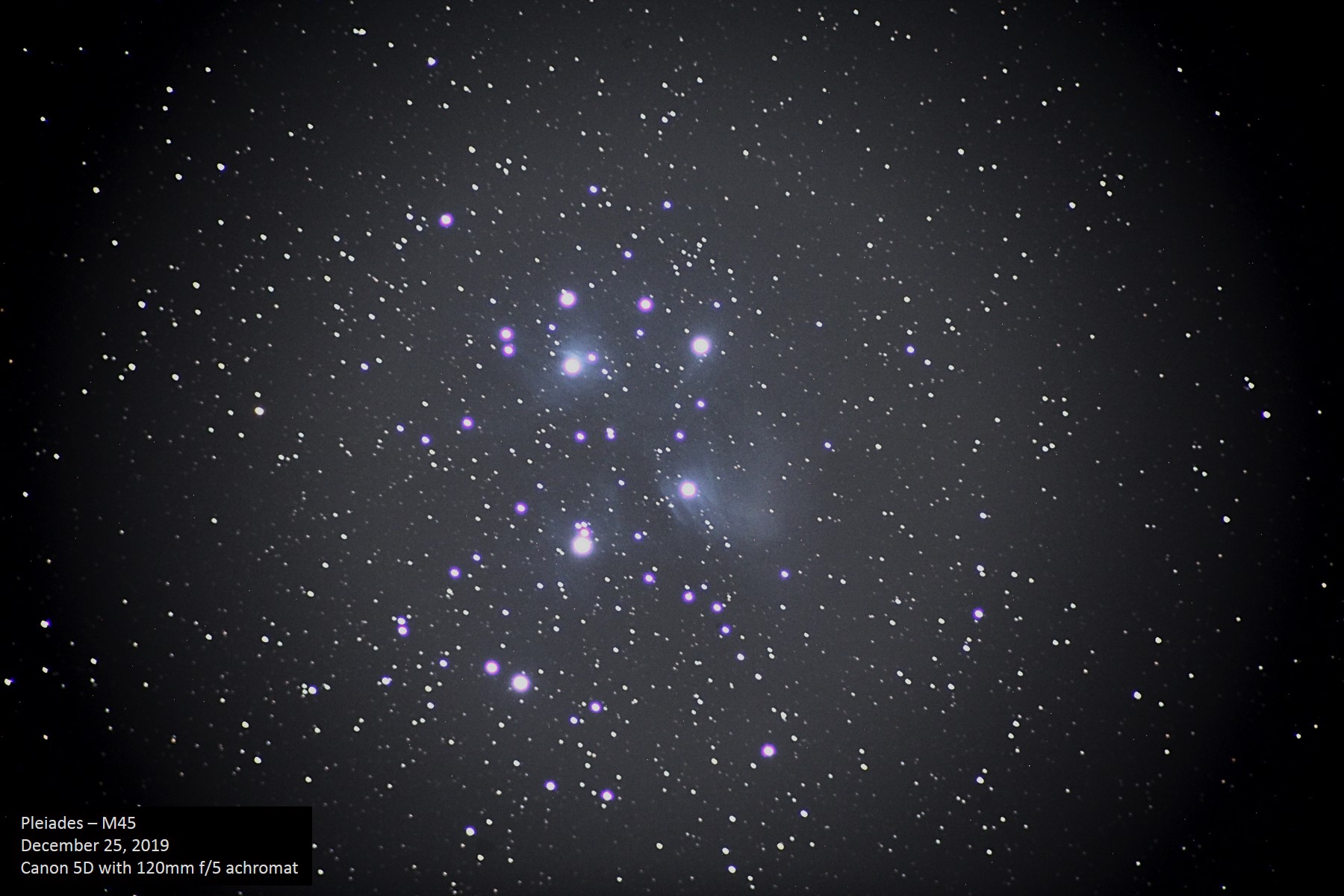 |
December 25, 2019: Pleiades The Pleiades at 90 seconds with my Canon 5D mkII (modified) and a 120mm f/5 achromat which yields a focal length of 600mm. The trailing doesn't appear too bad at this exposure but it's long enough to pick up the nebulosity around Merope. The focus is not the best, so I will have to make some adjustments the next time out. This image was acquired in the early evening on December 25, 2019. |
||||
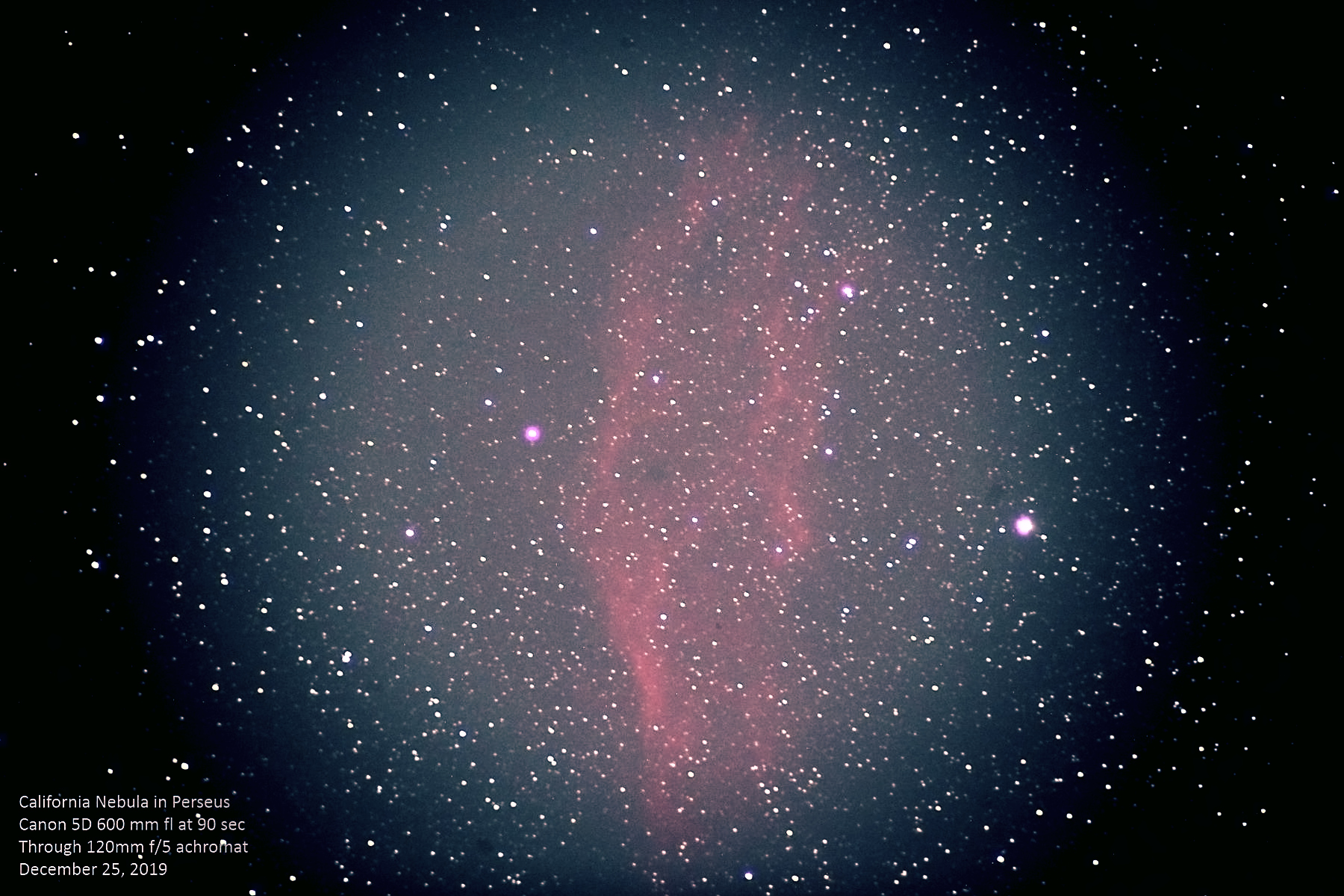 |
December 25, 2019: California Nebula I didn't think that using my 600 mm focal length achromat with my full frame Canon would result in too narrow a field of view to capture the full extent of the California Nebula, but it obviously is, or I should have reoriented the camera 90 degrees to get the full length. The exposure was 90 seconds and the star trailing is barely noticeable. This image was acquired in the early evening on December 25, 2019. |
||||
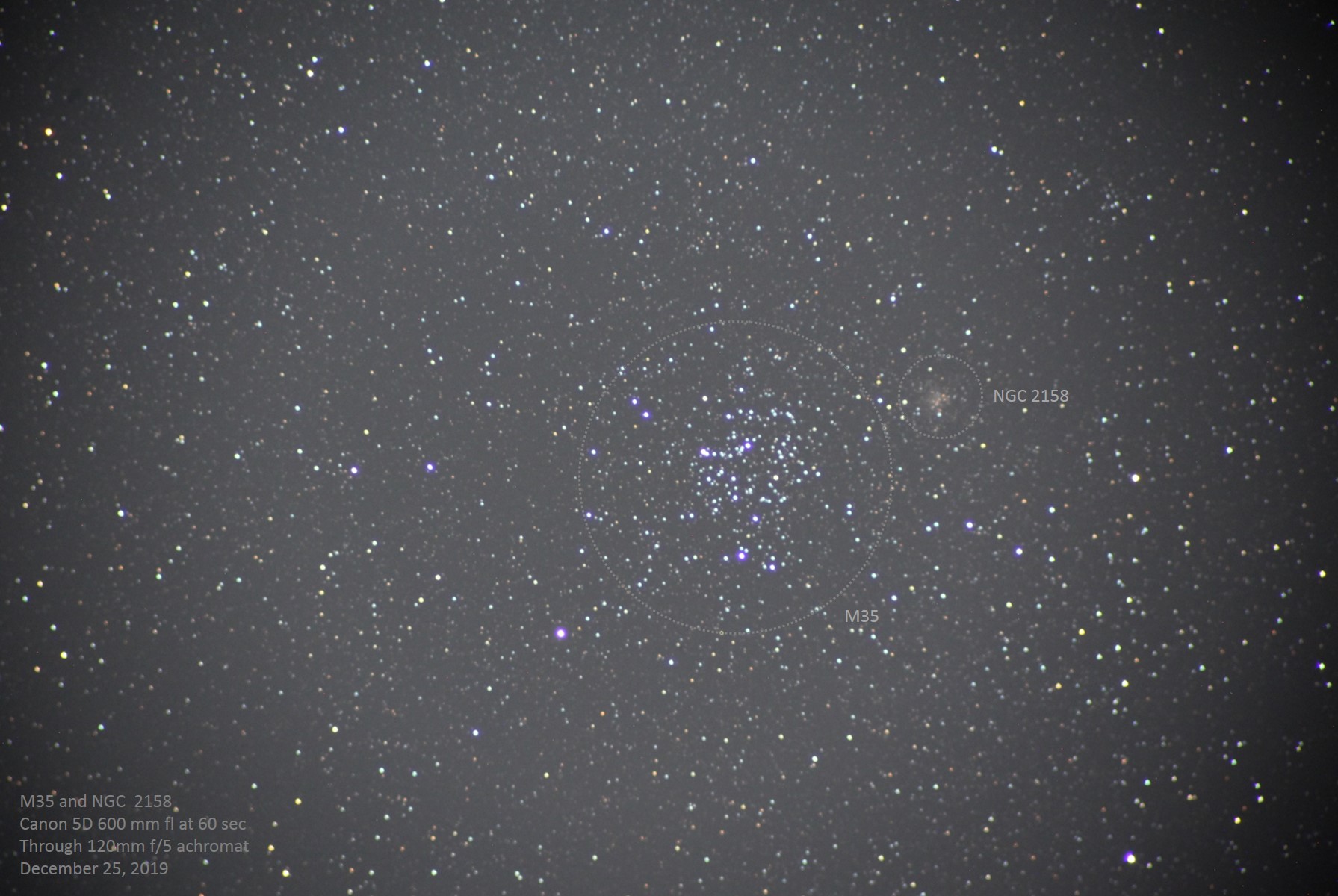 |
December 25, 2019: M35 in Gemini This is a 60 second image of M35 and its smaller neighbor, NGC 2158 (to the right of the main cluster). At only 60 seconds, the stars don't appear to be as trailed as in some of the other images I took this evening. I cropped this image some, so the image scale is not quite accurate compared to the other images. This image was acquired in the late evening on December 25, 2019. |
||||
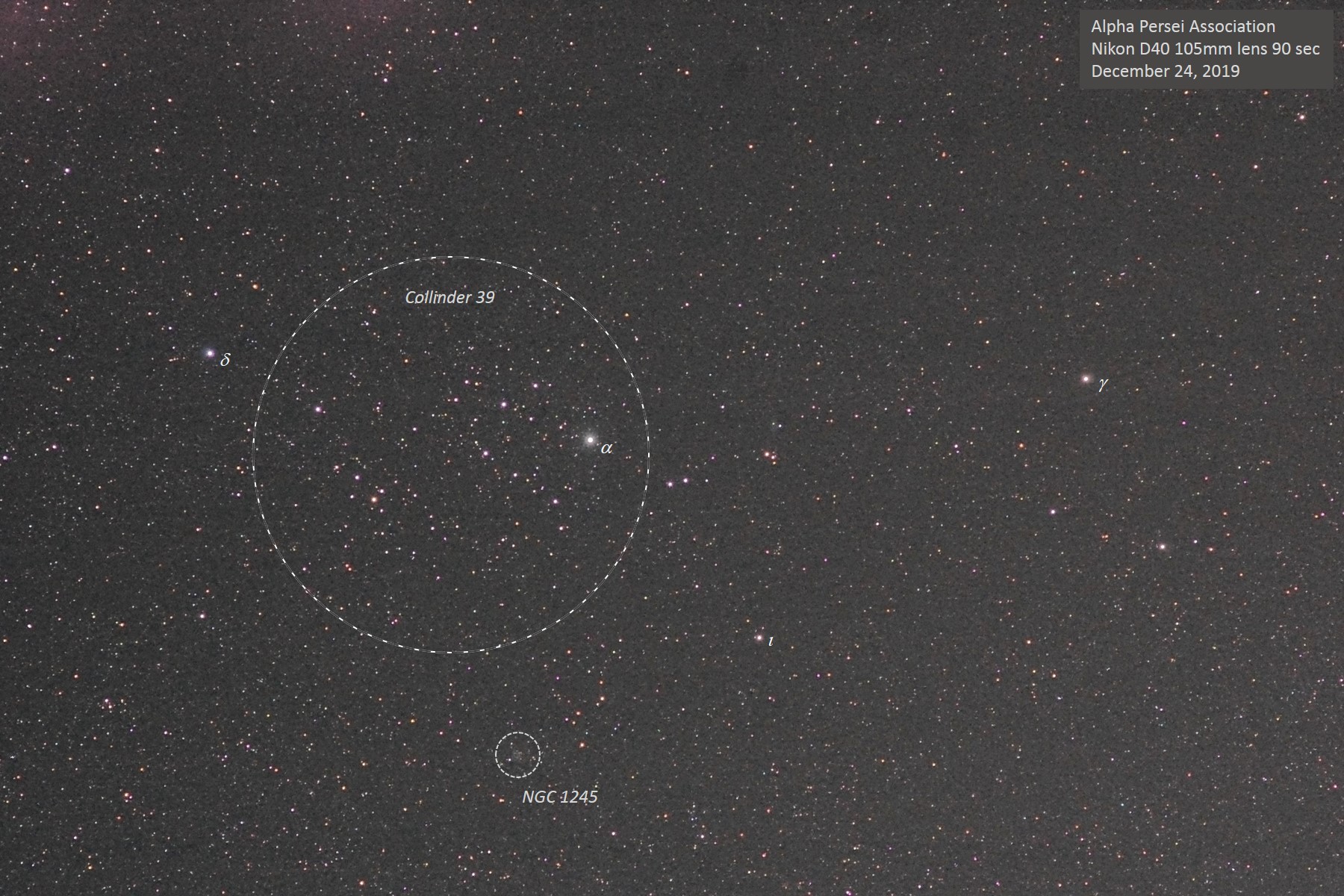 |
December 24, 2019: Alpha Persei Association I always thought the grouping of stars around Alpha Persei (Mirfak) was an "association", but this evening, after looking at my image of the group, I see that Wikipedia refers to it as a cluster; when did this change occur? I recall reading a long time ago that the grouping was part of the Melotte catalog, but I didn't know that it was also in Per Collinder's catalog, so on my image, I decided to label it Collinder 39. The grouping has always been notable to me for the multiple smoothly curving arcs of stars. This image was taken just after midnight on December 25, 2019, which means that I was still thinking it was December 24, Christmas Eve LOL. |
||||
 |
|
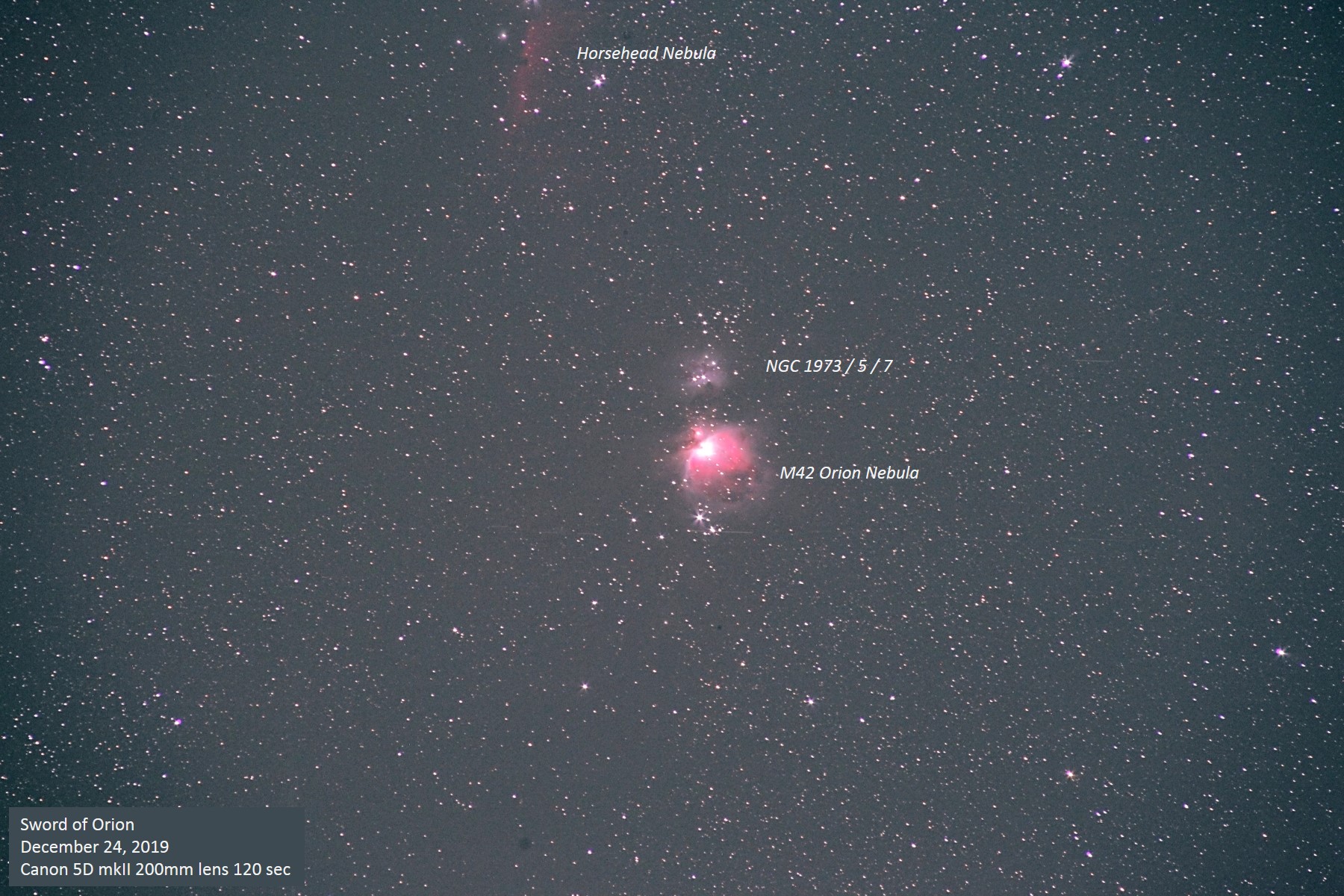
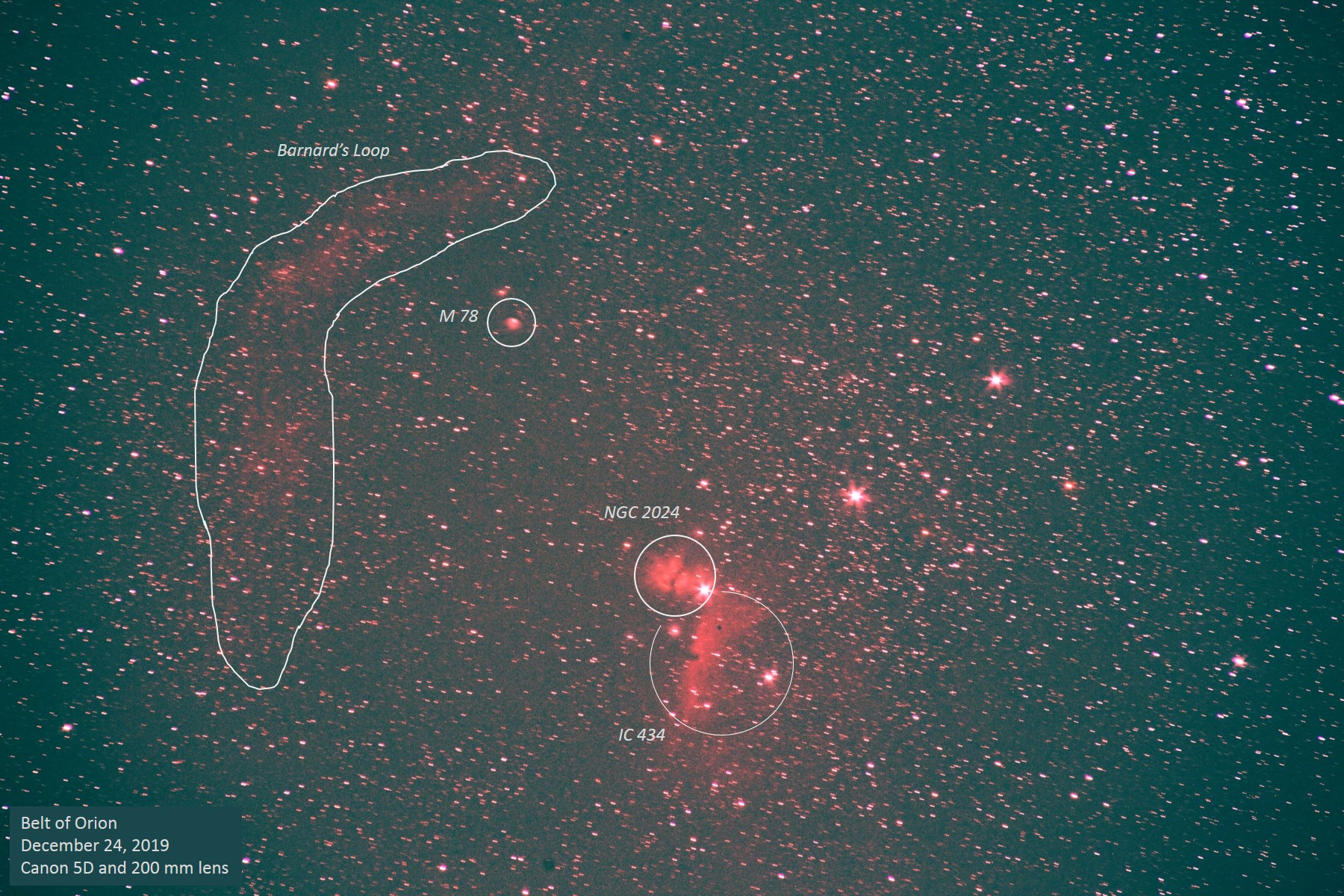
December 24, 2019: Central Orion It's winter time so what else should I try to image but the Orion Nebula? I am just in my driveway less then 10 miles from Fredericksburg, so the light pollution here is still pretty bad, but looking straight up or south is tolerable. The Celestron 8 on which I piggybacked the camera tracked well for these two minutes lol. Note that the camera I used, my Canon 5D mkII, was modified for Hydrogen-α, so it's much more sensitive in the red end of the spectrum. This image was taken just before midnight on December 24, 2019. |
|||
 |
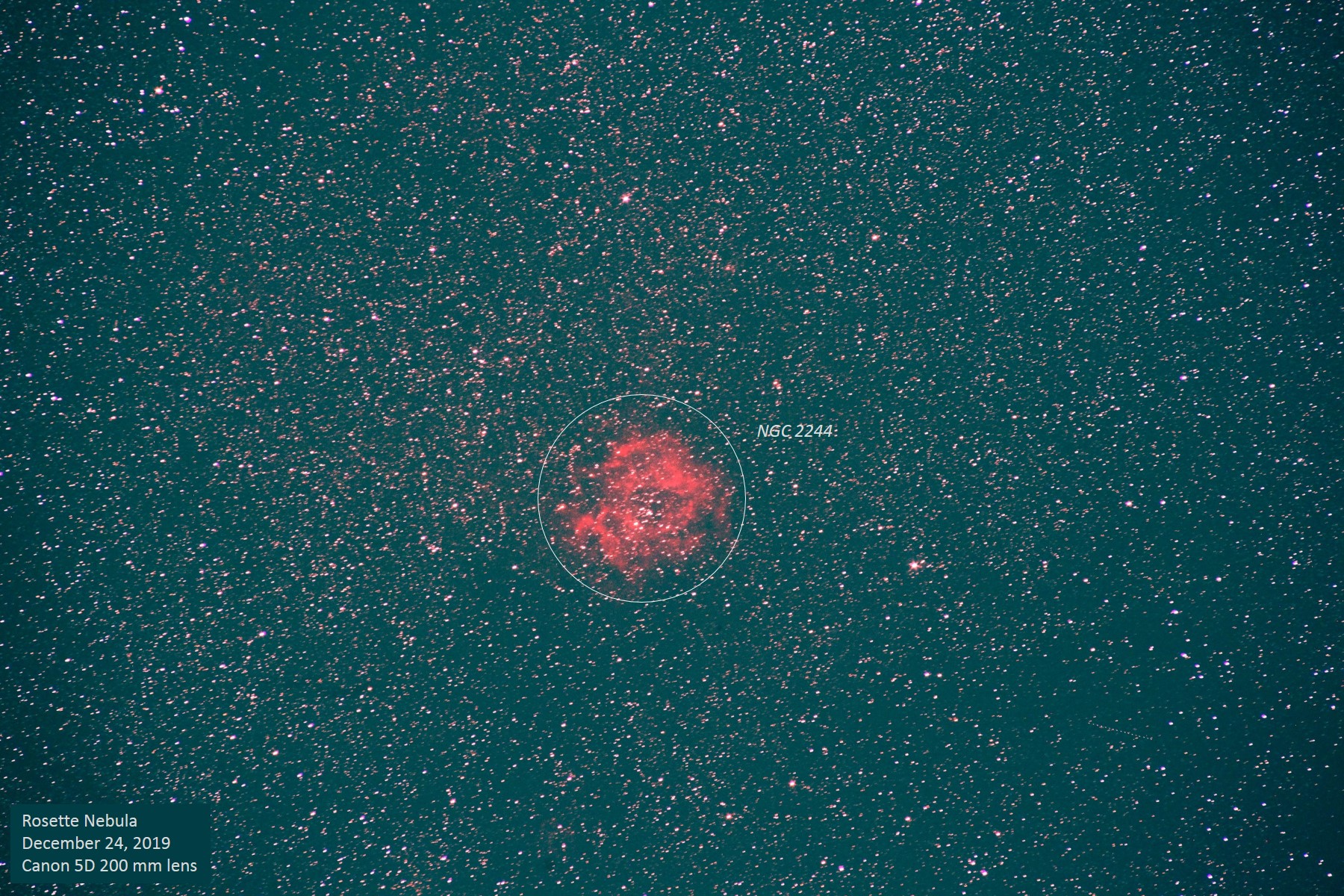 |
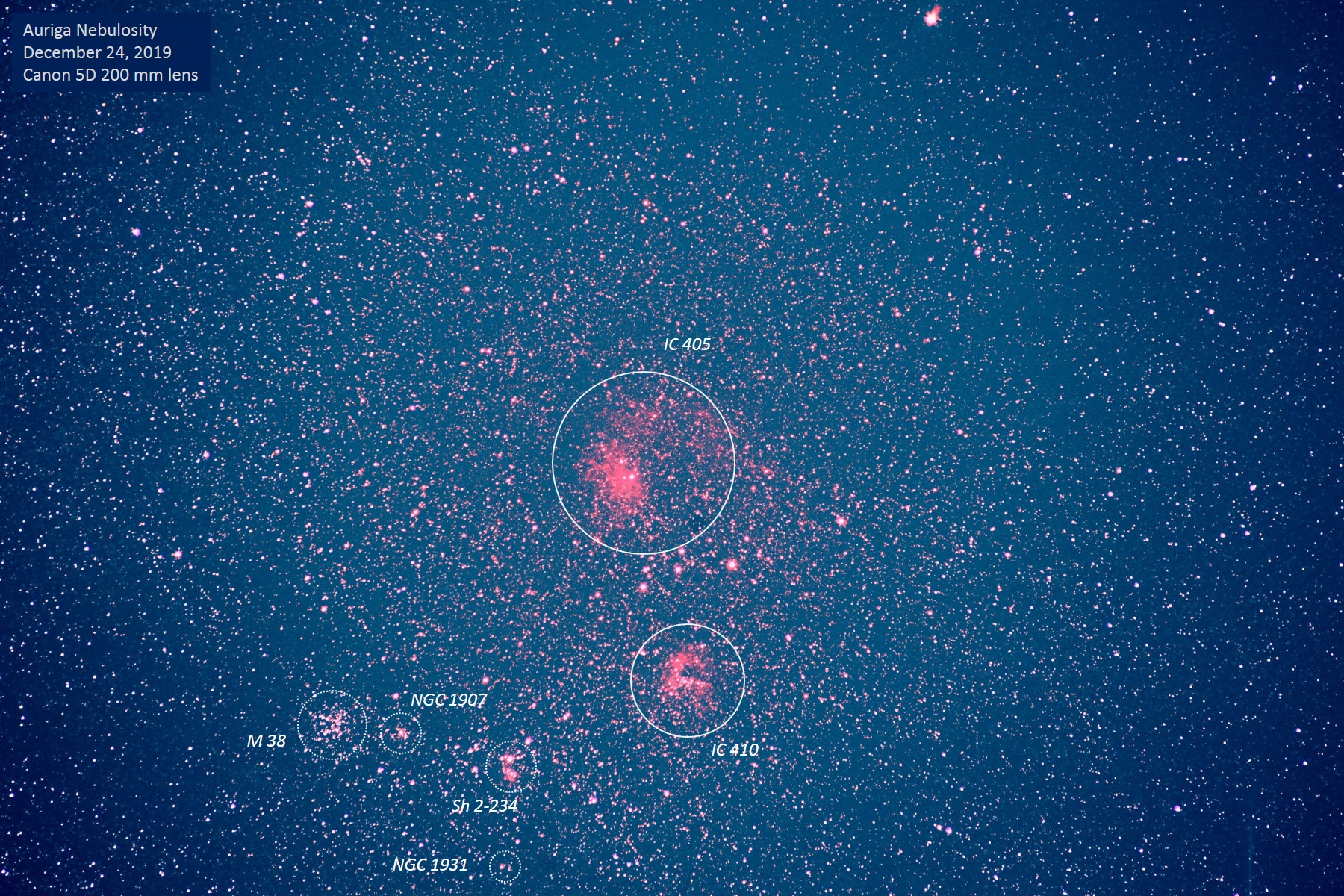
December 24, 2019: Central Auriga and Rosette Nebula With my modified Canon 5D, I took some pictures of central Auriga and the Rosette Nebula late in the evening, just before midnight on Christmas Eve. Deep images of the area reveal that the entire region is awash in emission nebulosity. My image was taken just before midnight on December 24, 2019. The Rosette Nebula shows up much better than the nebulosity around the Christmas Tree cluster at the top edge of the page. |
|||
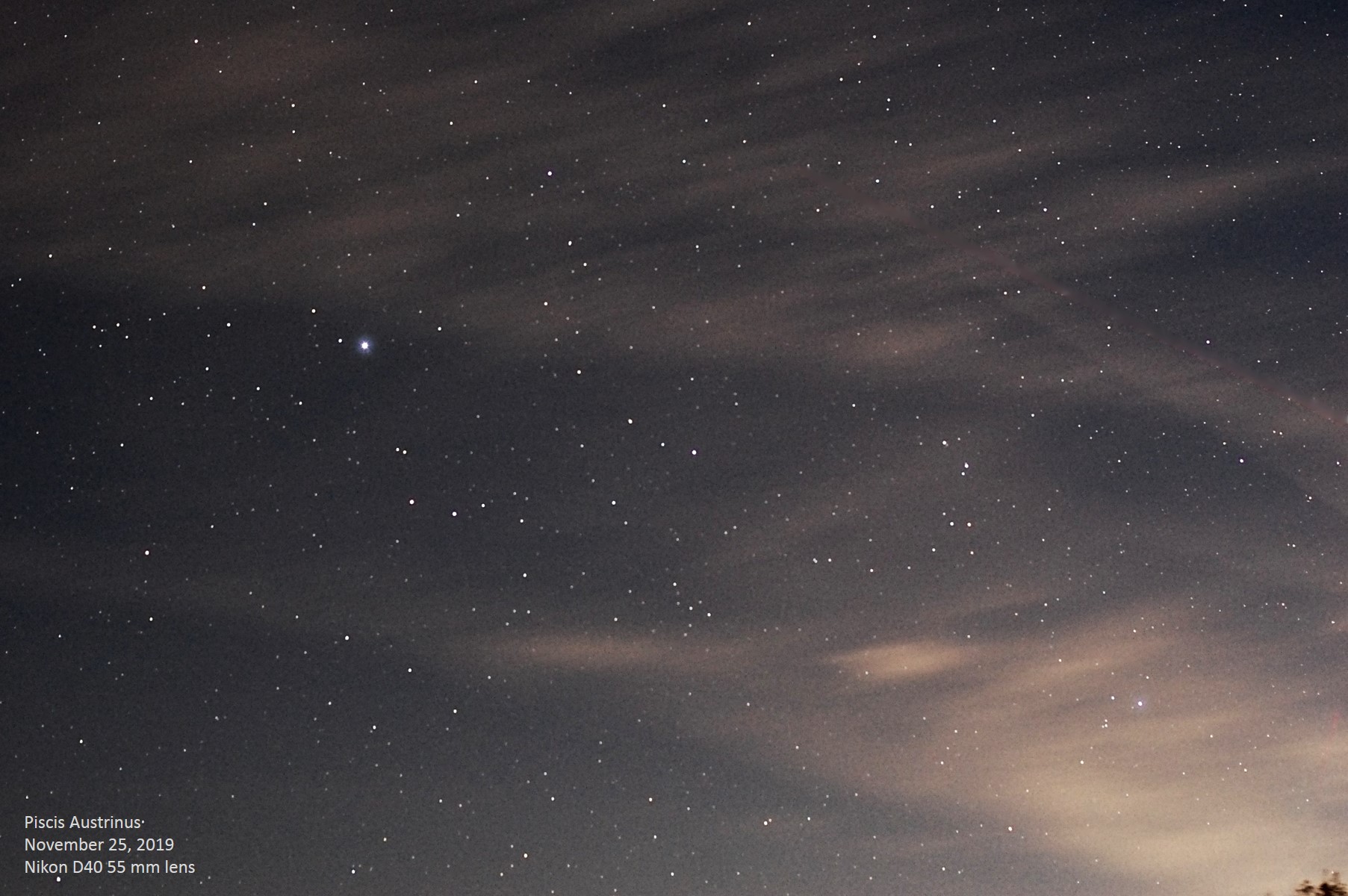 |
November 2019: Southern Fish The southern fish on display early one late November evening; they've got Fomalhaut but otherwise they are not as interesting as their northern finfriends. I read that Fomalhaut was recently discovered to be a triple system, which surprised me since I didn't know it was a multiple star to begin with. It turns out the first companion discovered is several degrees to the south, which is annotated on the image as TW. It makes a nice little pair with an unrelated star of about the same brightness. |
||||
 |
 |
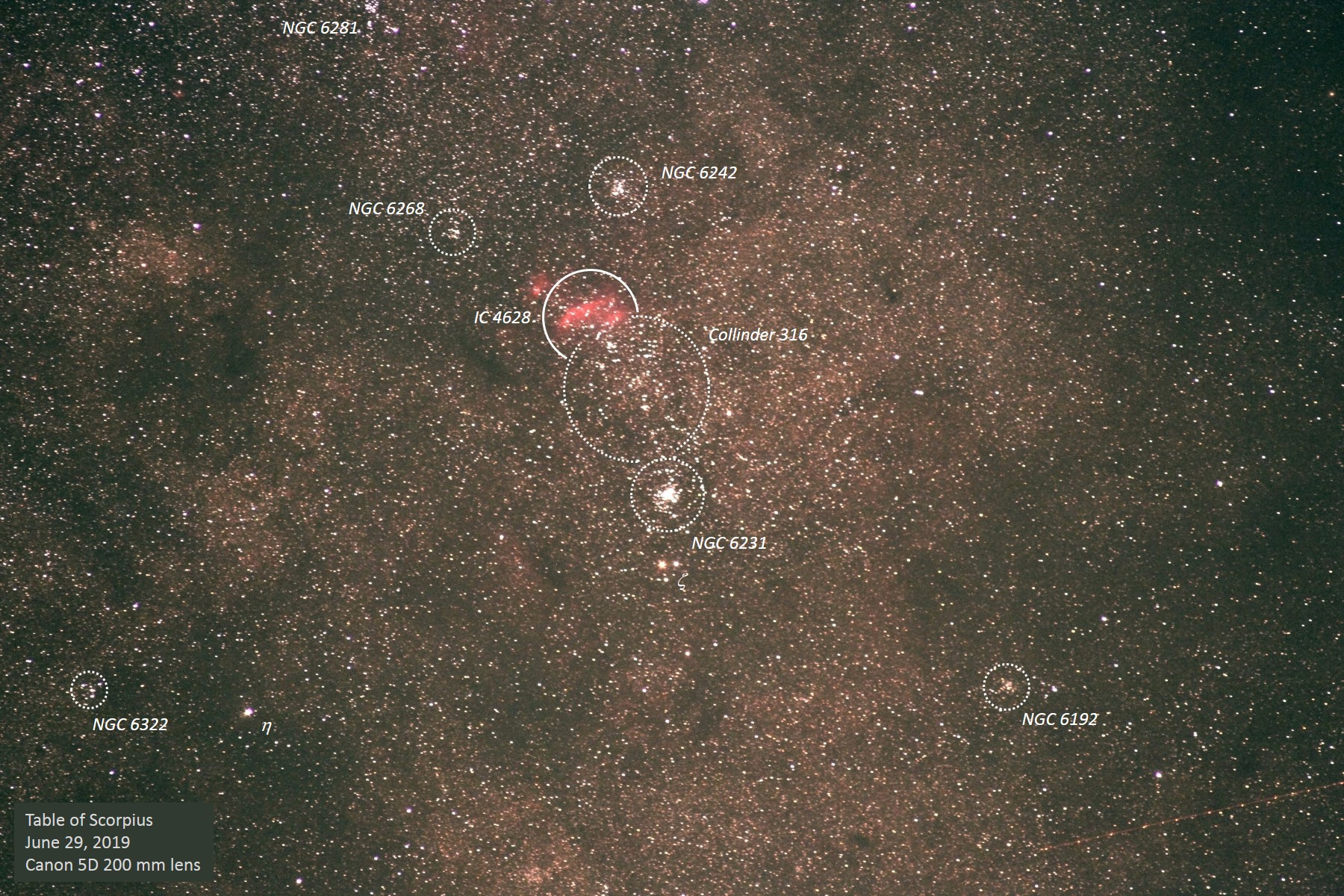 |
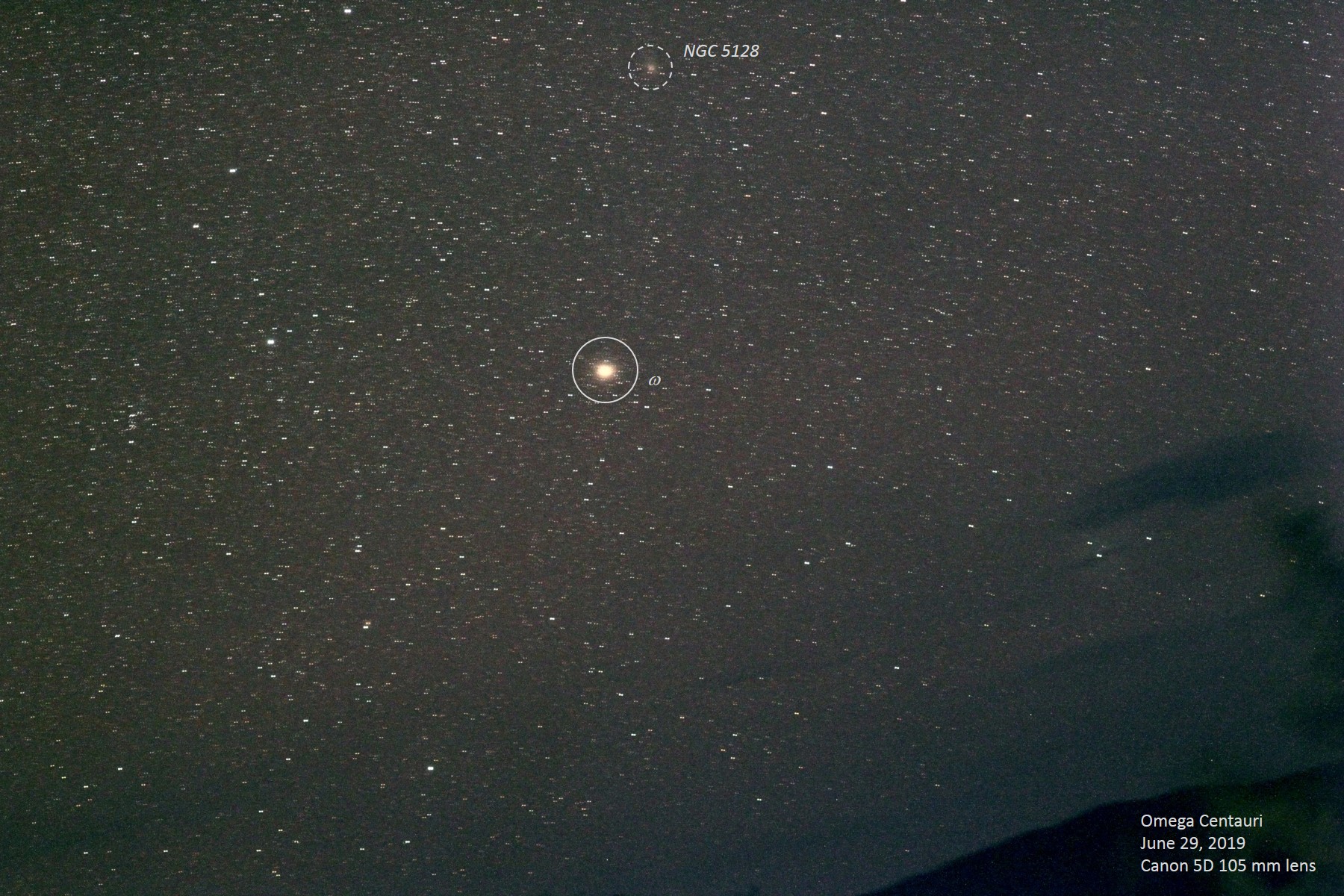
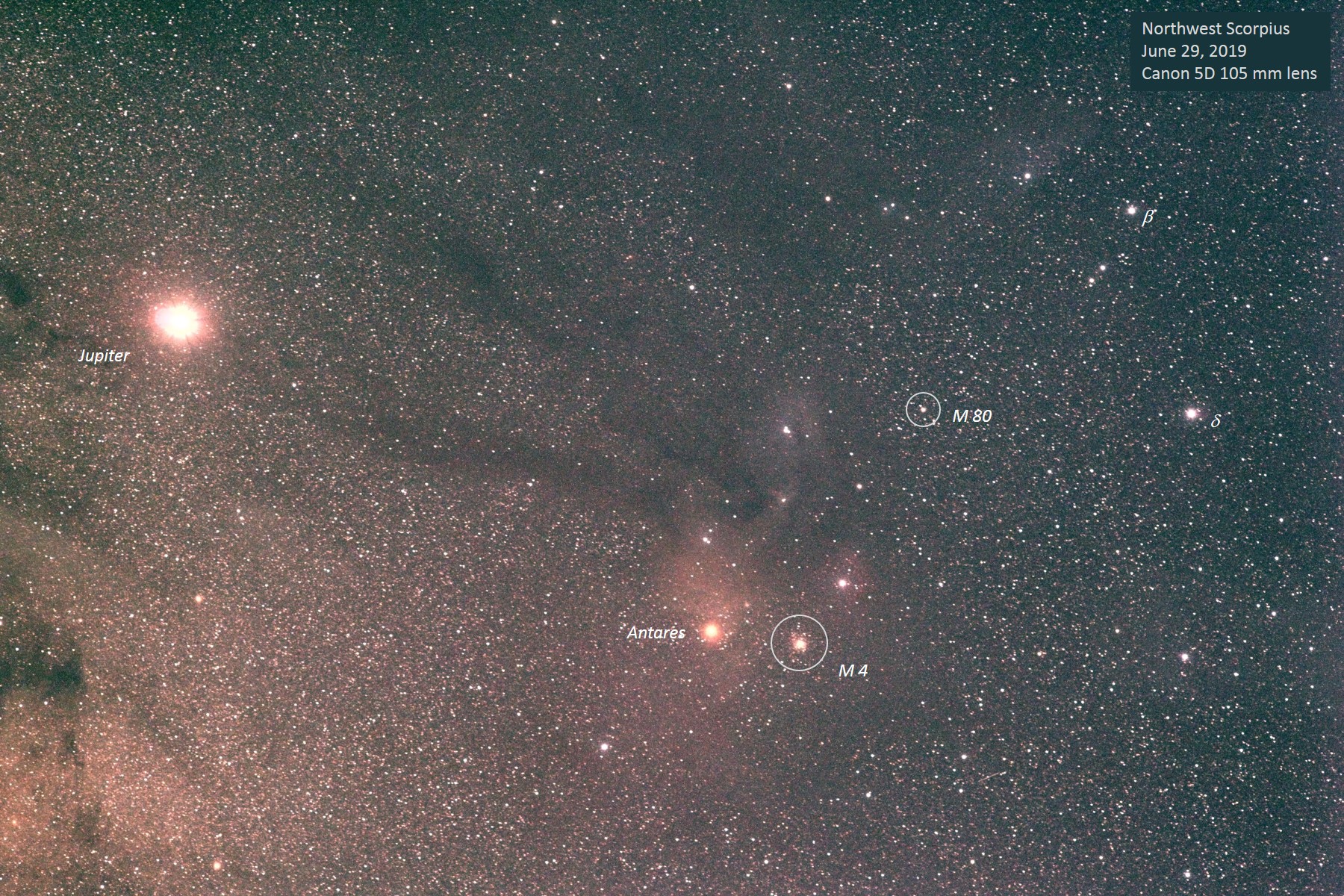
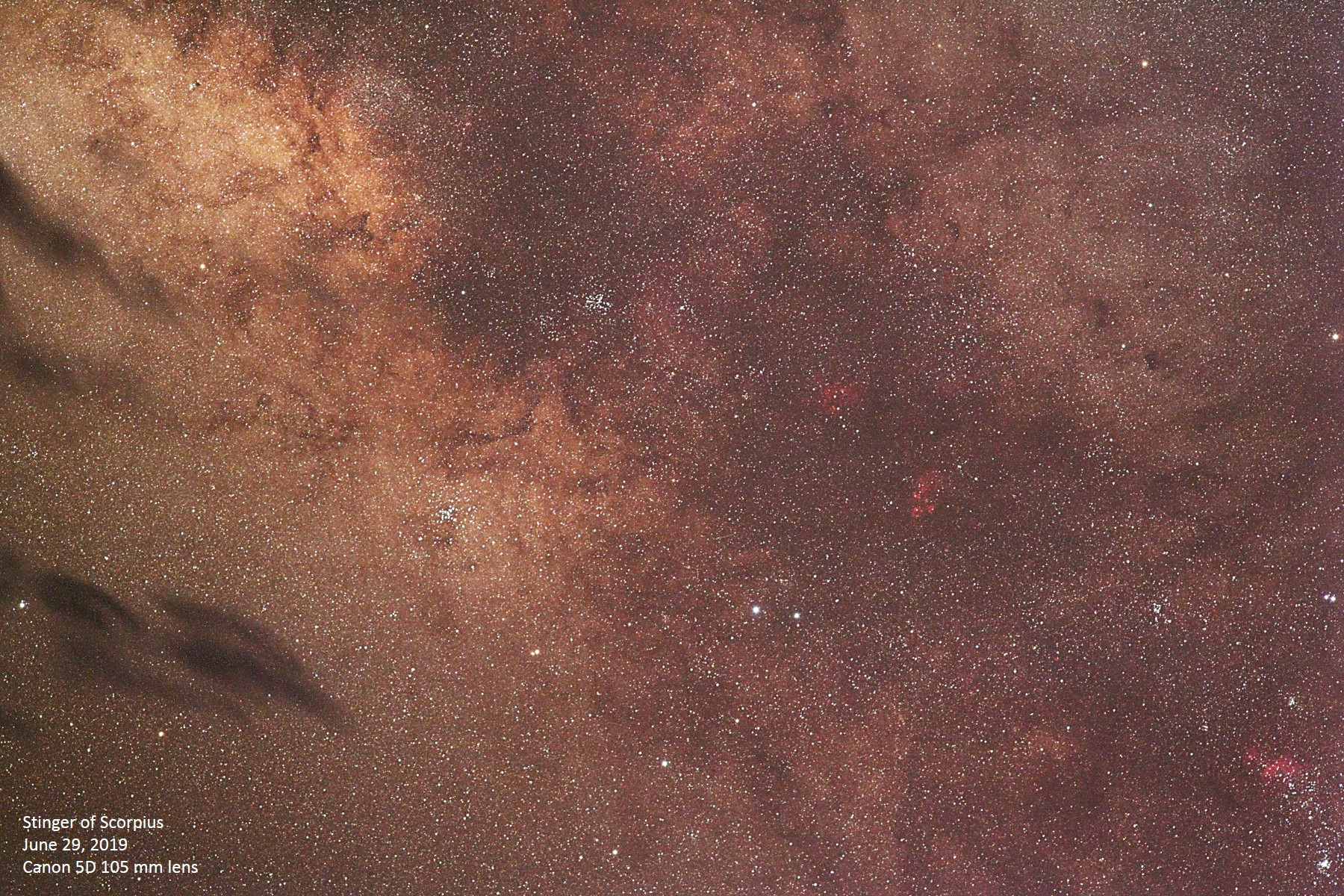
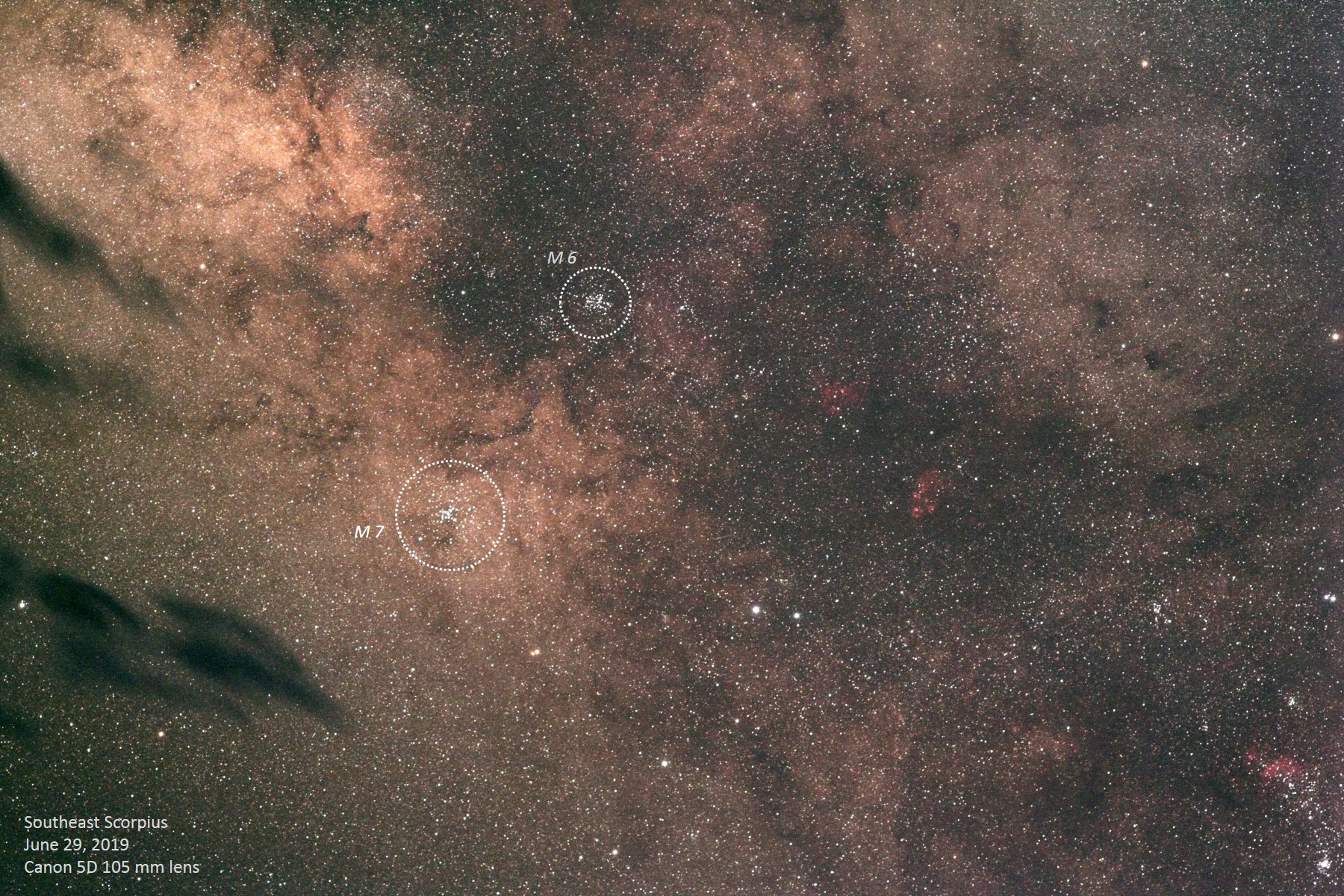
June 2019: Big Bend National Park These pictures were taken in Big Bend National Park on June 29, 2019 from a parking lot in Rio Grande Village with my modified Canon 5D camera piggybacked on a Celestron C8 telescope. |
||
|
 |
||||