Planet Scenes 2016
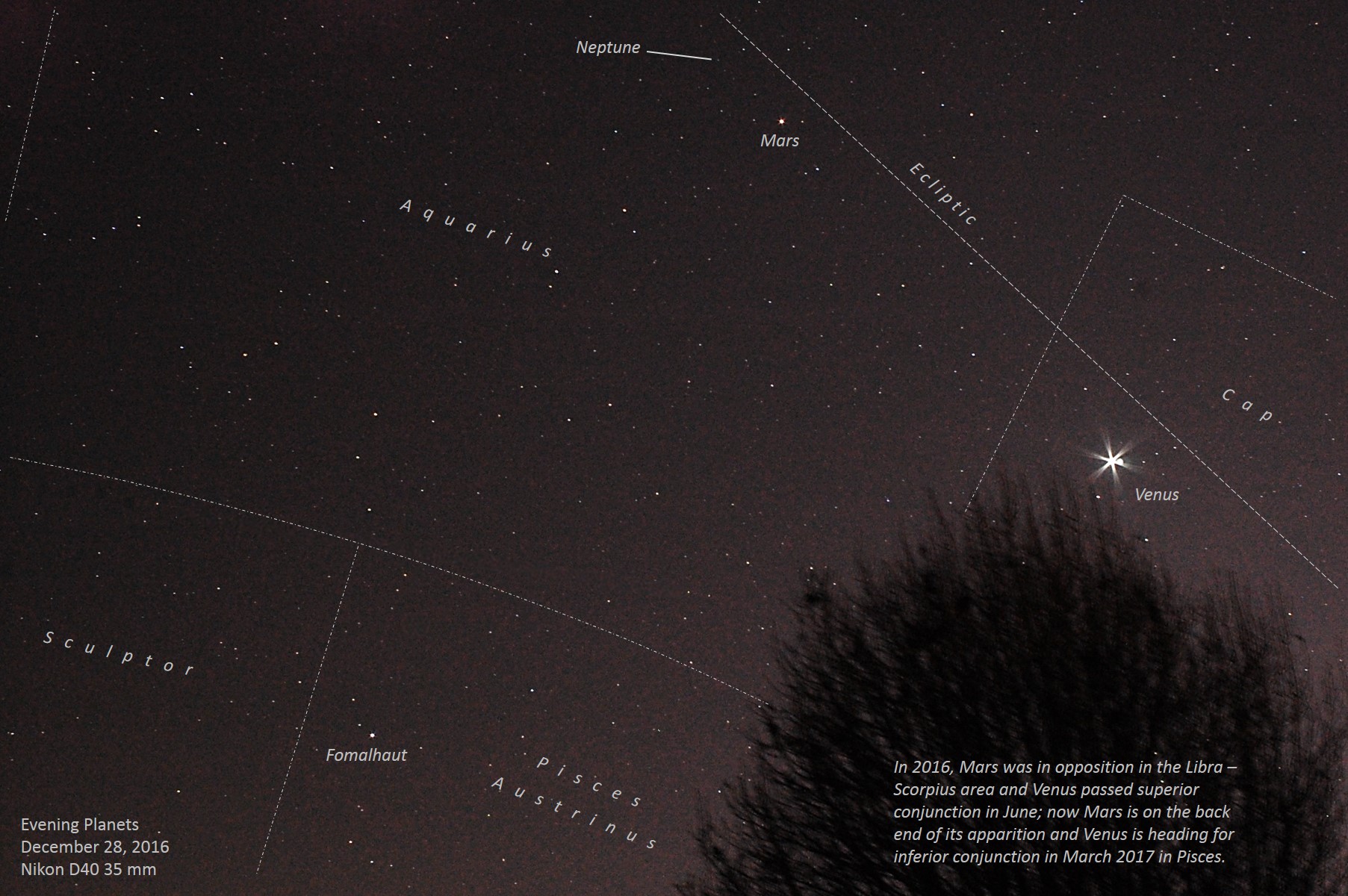 |
Venus, Mars and Neptune, Dec 28 We finally get an opportunity to capture all three planets in one view, from Venus still located in Capricornus to Mars and Neptune in neighboring Aquarius. Please excuse the mis-spelling of Piscis Austrinus! |
|
 |
Mars and Neptune in Aquarius, Dec 20 Mars is still bright despite being over six months beyond its opposition time, and by now has just moved into Aquarius to join Neptune. |
|
 |
Venus and Mars in Capricornus, Dec 10 Venus is finally gaining significant altitude now so its visibility is improving dramatically. Here we see her on the western side of Capricornus while her War brother has his bivouac on the east side of the constellation. |
|
 |
Neptune in Aquarius, Nov 27 A month after recording the position of Uranus near its opposition, I went back to locating and imaging his fellow ice giant in Aquarius. Neptune was at opposition back on September 2, so we are now almost 3 months past its peak time of visibility. |
|
 |
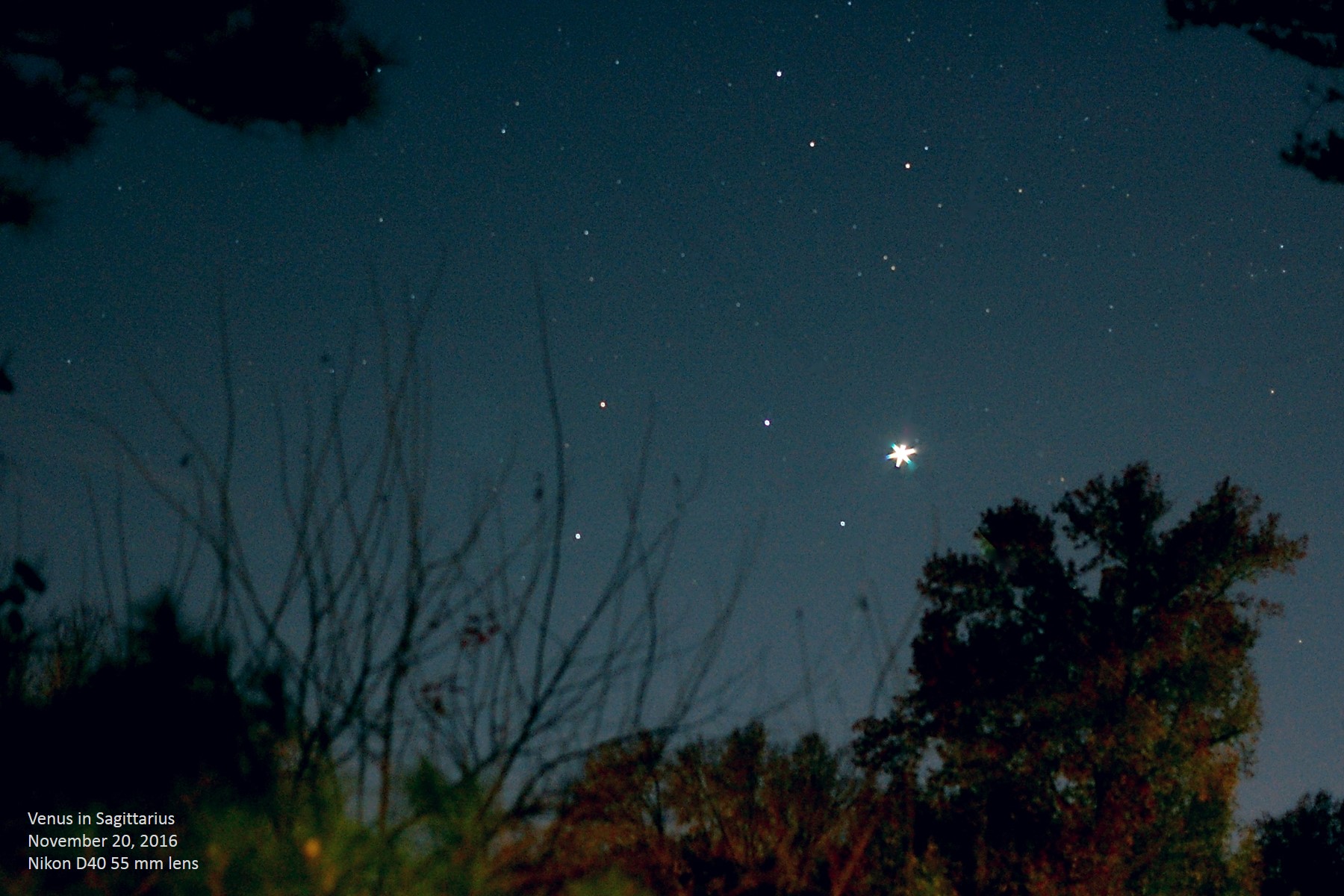 |
Mars in Capricornus and Venus in Sagittarius, Nov 20 Mars is way beyond its opposition time in Scorpius back in May, but still almost as bright as Betelgeuse as it moves across the skies of the Sea-Goat. Venus will pass by Mars later on during this evening apparition, but for now she is still close to the horizon after twilight ends, here reprising her 1984 movement through Sagittarius. |
 |
Uranus in Pisces, Oct 28 This shot of Uranus is screwed up in some way that I can't quite figure out ~ each star is doubled with a slightly smaller copy to its right. Maybe I bumped the camera tripod or something? At any rate, we see Uranus 13 days after opposition, and we can see how far it has moved compared to the last time we checked in on it, which was November 21, 2014. See that in 2014, Uranus was at the longitude of δ Piscium, but now it has moved beyond ζ Piscium. |
|
 |
Venus and Moon in Libra, Oct 3 Venus and the crescent Moon gathered in the evening sky near the star with the best name in the heavens, Zubenelgenubi! The 105 mm lens really lets you see the duplicitous nature of the star. |
|
 |
Venus, Jupiter and Mercury, Aug 28 A very close conjunction of Venus and Jupiter occurred in late August, which was augmented this time by Mercury. I did not get a picture of it nor did I observe it, so it must either have been a result of poor weather or being to busy with moving into my rental house. Because this event is so important in the ken of planetary alignments, I found a great picture of it taken by Luke O'Brien of Australia. |
|
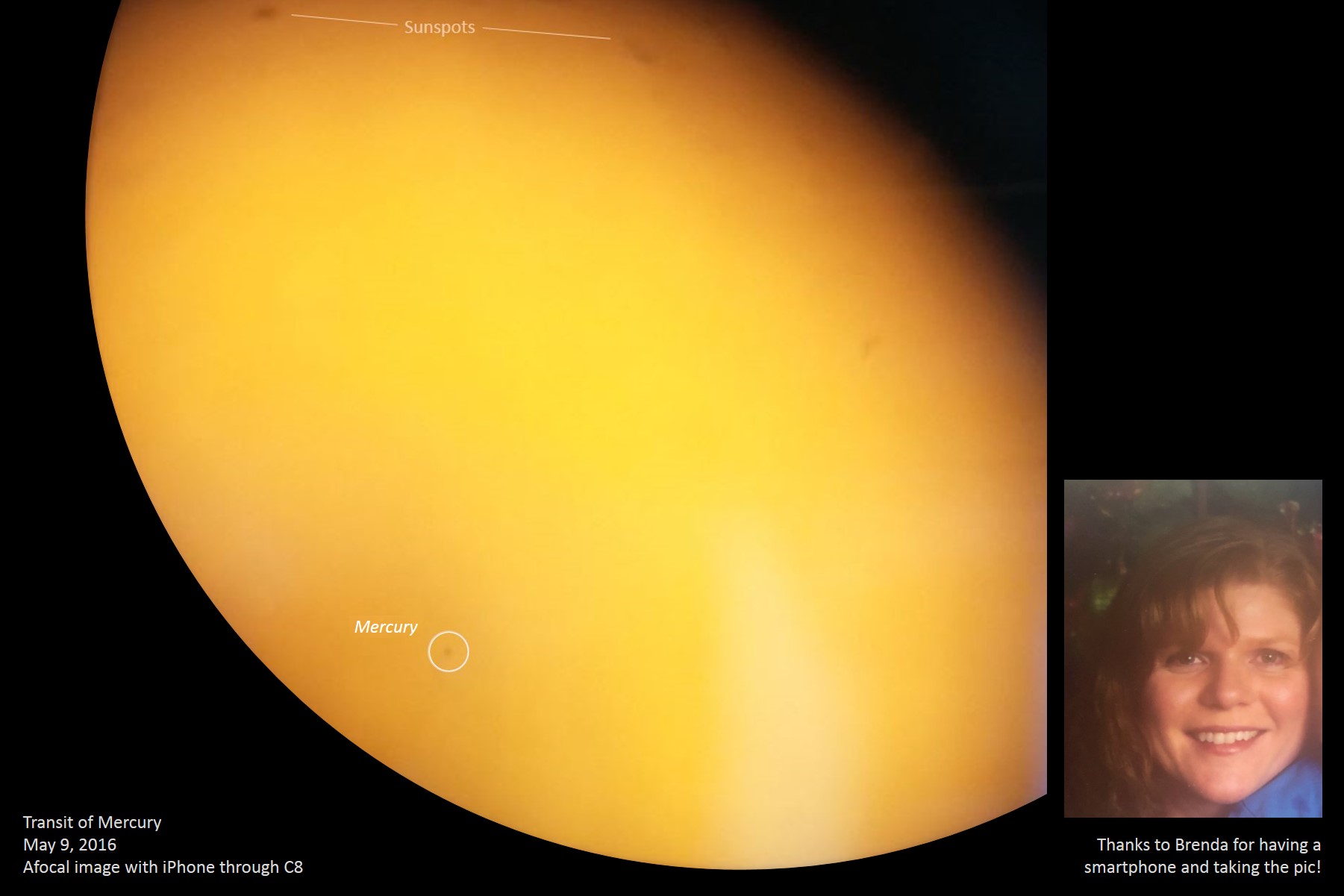 |
Mercury Transit, May 9 A fairly rare event occurred this year, namely a transit of Mercury. This is when Mercury goes through inferior conjunction, passing between the Earth and the Sun directly so that one can see the tiny black dot of Mercury against the face of the Sun. I observed this event at work in the parking lot by using my Celestron C8 telescope and a white light solar filter. One of my friends, Brenda Baird, used her smart phone to record the scene afocally. |
|
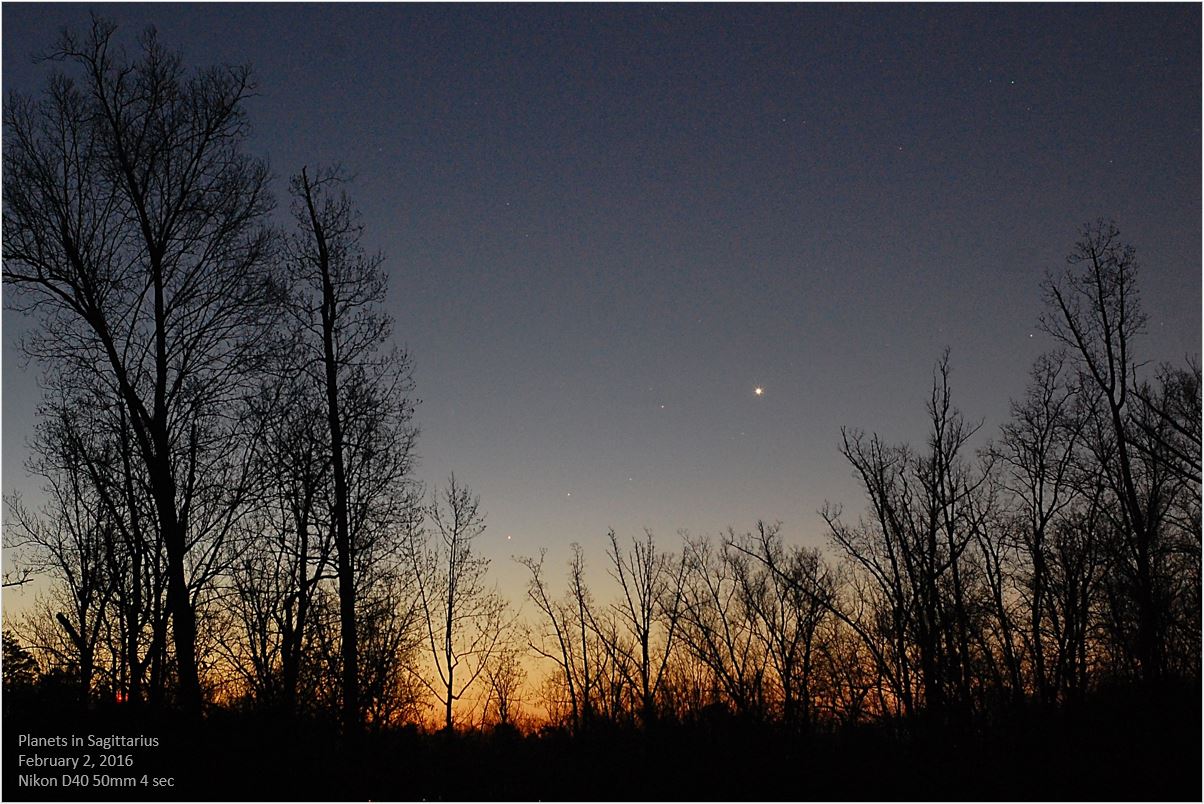 |
Venus and Mercury, Feb 2 Venus is joined by Mercury in the Teaspoon area of Sagittarius on this mid-winter morning. |
|
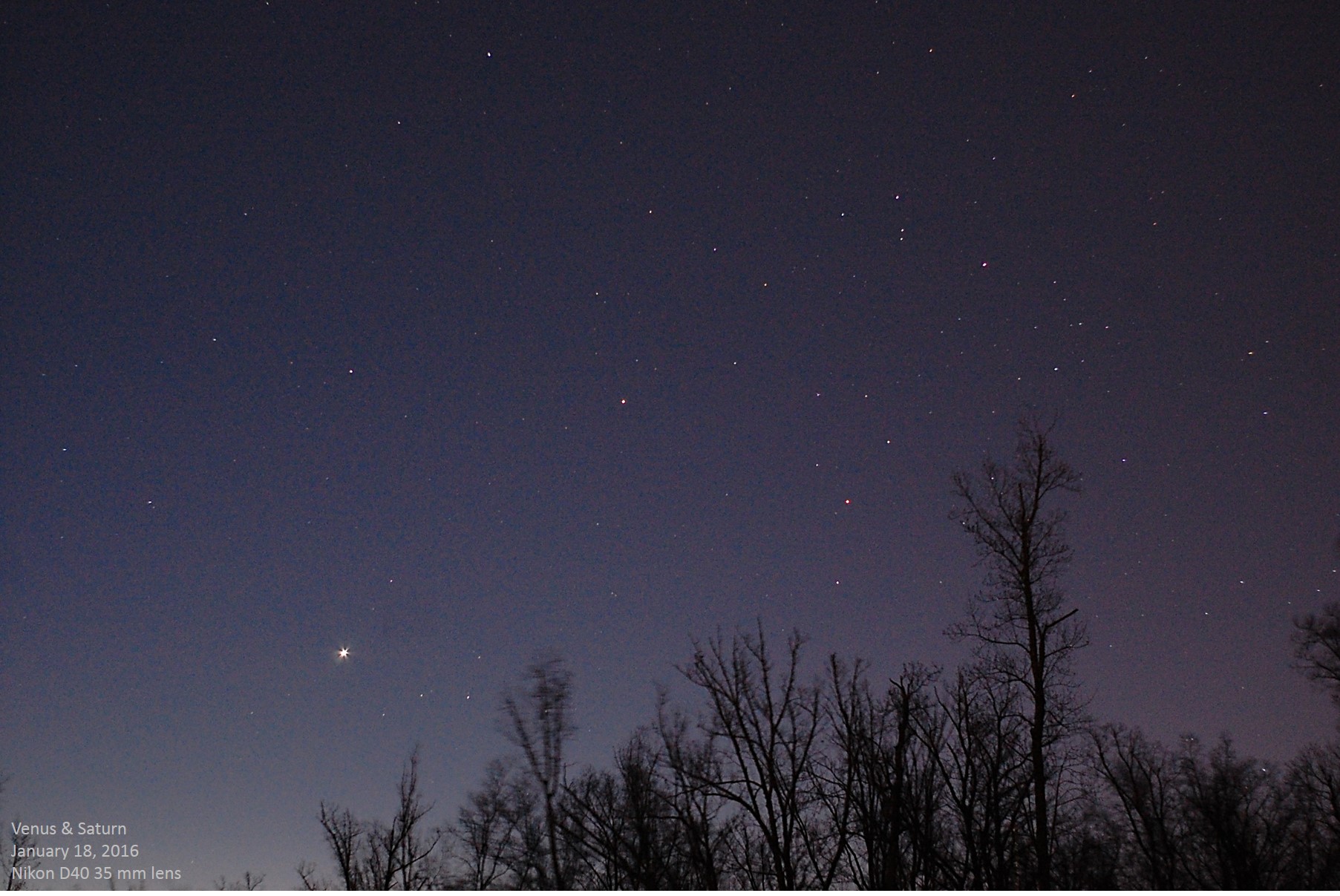 |
Venus and Saturn, Jan 18 Venus is still in the middle of its morning apparition that started in August 2015, but it will lose altitude rapidly as it traverses the ecliptic in Sagittarius, Capricornus, and Aquarius. Saturn is going to spend most of 2016 in the area of Ophiuchus near the star Antares, much like it did in 1987. |
|
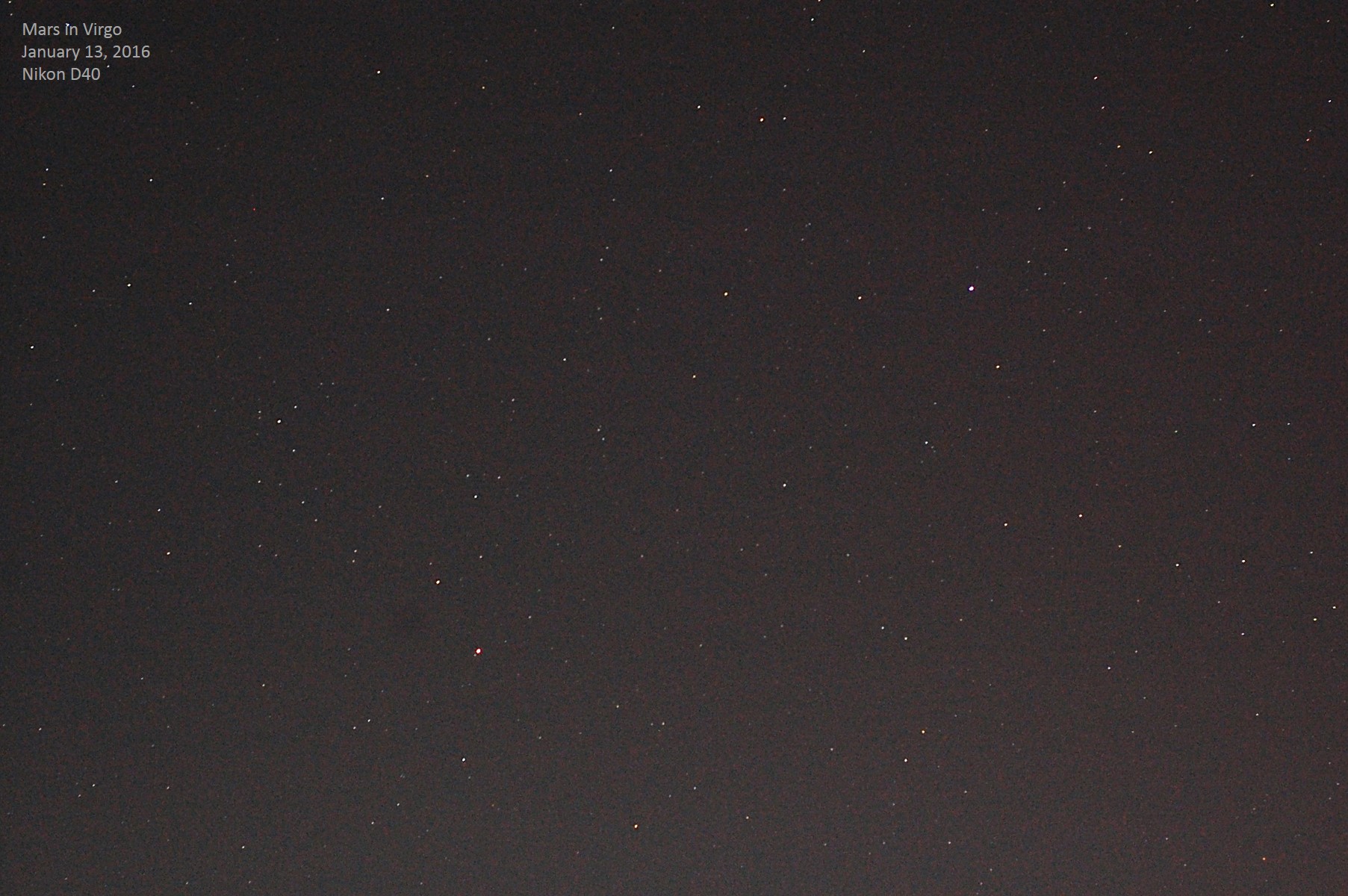 |
Mars in Virgo, Jan 13 The year 2016 is an opposition year for Mars. It will occur on May 22, in the head of Scorpius, near to the border of Libra. Thus, from now until then, Mars will be moving at an ever slower rate along the ecliptic from Virgo through Libra into Scorpius. Here we see Mars in eastern Virgo, still rather dim but brightening. |
|