In late August 2016, the planets Venus, Jupiter, and Mercury engaged in a series of conjunctions very low in the evening sky. Owing to the low angle of the ecliptic in the northern hemisphere during this time of year, and their limited elongation from the Sun, the conjunctions were very difficult to view from Virginia. However, observers in the southern hemisphere had a much easier time seeing the events owing to the steep angle the ecliptic makes in the west after sunset south of the equator. I was mov- ing from one house to another in August 2016 and as a result I didn't make an attempt to observe much less photograph the conjunction. However, in terms of planetary conjunctions, it was important enough that it deserves some discussion, as well as showing some of the amateur images taken at the time.
In 2016, Venus' year consisted of a morning apparition that started with a reasonable elongation west in January, then ever decreasing elevation until a superior conjunction on June 6, followed by a very gradual move into the evening sky, very low for months, but finally at the end of the year becoming a an easily observed evening star high in the southwest. Jupiter spent most of 2016 in Leo, arriving at opposition on March 8. Once it completed its retrograde loop, it resumed eastward motion and ended up in Virgo by the end of the year. Our conjunction materialized as Venus, moving rapidly eastward as it moved from Leo into Virgo, passed by Jupiter which had also just moved into Virgo. Observers south of the equator were also able to easily see Mercury south of the two bright planets, but for those of us in the northern hemisphere, the speediest planet was too low to be seen in the days immediately prior to and after the Jupiter-Venus conjunction.
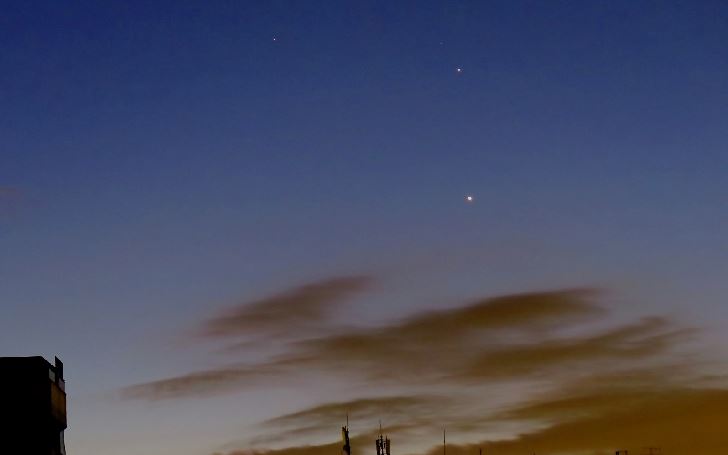
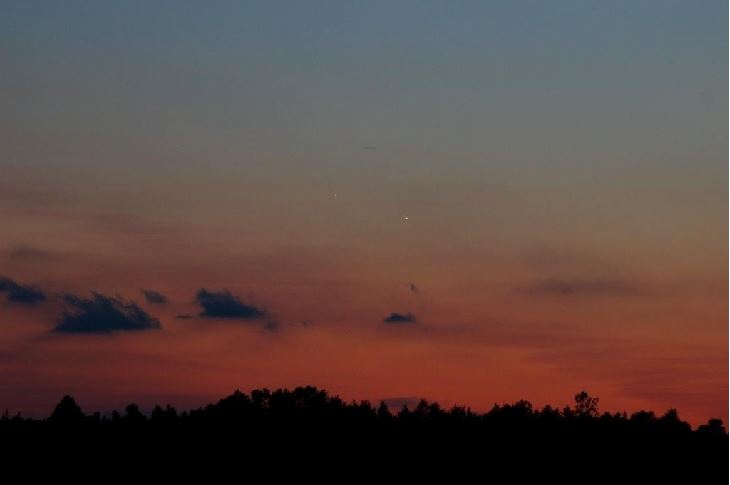
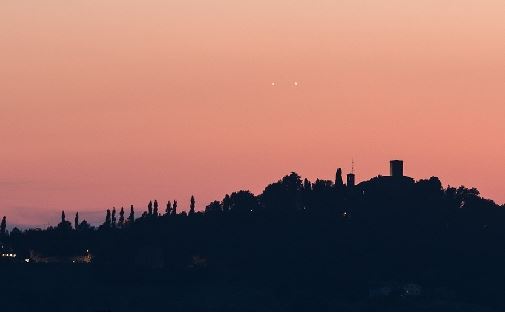
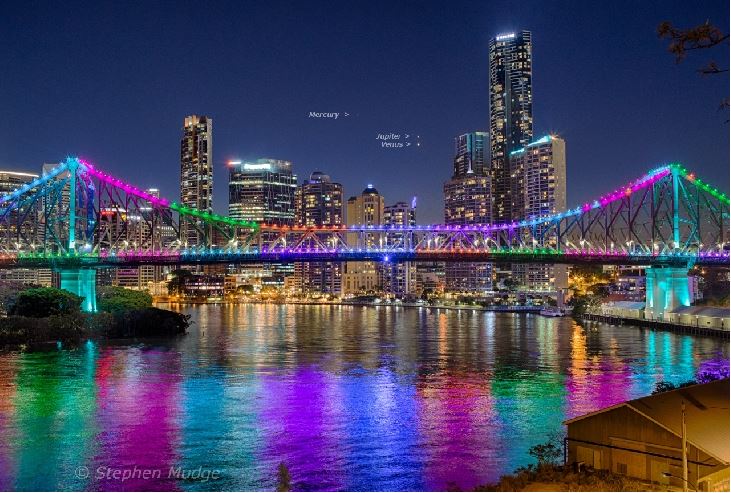
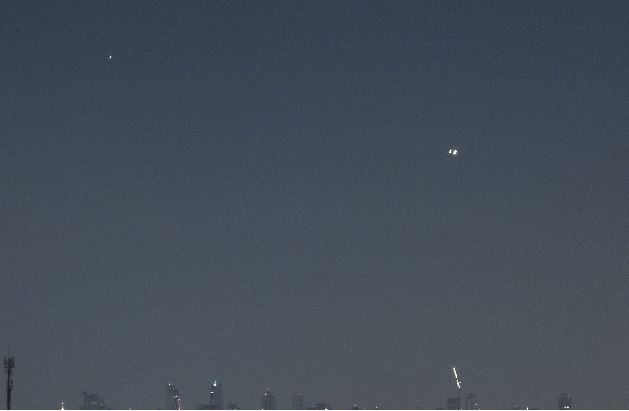
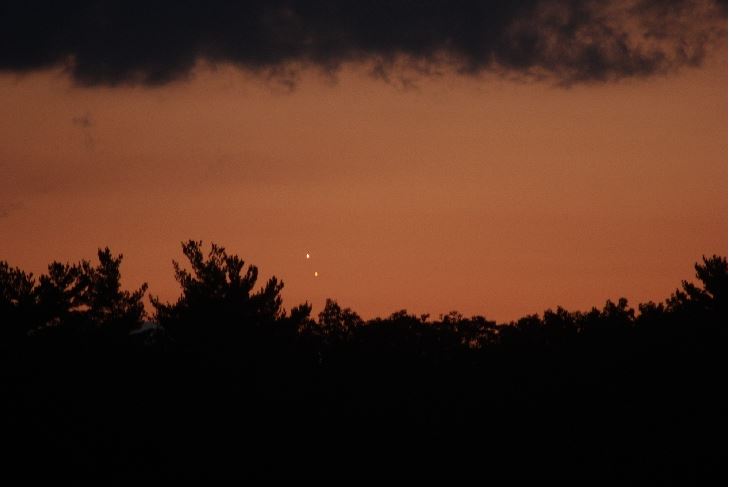
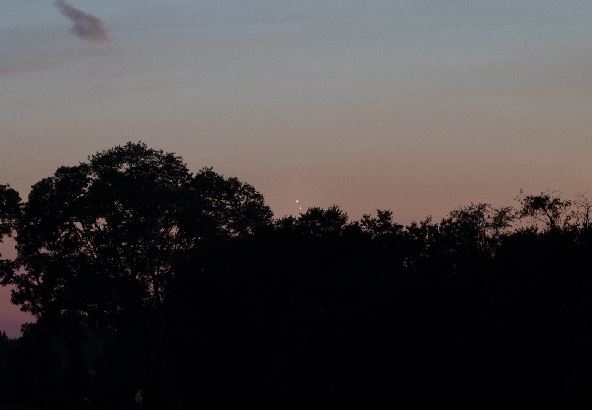
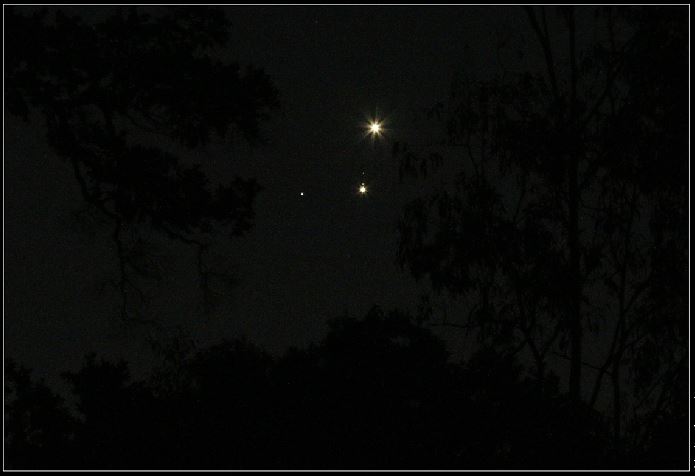
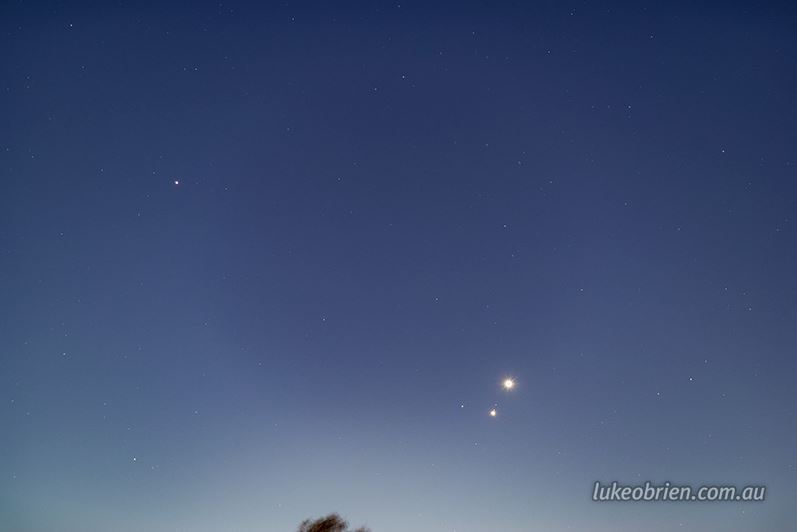
The images at right span the time frame of August 24 to August 28; most of the pictures were taken in the northern hemisphere but some are from South America and Australia. Those images show the planets higher in the sky against a darker background, while in the northern hemisphere pictures, the planets are hugging the horizon. The middle picture in the left column, by Luke O'Brien of Australia, mirrors most closely what I would try to capture if I could get the planets in a dark sky. His image was from August 28, with Zavijava just to the left of Jupiter and Mercury at upper left of the Venus - Jupiter pair.
At the time of closest separation, which occurred on August 27 at around 22:30 UT, the distance sepa- rating the two planets was around 4' arcminutes. This would have been at 18:30 hours EDT on the 27th, but they were still very close together the next evening (the 28th). Venus was at magnitude -3.9 that evening, Jupiter was -1.7, and Mercury was about +0.8. In some of the pictures I included here, Venus and Jupiter are very close to the star β Virginis, otherwise known as Zavijava.
How does this conjunction fit into the longer term pattern of Jupiter-Venus conjunctions? Given their 24-year repeating pattern, the prior instance of this characteristic alignment was in August 1992; at that time I was living in Boulder, Colorado, but I don't recall observing or photographing the event. The next event in this series is 2016 + 24 = 2040, so I only have 14 years to prepare LOL.
Hover over the last image in the right column to see how the view from Australia would have to be ro- tated in order to match the view from my latitude of Virginia. The view is oriented so that the hori- zon is parallel with horizontal; as can be seen in Luke O'Brien's rotated image, Mercury is far below the pair of bright planets from a northern hemisphere perspective.