The first transit of Venus since the late 1800's occurred in the eastern United States during the morning hour after sunrise. As the Sun rose, the transit was already well underway, so as a result, we were only able to observe the final third of the event. Unfortunately, here in east central Virginia, the weather wasn't great, so there was a significant amount of haze and clouds that obscured the Sun. We were not even able to see the it at the time of its rising, only catching sight of it after it had climbed several degrees above the horizon.
I observed the transit with my 84-year old father from the naval base in Dahlgren, Virginia, from a treeless area looking east over the Potomac Ri- ver toward Maryland. The transit ended around 7:17 a.m. Eastern Daylight Time, but clouds thickened and obscured the view ten or so minutes before then, which is about the time of the picture I was able to take. In hind- sight, I would probably travel to a location with a greater potential for clearer weather rather than observing it under such sketchy circumstances.
We used various binoculars, including 10x50 and 20x80 models with solar filters, and a Meade 2045 4" SCT telescope, to observe the transit. The camera I used was a Nikon FE2, to which I attached either a 200 mm zoom lens or the 1,000 mm focal length telescope.
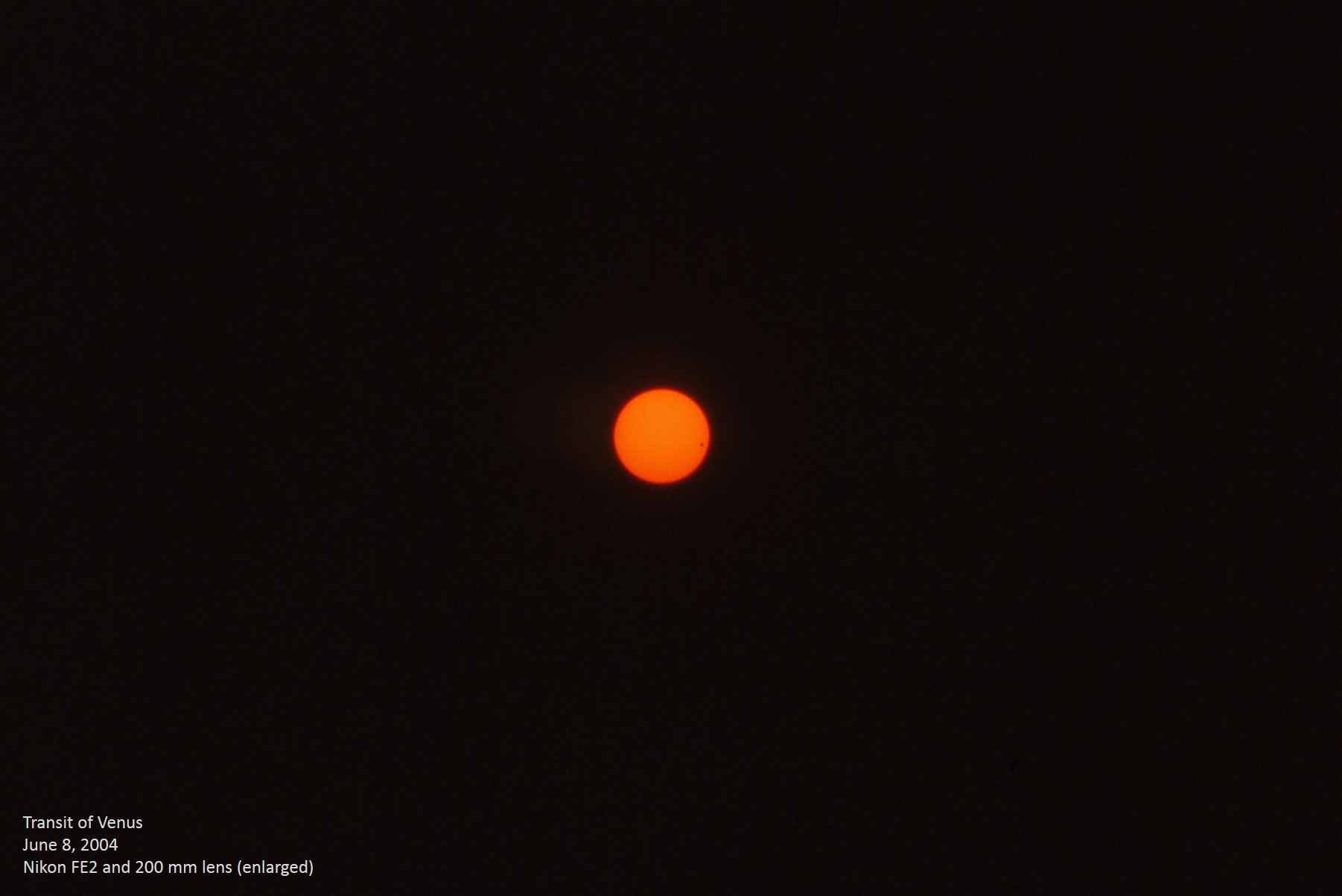
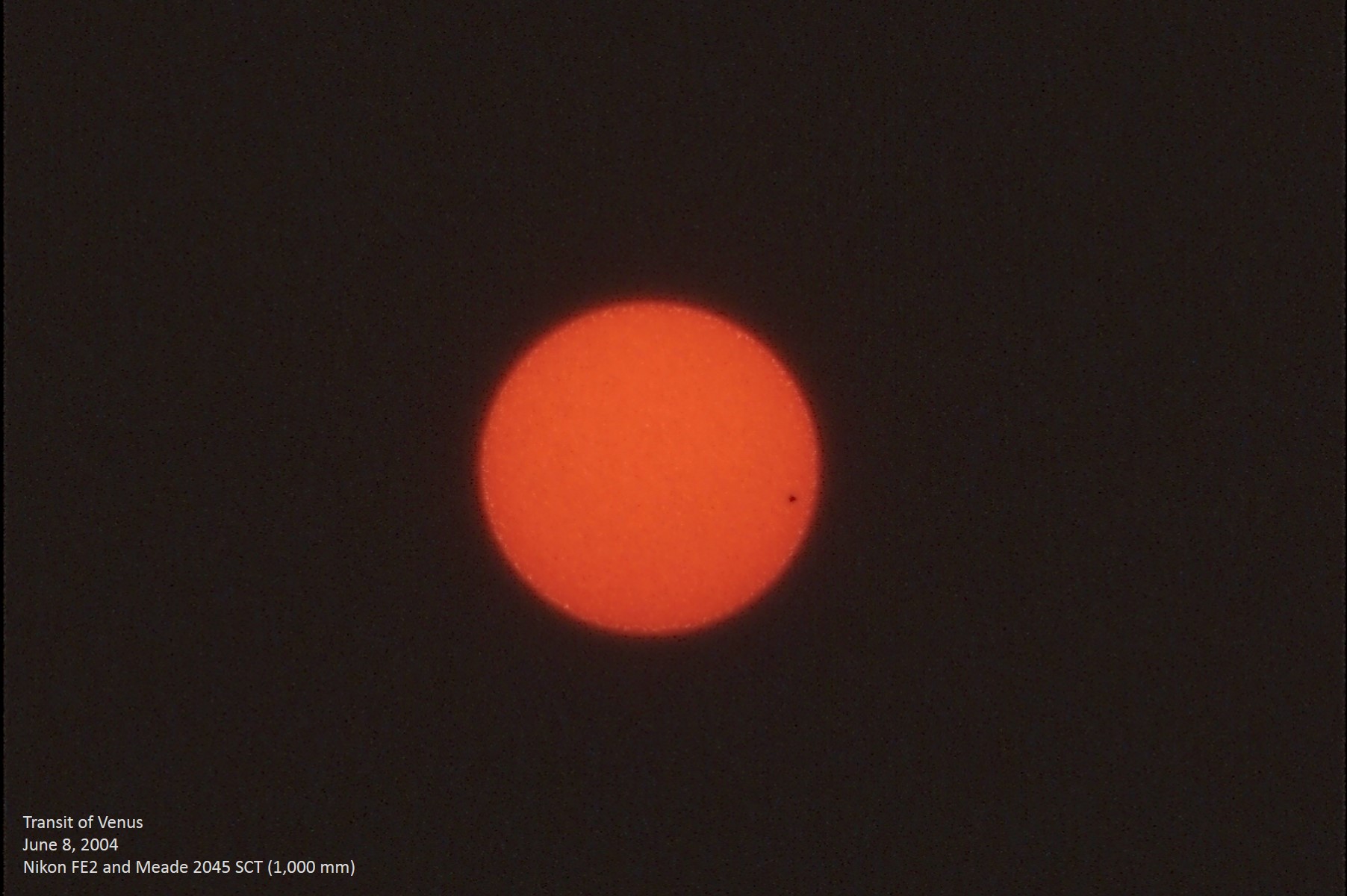
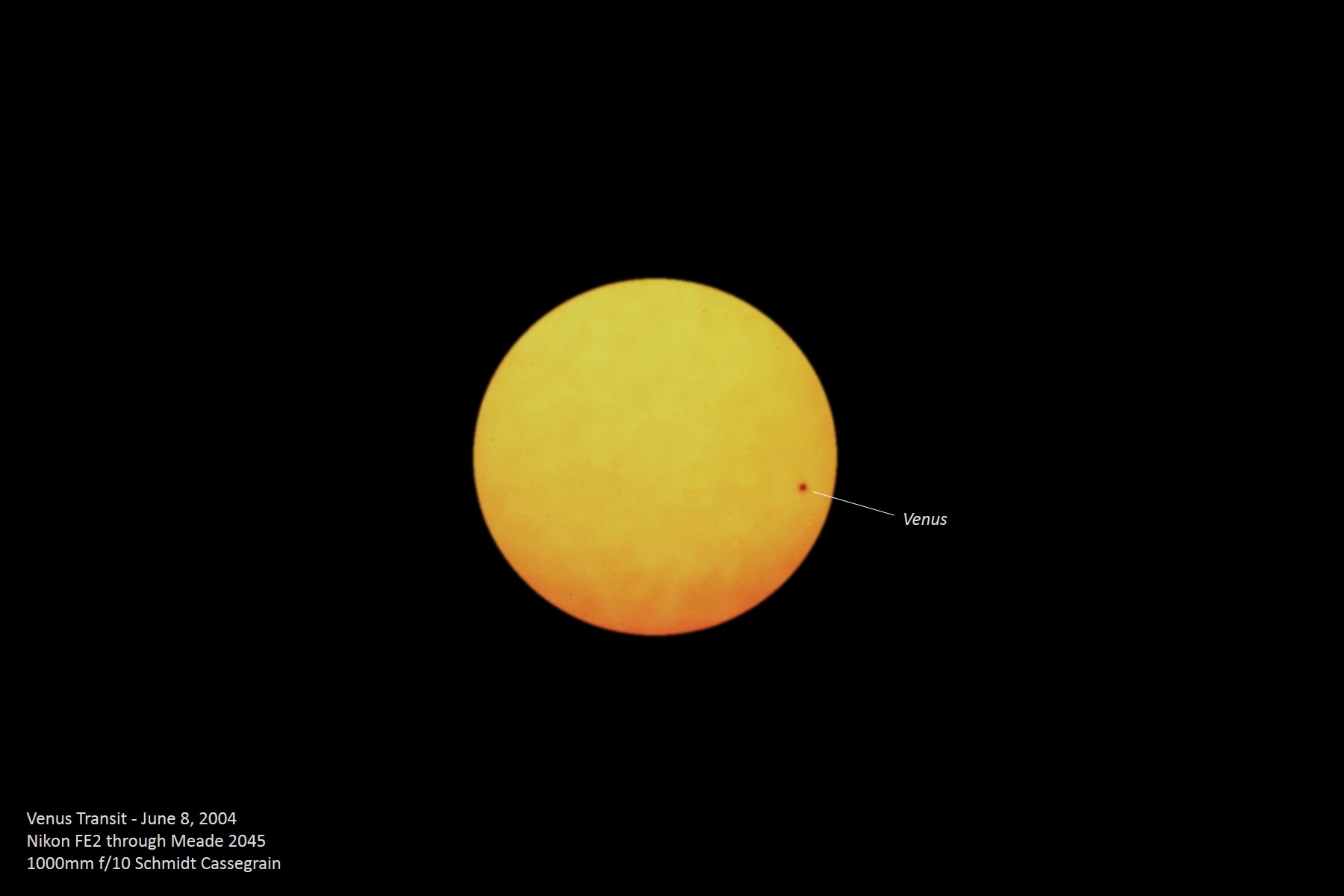
From western Europe or somewhere in the eastern Atlantic Ocean, or anywhere you could see the entire transit, you would see the black silhouette of the planet crossing the face of the Sun over a span of 6 hours, 12 minutes, and 30 seconds. If our horizon and weather had been perfect, we would have seen the final 1 hour and 27 minutes of the event.
The orientation of the animation to the left is close to what we experienced that morning. Venus' direction crossing the Sun, if solar north is oriented to up, was from about 8:30 on the clock to about 4:30, but since the Sun was rising in the morning from our vantage point, Venus made roughly the track I am showing in the animation. The picture I took was obtained near the end of that track.