|
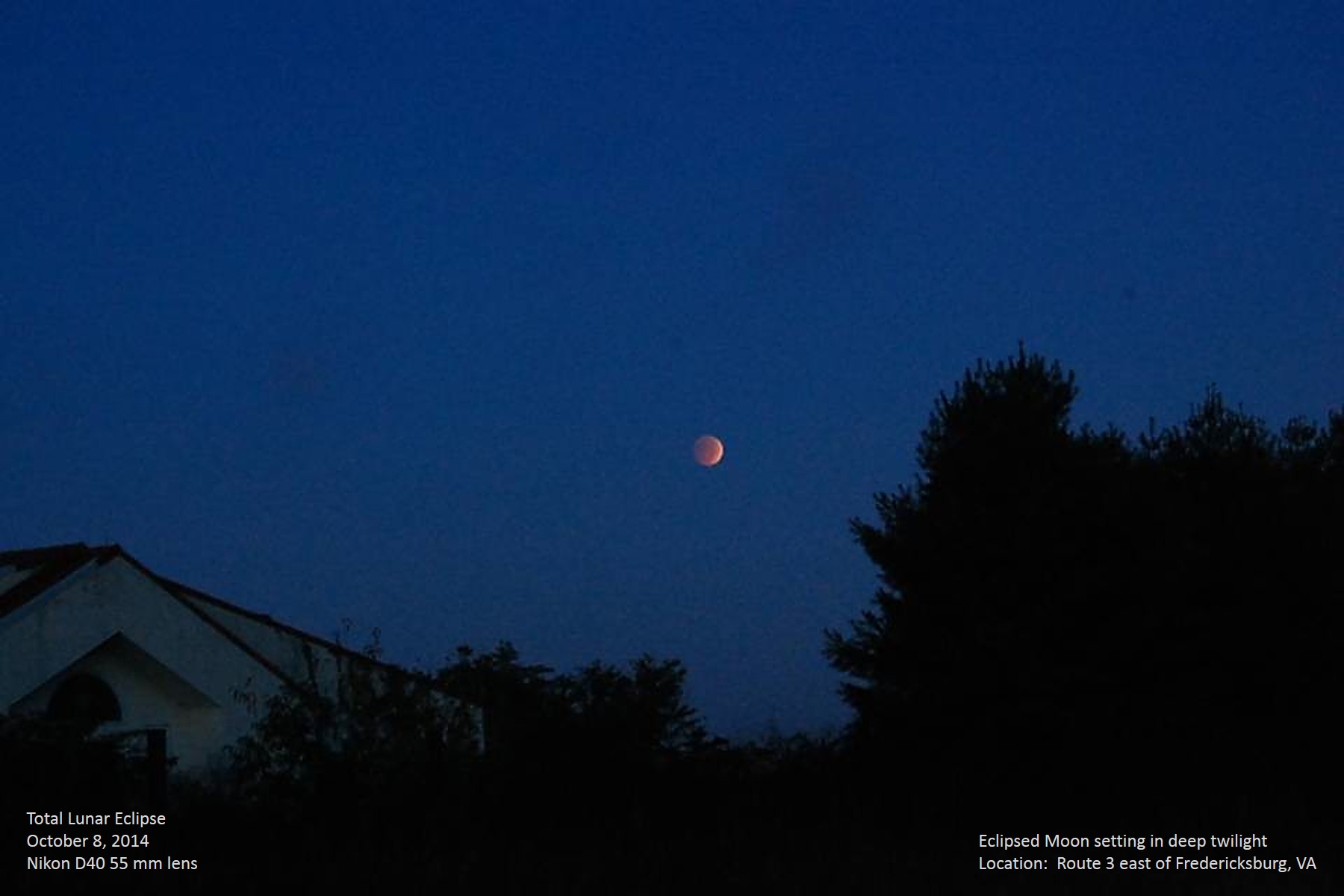
We were graced with a total lunar eclipse in early October, which we were
able to see in the morning hours before sunrise. In Virginia, the eclipse
began in darkness in the western sky but during totality, the sky started
to brighten due to the onset of twilight. I observed the event from Route
3 east of Fredericksburg because there are many points which offer a flat
western horizon, as well as hardstands for setting up tripods.
The eclipse occurred while the Moon was in Pisces, just prior to the Moon
moving through its descending node. This means that it travels across the
northern portion of the Earth's umbra, and thus that the northern part of
the Moon will be brighter than the southern section.
|
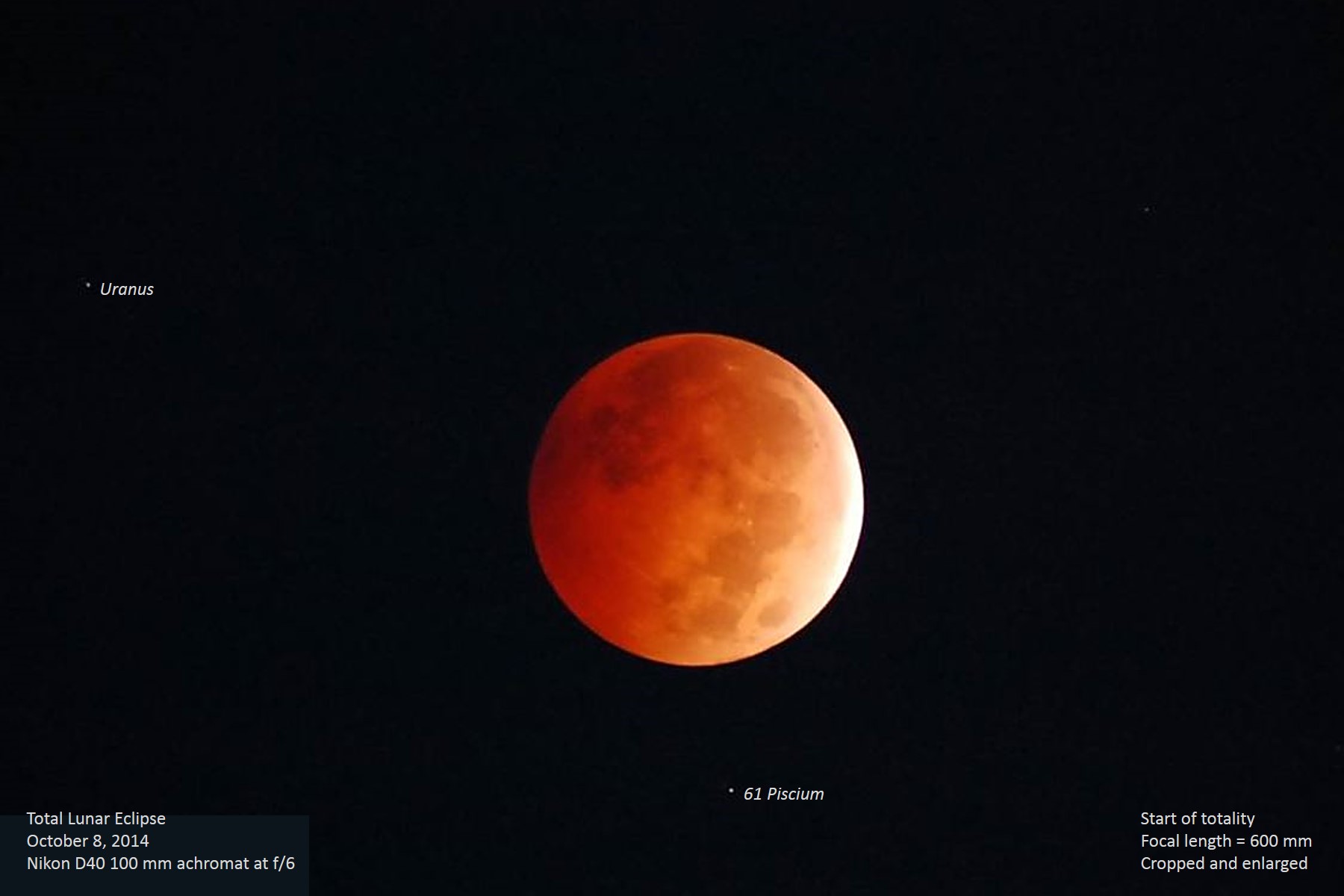
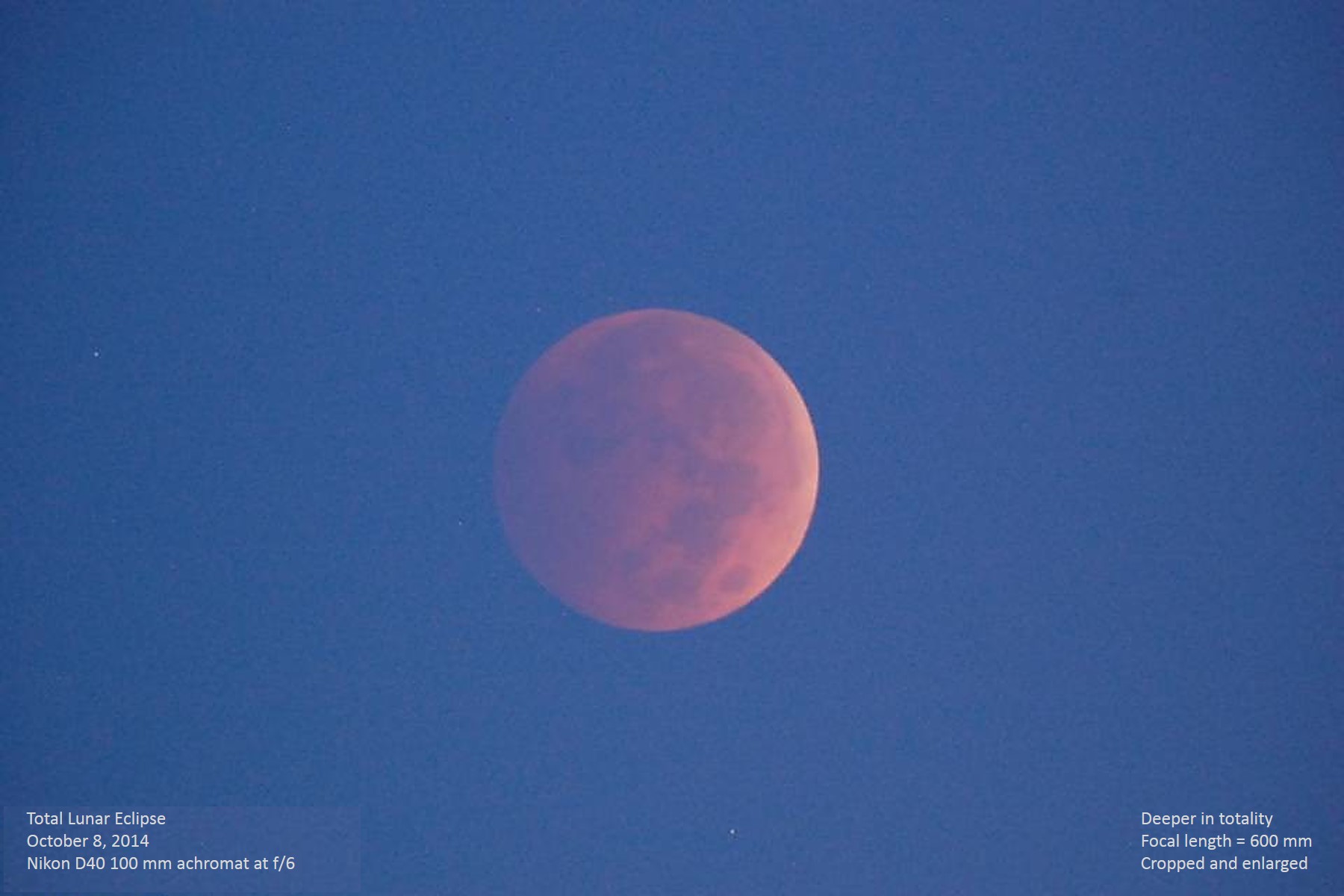
One of the interesting aspects of this eclipse is that the Moon was only about 1° from the planet Uranus, labeled in the second picture below. The closest star to the Moon, visible off of its southern limb, is known as 61 Piscium, magnitude +5.74, which is almost exactly as bright as the planet Uranus was on this date, at magnitude +5.71. My equipment for this event consisted of my Nikon D40 DSLR, a short tube refractor (an Orion 100mm f/6 achromat, with 600mm focal length), and of course a variety of ordinary camera lenses. The main images were all ob- tained with the refractor and the wide angle shot was taken using a 55mm f/1.2 Nikkor lens. |

|
|
|
|
|
The video at left illustrates the progress of the eclipse as seen from my location on route 3 east of Fredericksburg, across the road from what was at one time the Renaissance Faire. At this hour of the morning in October the Moon's hourly motion against the stars would be diagonally toward the upper left, but since it is heading toward descending node, the direction of this diagonal would be slightly less inclined to the horizon than that of the stars or Uranus would be. More information on this eclipse is available at the following links: |