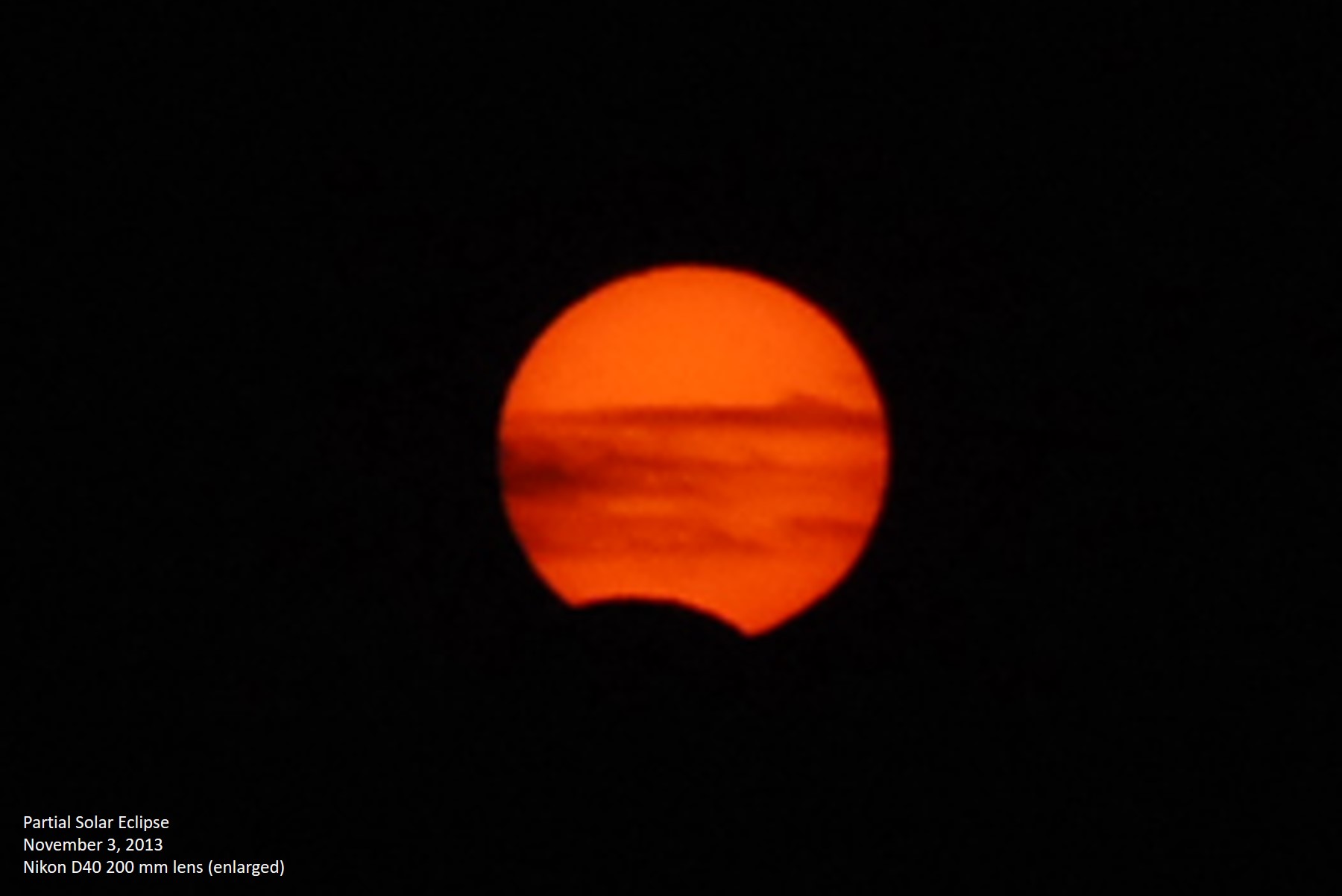
Partial Solar Eclipse November 3, 2013
|
A hybrid total and annular solar eclipse graced the eastern hemisphere on
November 3, visible across much of Europe,
Africa, and western Asia; only
the very ending of the eclipse was visible in the early morning in eastern
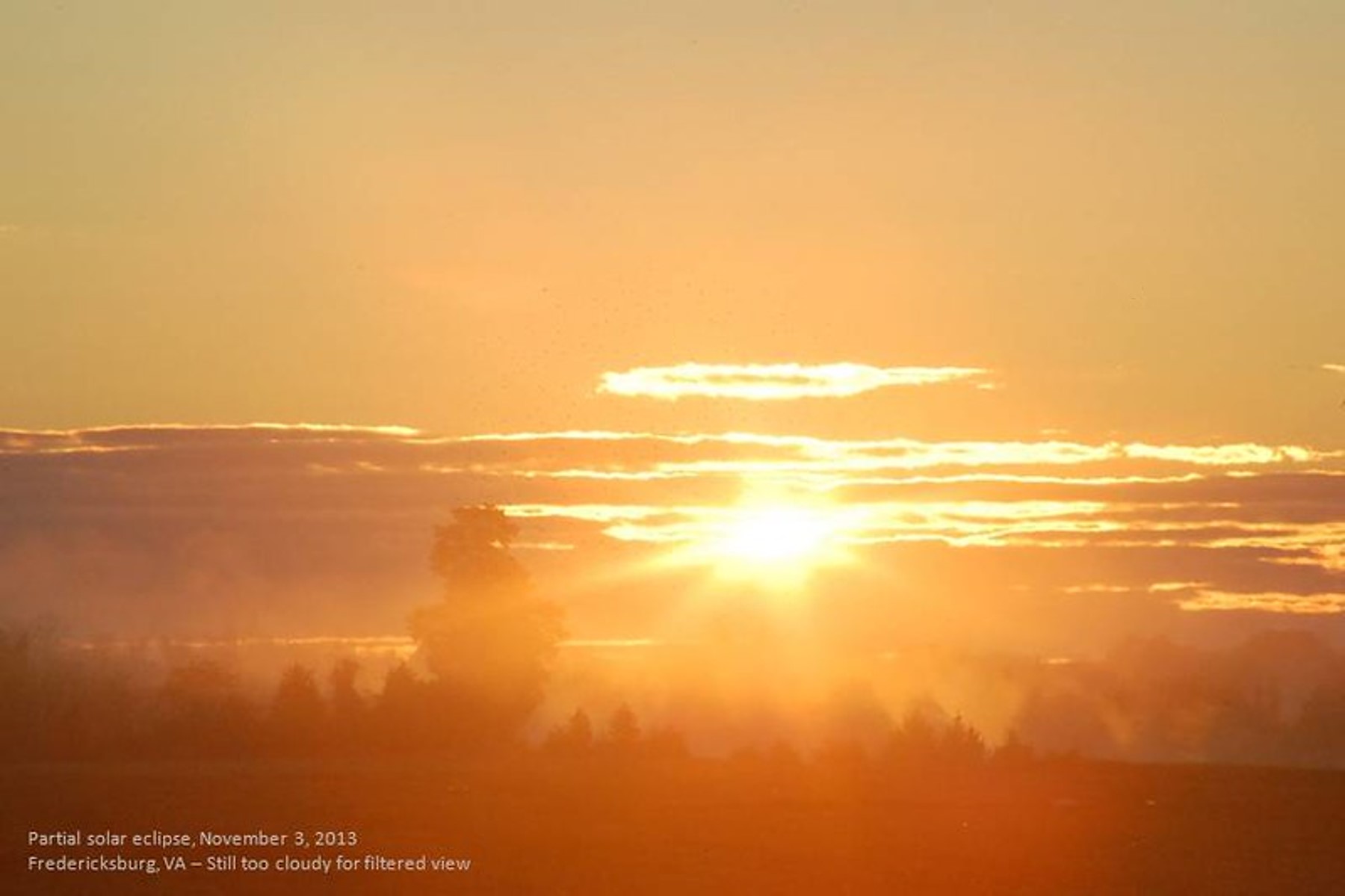
North America, however, so I went out to an open field east of Fredericks-
burg with a clear eastern horizon to try to catch it. This more dramatic
view from Florida
shows the Sun amid clouds; I should have tried to image
the Sun with no filter too!
What we are seeing here, since it is early morning, is that the Moon has
already passed over the Sun from our vantage point, and the first bit of
eclipse that anyone on Earth sees is the last part of the Moon departing |
This eclipse occurred with the Sun situated in western Libra, to the upper right of the star Zubenelgenubi. Two planets were also located nearby, the innermost planet Mercury above the Sun in Virgo, and Saturn down below and to the left of the Sun, only 3°23' away.
My equipment for this event was pretty basic, just my Nikon D40 and 200 mm
telephoto lens. I didn't bother bringing a telescope with me because to be
honest this was not going to be some spectacular eclipse LOL. I did try to
image the Sun without a filter but that didn't work well at all; the only
usable image I got was a couple of shots at 200 mm through a photographic
solar filter. Note that the cropped sensor of the D40 results in an image
with an equivalent focal length of 300 mm if you were using a camera with |

.jpg)

|
|
|
For people in Europe and Africa, this eclipse was a much more significant event. Particularly in central Africa, observers along a narrow path were able to see a hybrid eclipse that began as annular, became total for only a short time in the middle of the path, and then evolved back to annular. Observers in Bermuda experienced the partial eclipse for much longer than I did in Virginia. The farther east you were, the more of the eclipse you could see, as for example this observer in the Canary Islands. |
|
The video at left illustrates the progress of the eclipse as seen from my location. As the Sun rose, the eclipse was already nearly completed, so I only saw the last 27 minutes or so of the event. By the time the Sun was 5° above the horizon, the eclipse was over. Some additional comments on the ending or beginning of the eclipse are in order I think: I wrote at the top of the page that I saw the eclipse end- ing. By this I meant that from Virginia we only saw that portion in which the Moon had already traversed most of the Sun's disk and was departing ~ clearly the "end" of the event. But actually we could say that it was the beginning of the eclipse because we were the first people in the world to experience any of it! The first point on Earth which experiences any por- tion of a solar eclipse is the western edge of the planet which sees only the last moment of Moon "leaving" the trailing edge of the Sun. So we are simultaneously experiencing the beginning and end of the eclipse from two different perspectives. |