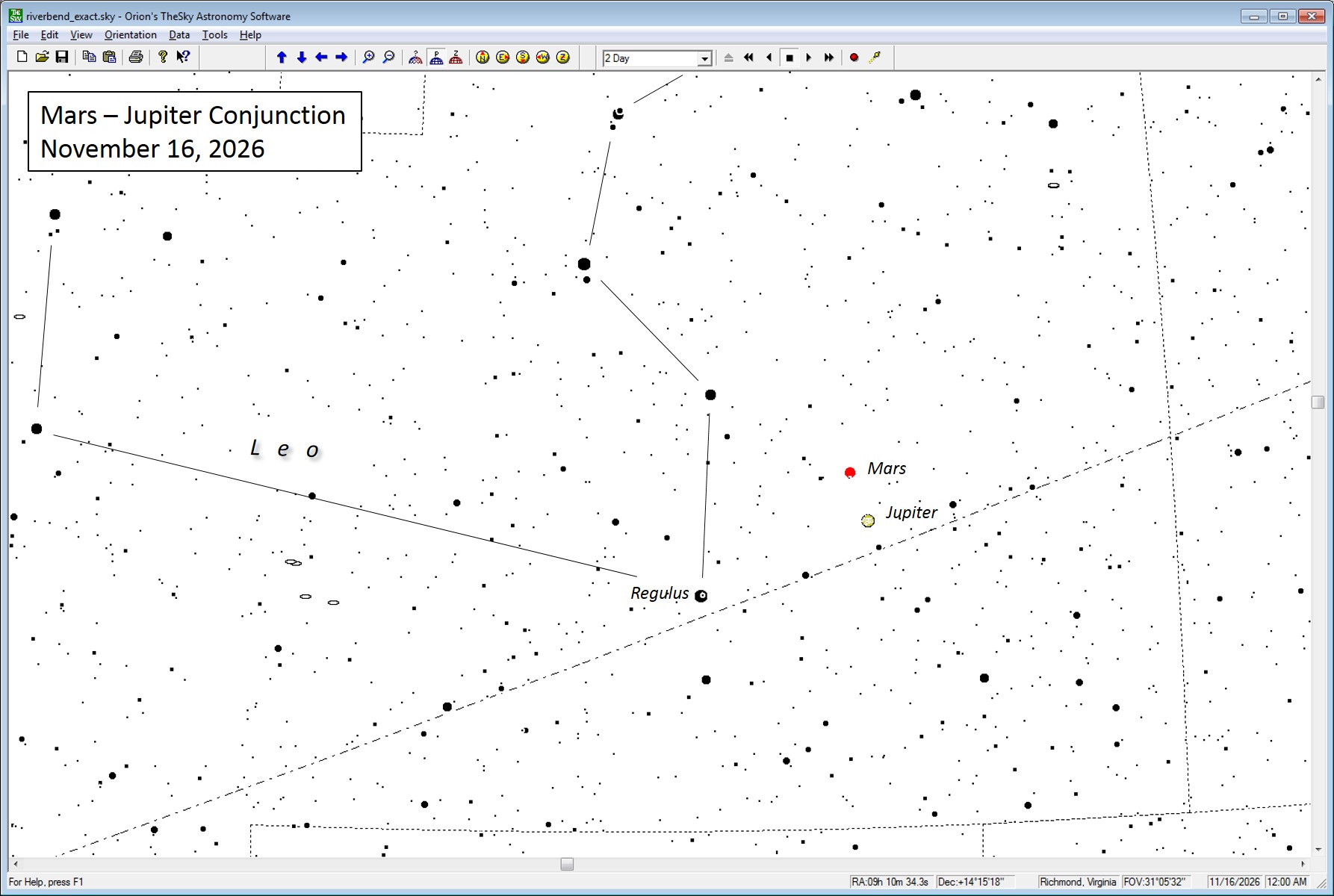
Mars and Jupiter will both experience opposition in February 2027. Jupiter arrives at its opposition first, on February 11, followed by Mars on February 19. The series of significant events begins on November 16, 2026 with a nice conjunction between them just to the northwest of Regulus. On this date Mars will be magnitude +0.70 and Jupiter will be -2.16, separated by 1°11'38". This means that Jupi- ter will outshine Mars by almost 14 times; nevertheless, the last time Mars was brighter than this at one of its conjunctions with Jupiter was December 18, 1986 in Aquarius, when Mars was magnitude +0.40 and Jupiter was -2.40. They were only separated by 28'17" on that date.
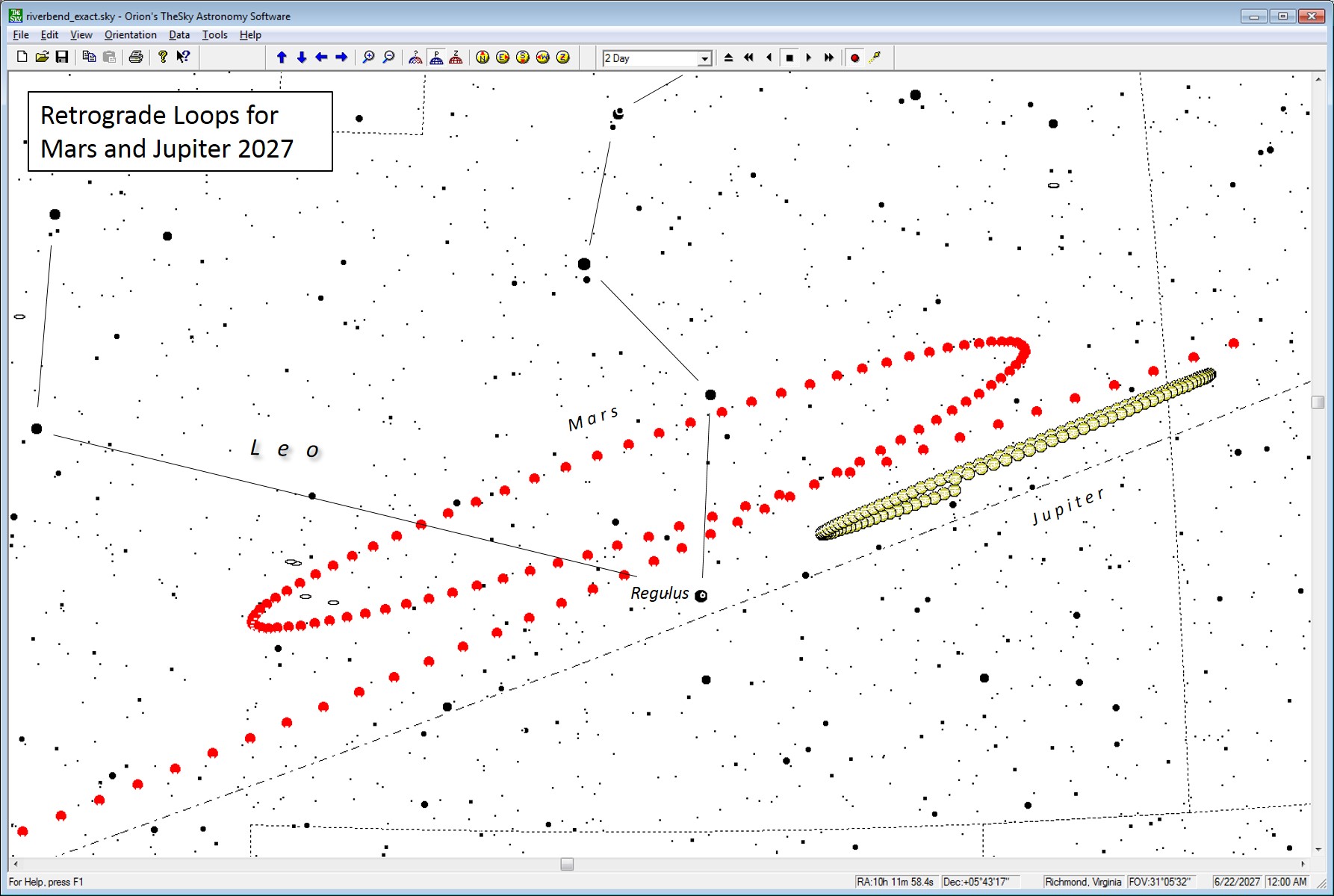
After the conjunction in November, the planets continue into Leo, the constellation in which they will execute their respective retrograde loops, shown in the second pane. As we can see, both planets are north of the ecliptic, so the middle of their loops is also the point farthest north of the ecliptic plane. Unlike 1980, however, this time the loops are not very well aligned, so after their conjunc- tion in November, they don't experience another one at any time during their opposition seasons. Jup- iter's retrograde loop actually takes it back into Cancer at the end of it, while Mars' retrograde loop is almost perfectly centered on the ecliptic longitude of Regulus, and is fully contained within the boundary of Leo.
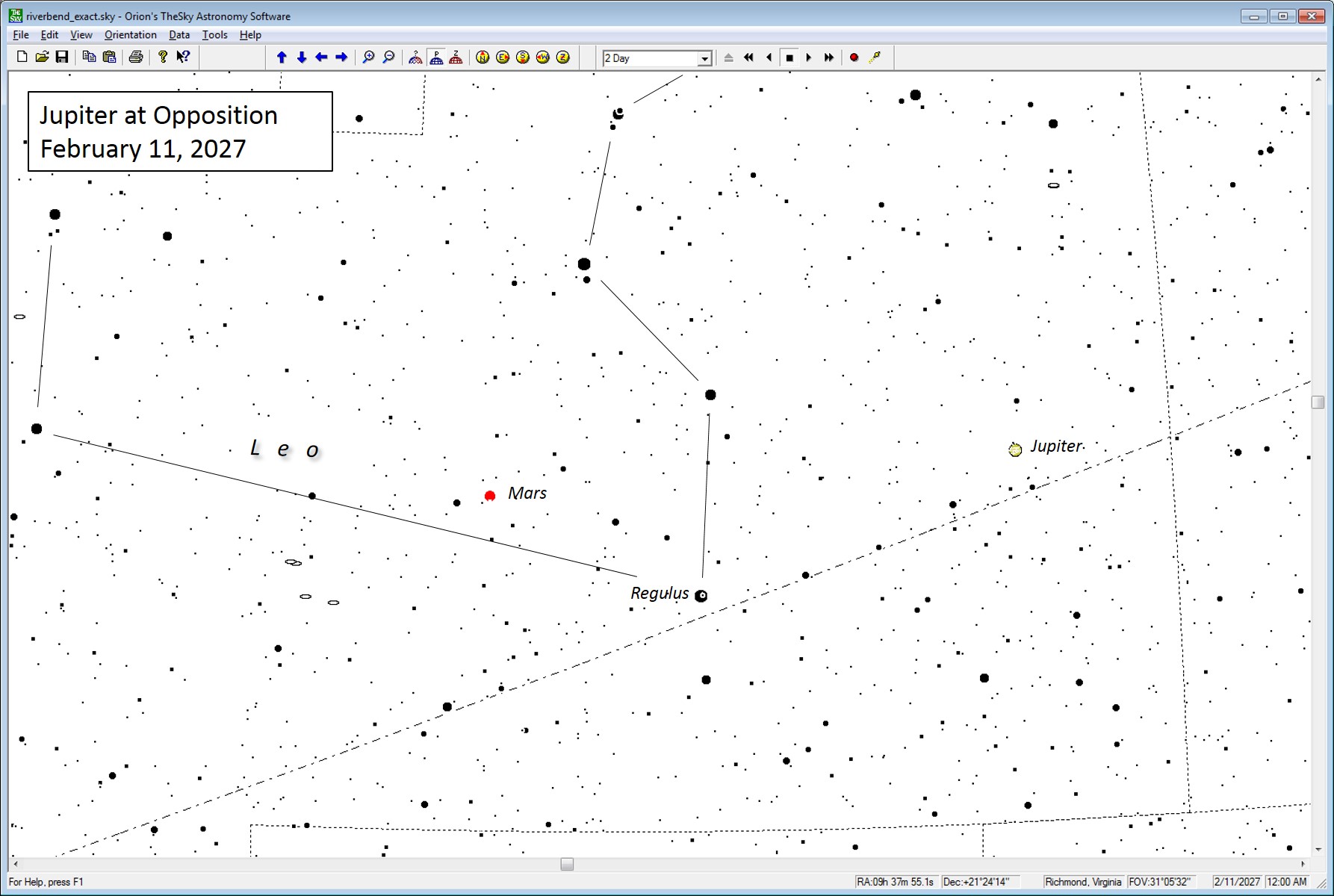
The next significant event is the opposition of Jupiter on February 11. Jupiter is located a little over 8° northwest of Regulus and shines at magnitude -2.56. Mars is somewhat more than 5° northeast of Regulus, at magnitude -1.12, and separated from Jupiter by 12°20', which is still a rather large distance to the unaided eye; it's more than twice the separation of the pointer stars of the Big Dip- per. Nevertheless, this should offer interesting opportunities for astrophotographers, especially since the Moon is only a few days after new, therefore not interfering in views of the nighttime sky.
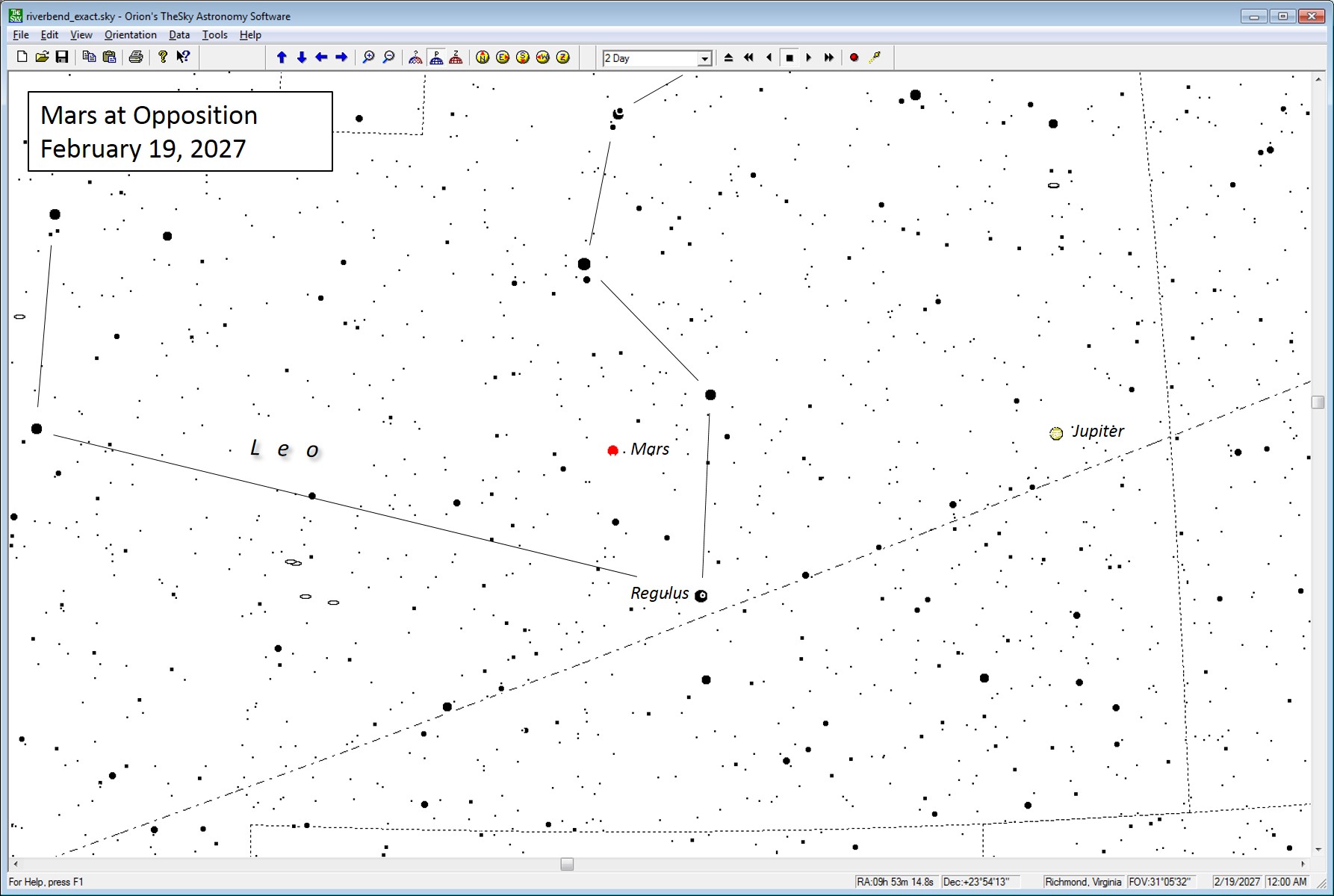
Eight days later, Mars comes to opposition. At this point, Mars is almost at the same ecliptic longi- tude of Regulus, being 4° northeast of that star, and shining at magnitude -1.21. Jupiter is at near- ly the same position, now a little more than 10° almost exactly due west of Mars. By this time, how- ever, the nearly full Moon is only 3°15' west of Jupiter, so photographers will have a difficult time capturing this scene. To get a picture of the two planets when Mars is close to its brightest, the window of about three days prior to the 19th or three days after the 19th is best, so waiting for the Moon to set on the 16th would be OK, or photographing Mars and Jupiter before the Moon rises on the 21st would also work.
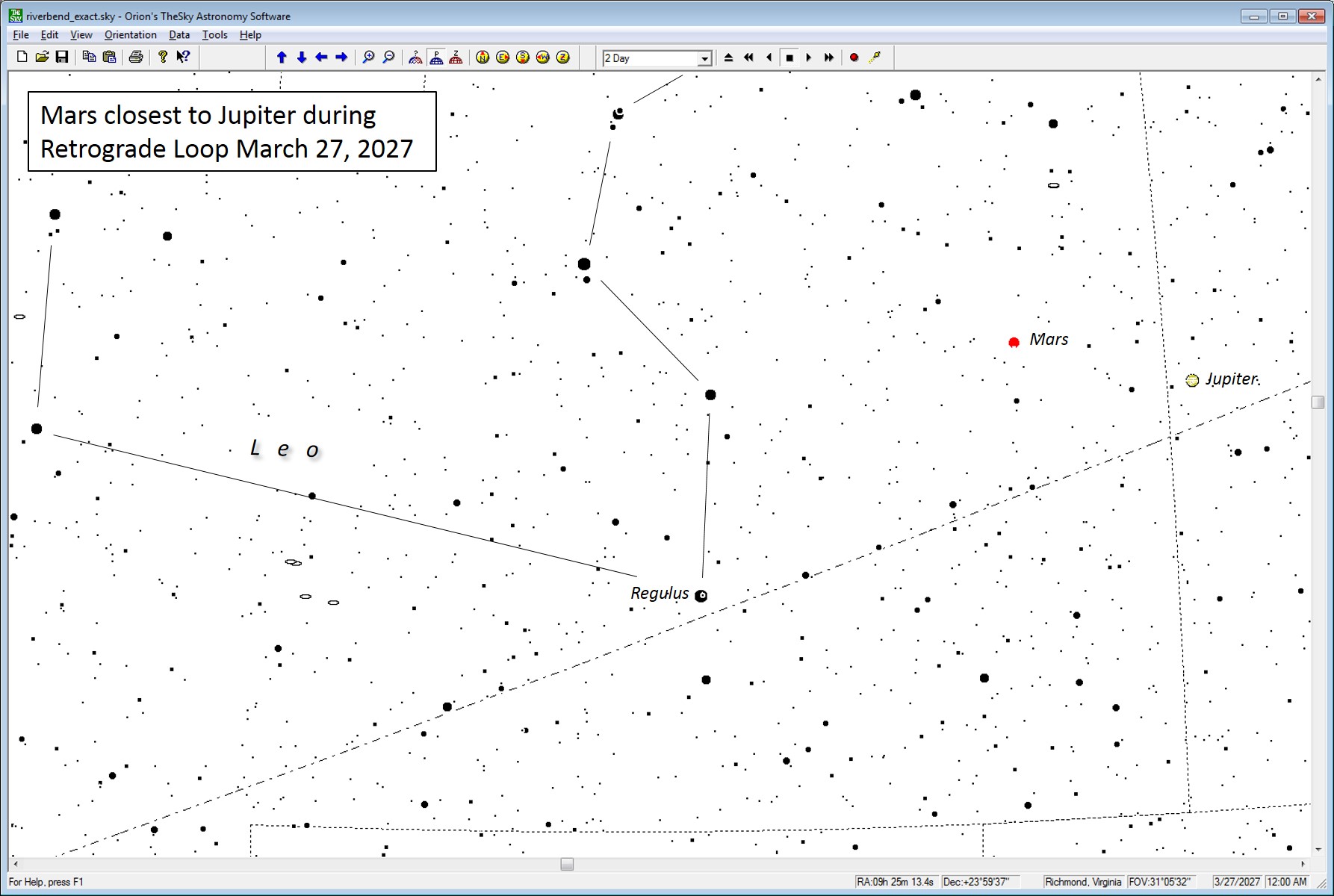
The last major event in the Mars Jupiter 2027 opposition season occurs on or about March 27, when Mars is near the westernmost point of its retrograde loop and therefore closest to Jupiter. Mars is still fairly bright at magnitude -0.47, more luminous than all stars except Sirius and Canopus, and Jupiter of course remains very bright at magnitude -2.41. They are separated by only 4°20' on the 27th, i.e., less than the pointer stars of the Big Dipper. After this, Mars will resume prograde motion and grad- ually pull away from Jupiter, slowly at first but then with ever greater rapidity move eastward.