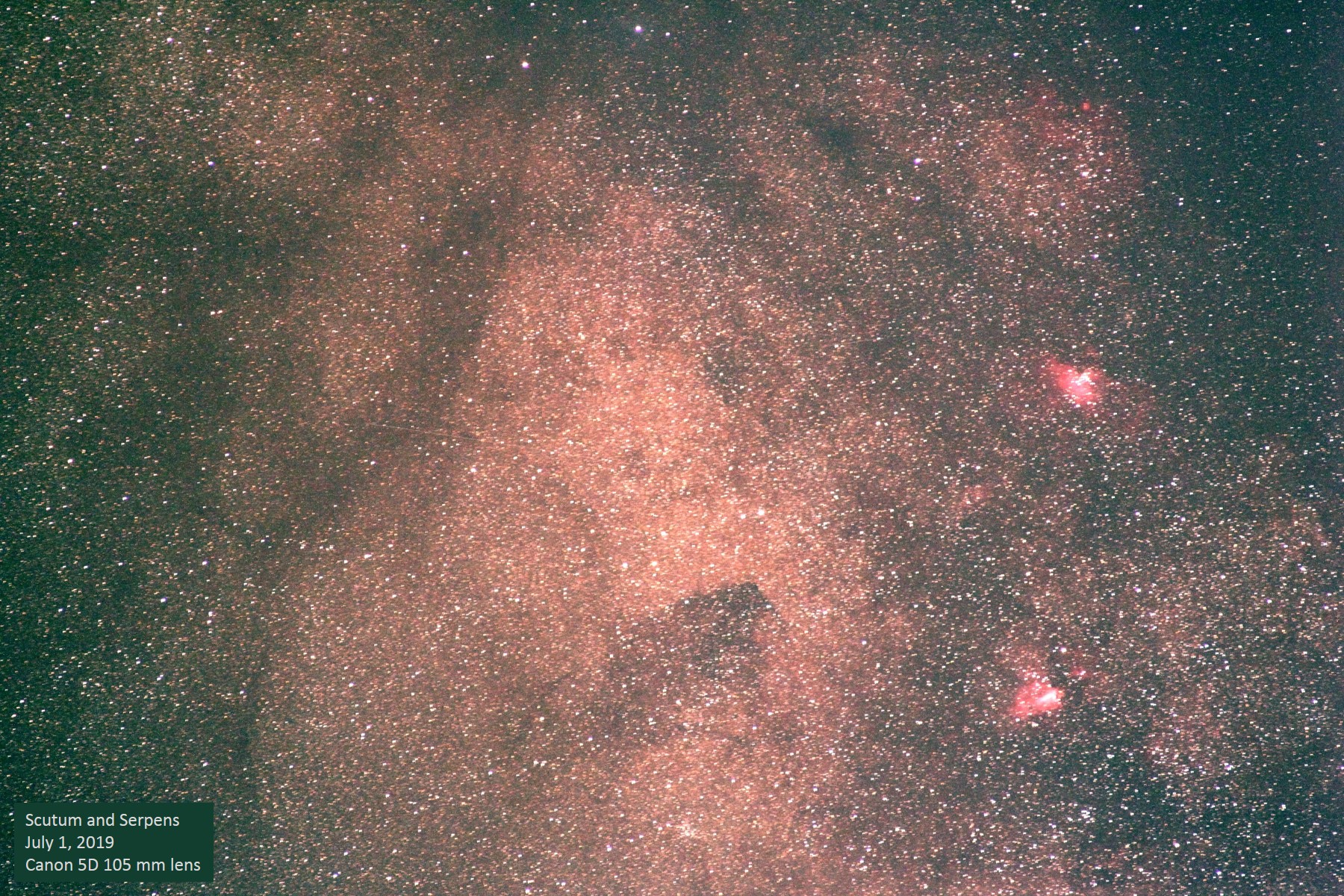
This area of the northern edge of Sagittarius, the eastern part of Serpens (Cauda) and the southwestern portion of Scutum is rich with star fields, dark nebulae, and HII emission regions. This image was taken in 2019 on the south rim of the Grand Canyon. The annotated version has been dimmed slightly so the text is more visible. Unannotated image.
The main showpiece objects in this field are the Omega or Swan Nebula (M17), and the Eagle Nebula (M16). The emission part of the Omega Nebula can easily be seen even in a small telescope, and it responds well to several different types of neb- ula filters. The Eagle Nebula is not easy to see in a telescope except as an open cluster because the emission portion has noticeably less surface brightness than Omega. This difference does not manifest in my image.
A much fainter area of nebulosity is situated to the north of the Eagle Nebula, and is denoted as Sharpless 2-54. It is larger than either M17 or M16 but would be extremely challenging to see in a telescope, certainly requiring the use of neb- ula filters. The open cluster NGC 6604, which is embedded within the nebulous area, can be easily seen in a small to medium telescope.
Several other open clusters can be well observed across the field. The largest is NGC 6645 at the bottom edge, in northern Sagittarius. Just below the Omega Nebula is the often overlooked object, the open cluster M18. It is small but bright and easily observed with a small telescope. NGC 6605 is the least conspicuous cluster in this part of the sky, despite ostensibly having magnitude 6.0 and a diameter of 29', the diameter of the Moon! It must be an example of an open cluster that is indistinguishable from the background stars.
My image is centered on one of the brighter star clouds visible to the unaided eye on clear, dark summer nights. But the area in the center of the image is not even the brightest cloud in Scutum! That area, called the Scutum Star Cloud, is just off the north edge of this image. We can however see a multitude of dark nebulae that obscure our view of the star clouds behind. The most easily detected of them is Barnard 312, a dark cloud on the north side of the border between Sagittarius and Scutum.