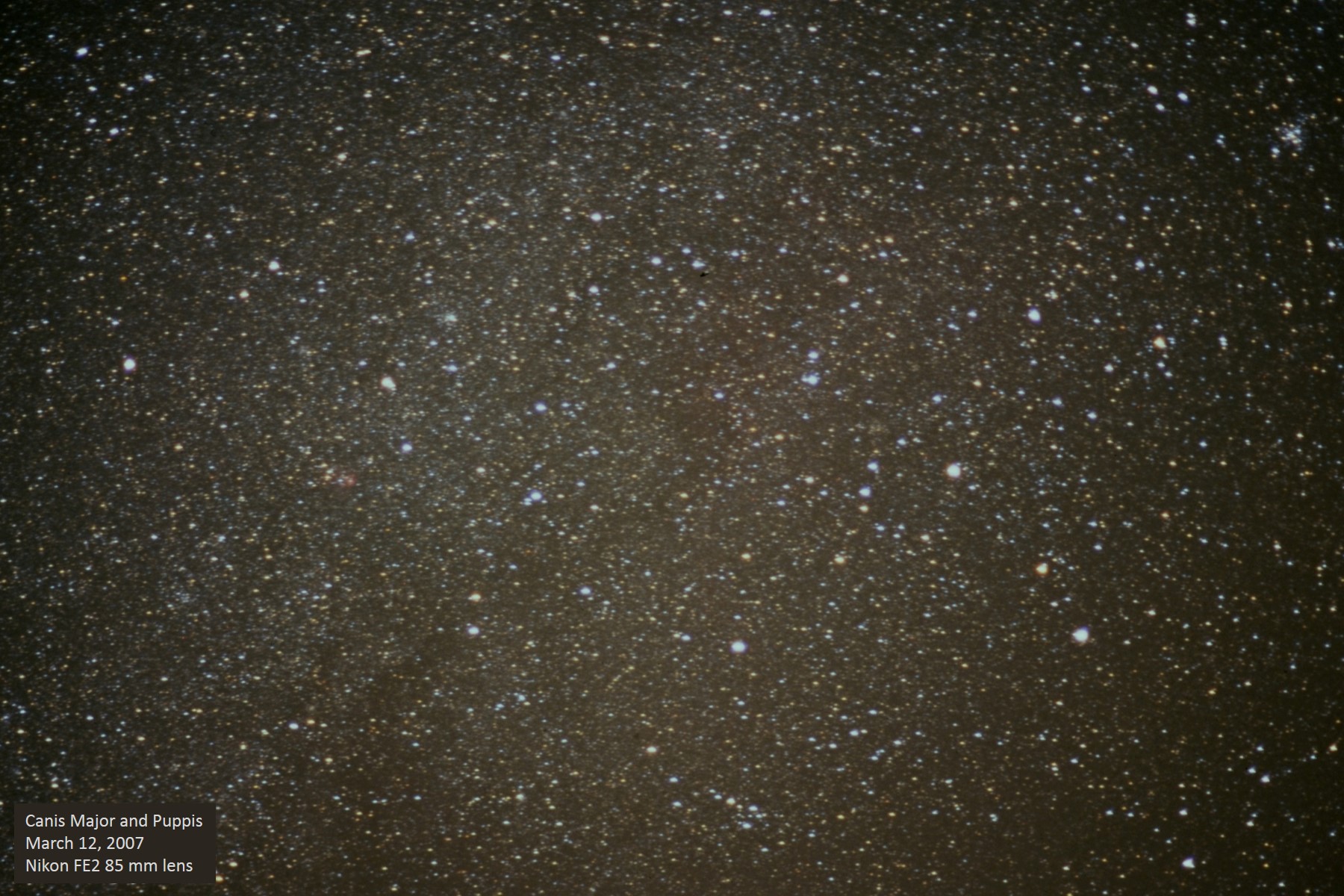
In early 2007, we must have taken a trip to Florida and while there I probably visited the Chiefland Astronomy Village or some other dark sky site. The southern Milky Way from Puppis and Pyxis all the way to Centaurus was on display throughout the night. Here we see the Milky Way from southern Canis Major to central Puppis, with open clusters from M41 on the right to NGC 2527 at lower left. Unannotated image, Back to Constellations, Back to Starvergnügen
The open cluster M41 is an outstanding target for
binoculars, even just 7 x 35 models, showing some
of the brighter stars and its large extent easily
in views through those binos. NGC 2362, which has
the colloquial name of Tau Canis Majoris cluster,
can be seen to the upper left of the three stars
comprising the hindlegs of the dog, but its small
size means that fairly high magnification must be
used to see it well.
Nearby is NGC 2354, which is faint but large, and
can be seen southwest of NGC 2362. Magnification
of 15x or 20x power is probably necessary to see
it well. Across the border in Puppis lies an area
rich in clusters and nebulae. M93 is another good
target for binoculars, which show its asymmetric
shape and some of its brighter stars. This region
of Puppis is marked by the pattern created by the
three stars k, ρ, and ξ Puppis; M93 is located to
the north of the arc made by these stars, but all
the other clusters visible with binoculars or low
power telescopes are below the arc. Open clusters
NGC 2467, NGC 2527, and NGC 2489 can be seen with
binoculars or low power telescope. Of these, 2527
is the most easily detectable.
Of these last three objects, NGC 2467 is the most
interesting. This object was initially classified
as an open cluster, but then the nebulous portion
of the object was discovered; more recent studies
have revealed that the stars once thought to form
the cluster are actually just groups of unrelated
stars at different distances. The nebulosity here
is probably not detectable in binoculars, but the
star grouping is. My image, however, does record
some of the reddish coloration of the nebula.
Lastly, the star grouping in southern Canis Major
near the border with Puppis is a large and sparse
nearby cluster called Collinder 140, first listed
as an object by Lacaille in 1751 but catalogued in
1931 by Per Collinder. This object is easy to see
even just with the unaided eye!