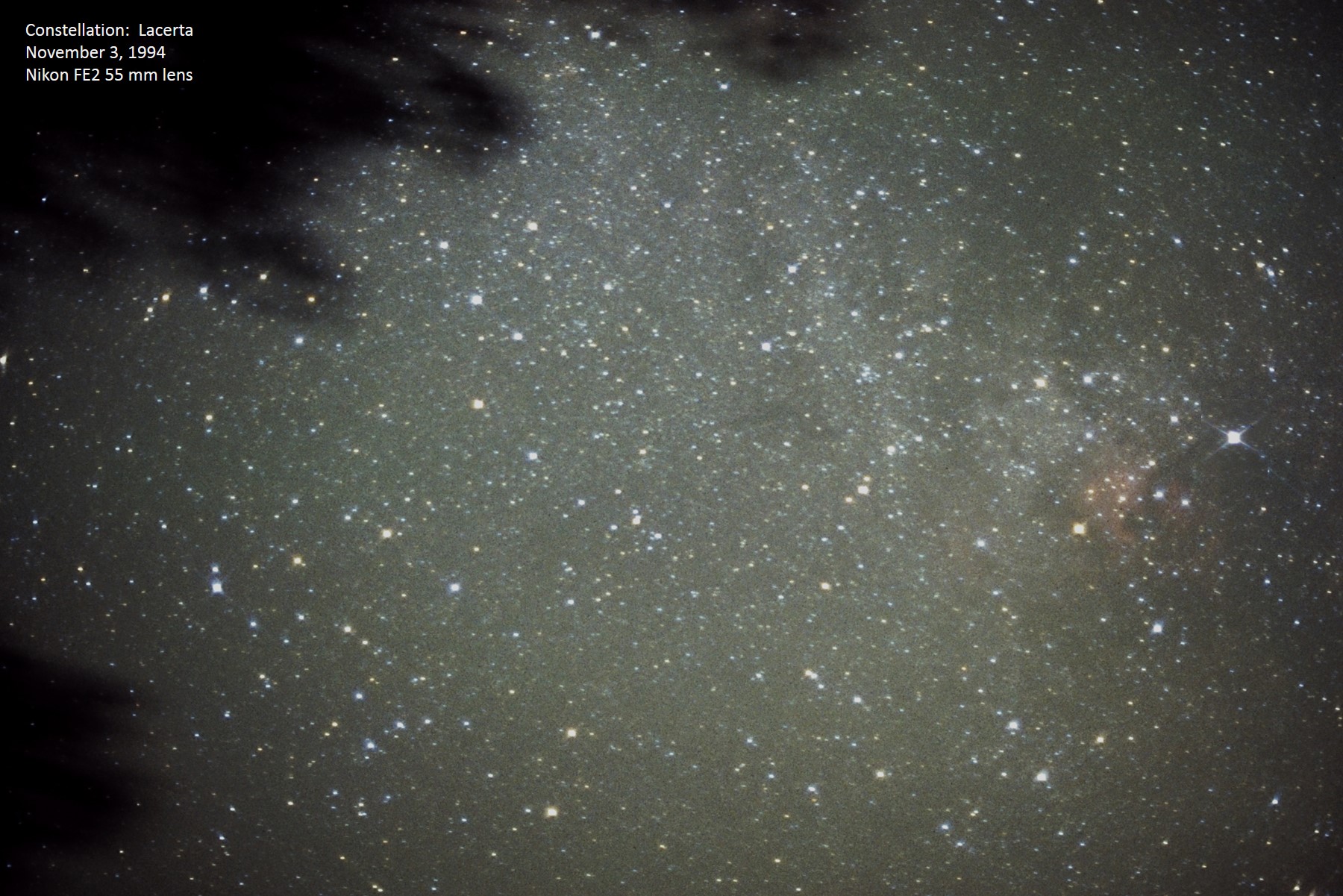
NGC 7209 is a bright open cluster that can be seen as a hazy patch even in low power binoculars. It makes a relatively straight line with the splashy open cluster M39 and the dark nebula B168 in Cygnus, so finding it should not be too difficult. The object is about 3,800 light years away from Earth which is indicative of the distance to the nearest spiral arm of our galaxy that lies in this direction.
The other principal object in Lacerta that we can see with binoculars is NGC 7243. It is also an open star cluster, but presents as somewhat more concentrated, with fewer but brighter stars, than NGC 7209. It lies at a distance of 2,800 light years from us, which places it closer than the spiral arm in this direction, the Perseus Arm.
Of course, we would be remiss if we failed to mention the photographic highlight here, namely the North America Nebula, otherwise known as NGC 7000, to the left of and just below the bright star at right, Deneb, the lucida of Cygnus.
This picture was taken on slide film with a Nikon FE2 camera and 55 mm f/1.2 lens at my childhood home in Hanover County, Virginia, back when it was still fairly dark there!
Lacerta the Lizard is an underappreciated constellation, because even though it resides near the plane of the Milky Way, no Messier objects nor very bright stars lie within its bounds. Nevertheless, there are several noteworthy open clusters and generally bright star fields that help to set off the dark nebulae in Cygnus and Cepheus nearby. Unannotated image, Back