In 1996, Venus repeated its performance of 1980 and 1988, which is the most
favorable kind of apparition for northern hemisphere observers. In the first
half of the year, she is high in the winter and spring sky, goes through
inferior conjunction in June, and then spends the summer and autumn high in
the morning sky. In the evening half of its apparition, Venus increasingly
moves north of the ecliptic, but as it passes between Earth and Sun, Venus
moves rapidly through its descending node, so that when it emerges in the
morning sky, it is well south of the ecliptic. Venus' orbital track for the
remainder of the summer carries it back north towards the ecliptic.
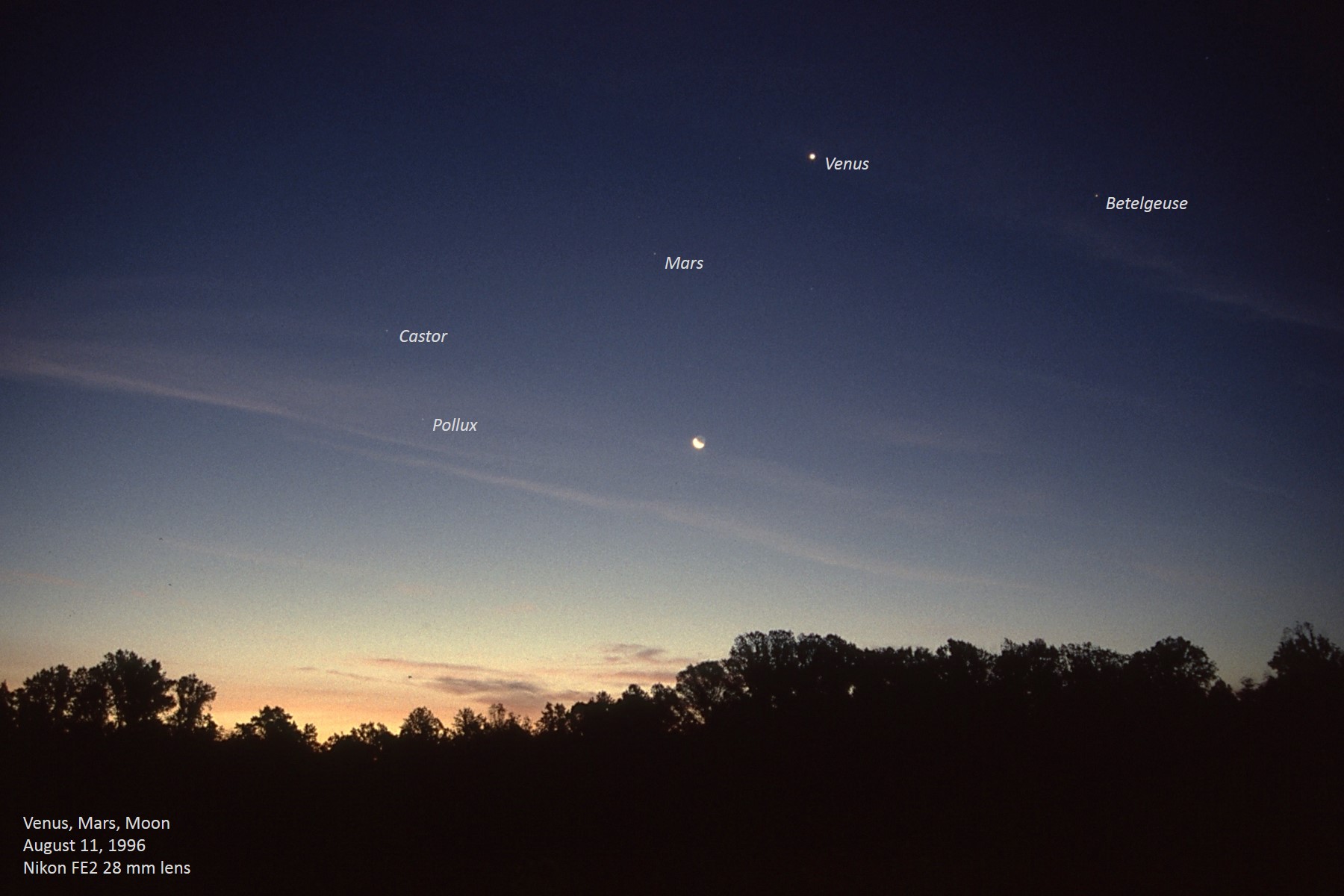
By the time of these photos on August 11, Venus is still considerably south
of the ecliptic but moving north each day as it races eastward against the
stars towards its superior conjunction in early April 1997. This is one of
those rare instances in which Venus is within the boundary of Orion, not an
ecliptic constellation. Venus is still at above average brightness, at mag-
nitude -4.36, but gradually losing brightness as sinks toward the horizon
each day.
Mars, during the 1990's and 2000's, is in a phase during which its opposi-
tion years are the odd-numbered ones. As a result, his oppositions occur in
January 1993, February 1995, March 1997, April 1999, etc. By definition
therefore, the even-numbered years are when Mars passes on the far side of
the Sun from our perspective, an event known as superior conjunction, or,
since Mars can never be between Earth and Sun, it is simply "conjunction."
Mars went through conjunction on March 4, 1996, and as such it is now slowly
increasing in western elongation from the Sun and as such gaining altitude
each morning. At times like this when Mars is still very distant, it is only
as bright as an average star, so this morning it shines at magnitude +1.52,
almost exactly the brightness of Castor in Gemini.
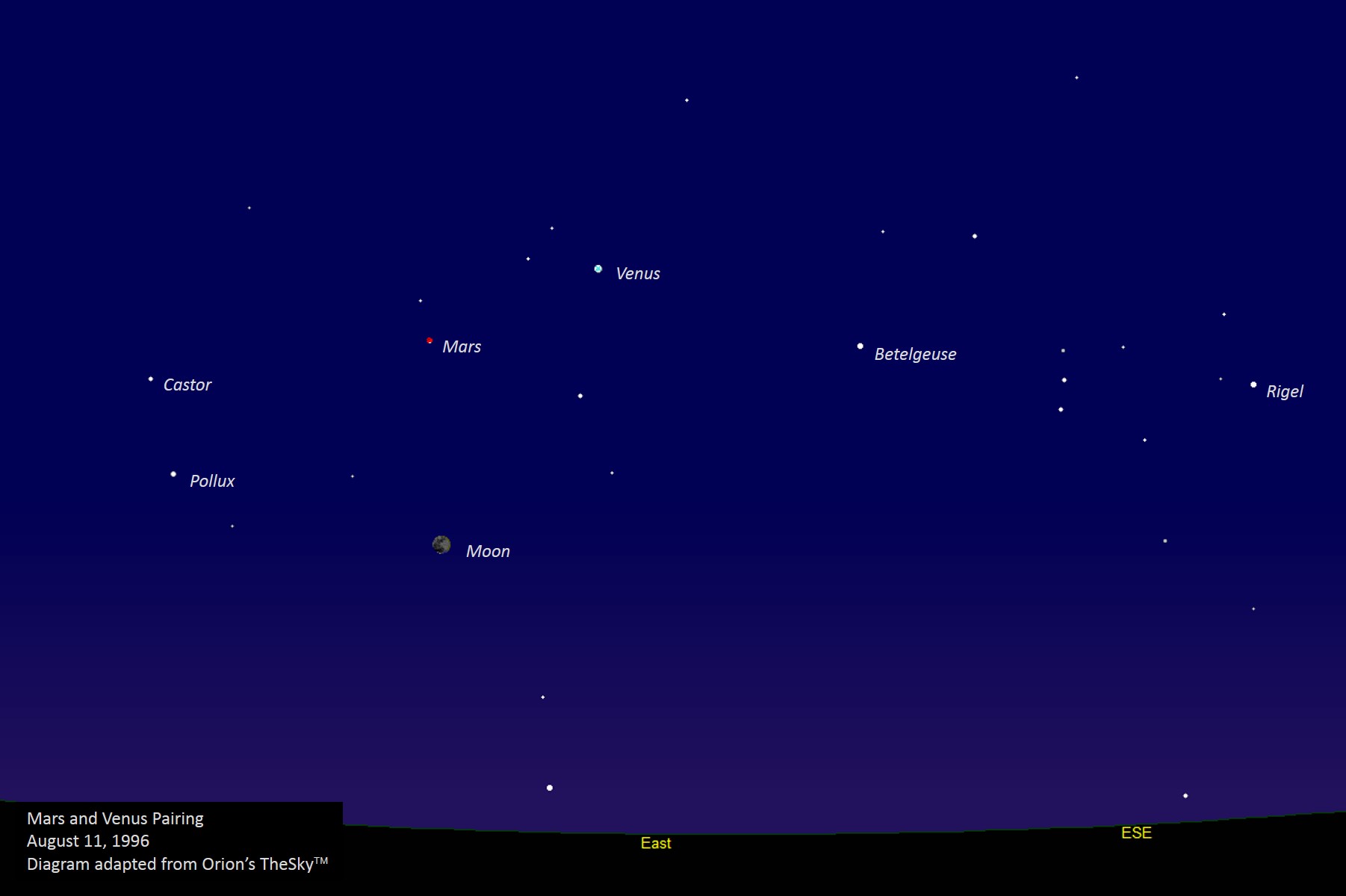
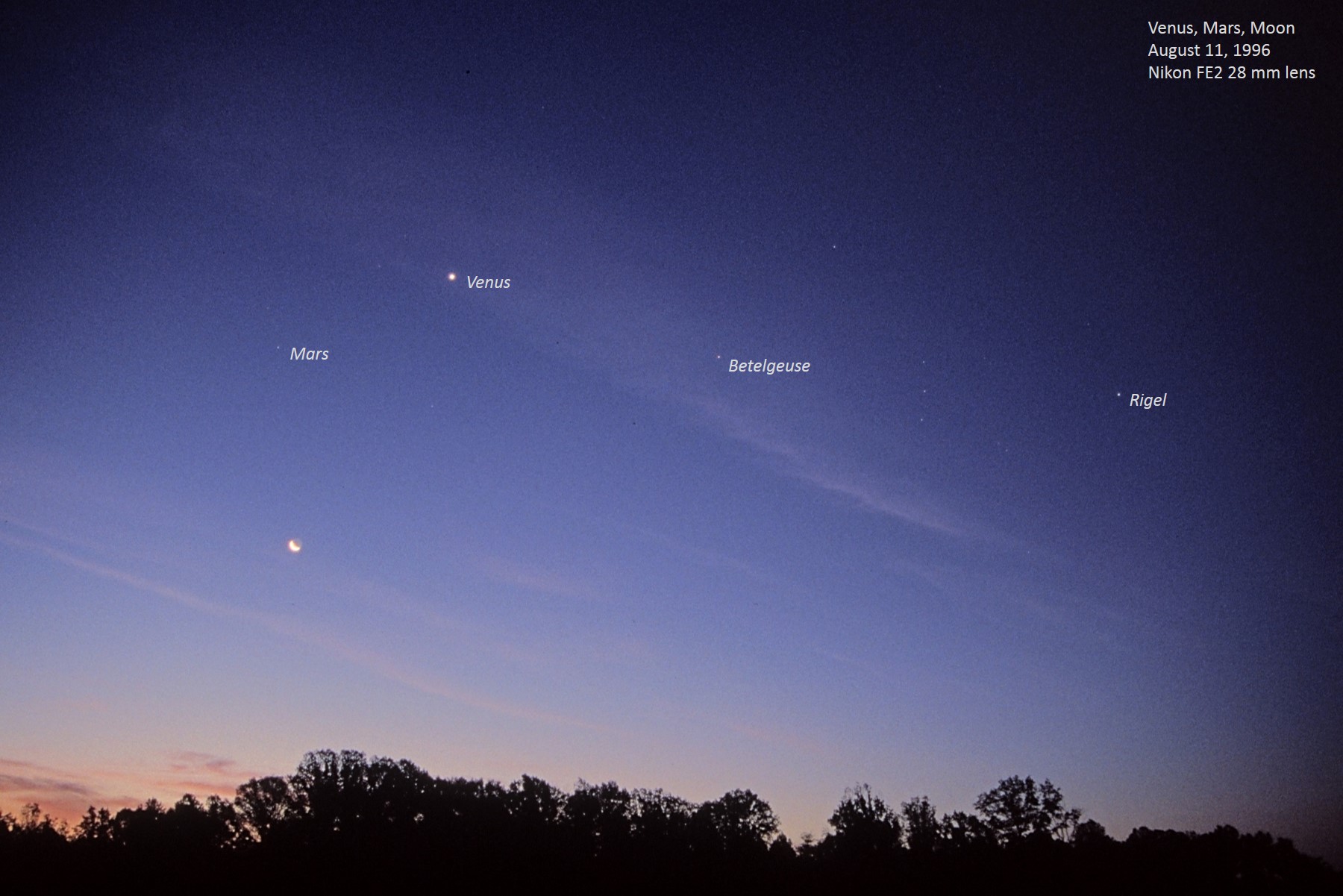
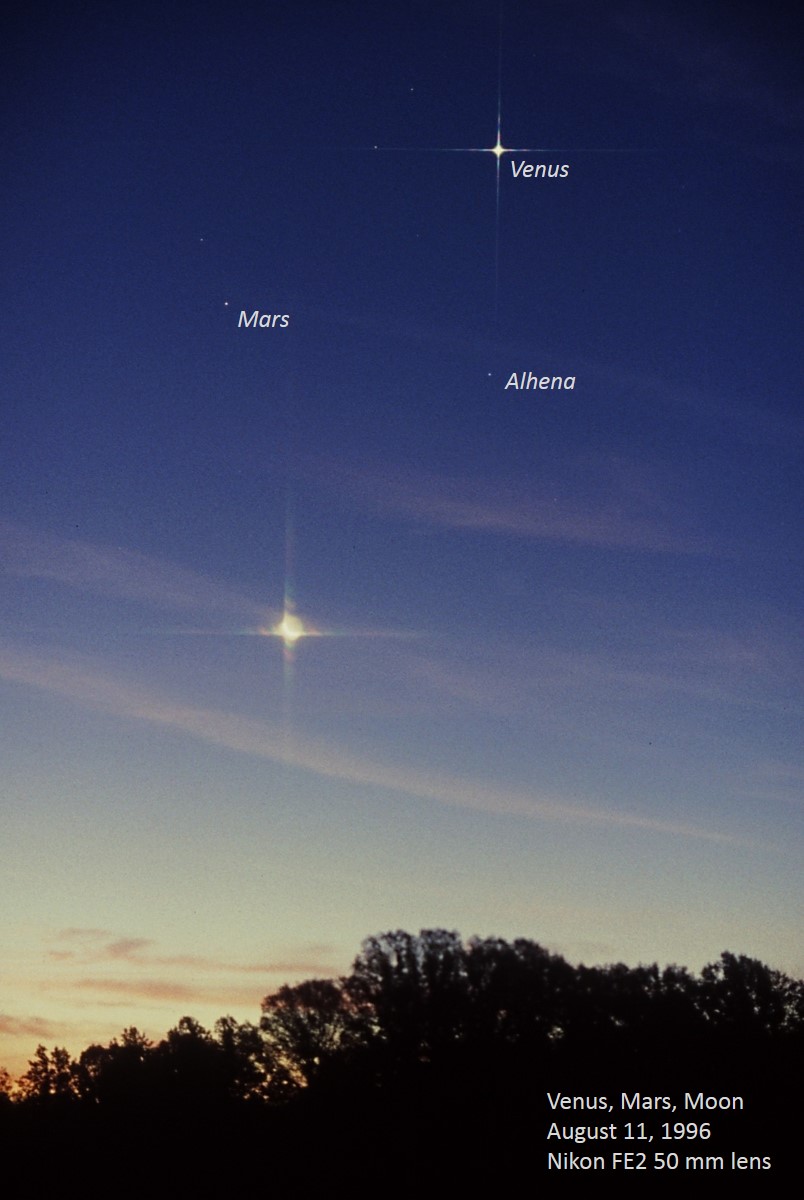
The images at right show, from top to bottom, a wide angle view of the scene
with Orion fully visible on the right, then a normal view of the planets and
Moon, and at bottom a wide angle view, centered on the planets, that shows
(albeit barely) the two main stars of Gemini to the lower left of Mars. The
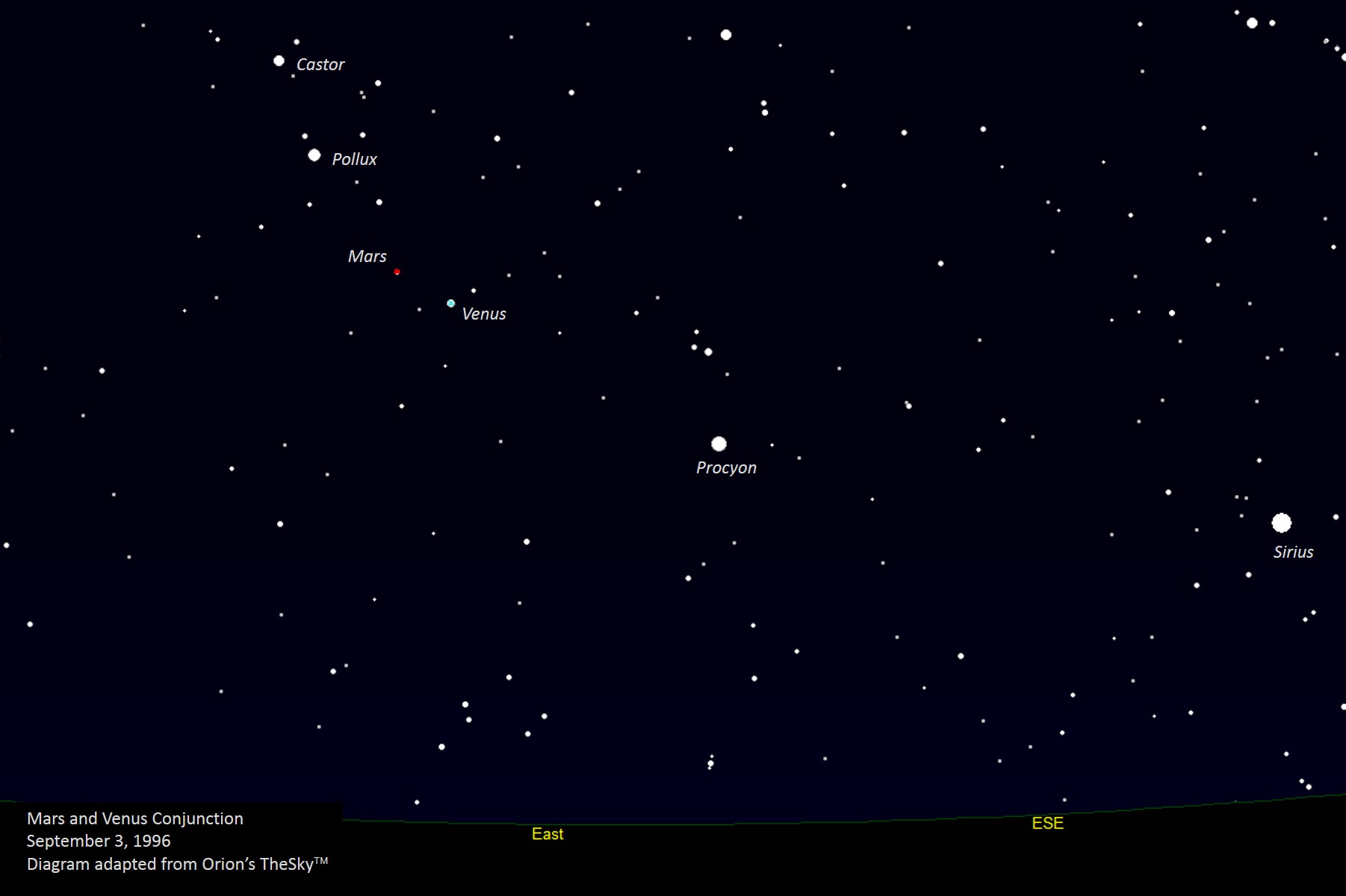
separation between Mars and Venus this morning was 8° 40' 14". Mars will
be passed by Venus in early September, with their closest approach being on
the morning of the 3rd. The below images expand to the views on these dates: