Total Lunar Eclipse, April 4, 1996
The images begin with the first picture of the eclipse at lower left, then progress up and right until the last picture I took shown at upper right.
The eclipse of April 4, 1996 was the first one in the two-eclipse season during that month, the second being a solar eclipse on the 17th. This event favored Europe and Africa, however it was visible low in the east after sunset from the east coast of the United States. The eclipse was already well underway by the time of moonrise here in Virginia, however the total phase was clearly observable as long as your eastern horizon was low. Of course, during an early April eclipse, the full Moon will be in Virgo, so here we see the Moon rising just to the right of the east point on the horizon. The Moon passed nearly centrally through the Earth's umbra, which usually means that it will be a fairly dark one; the time of ascending node is several hours after the eclipse, so that means that the Moon is traveling through the southern portion of the Earth's umbra.
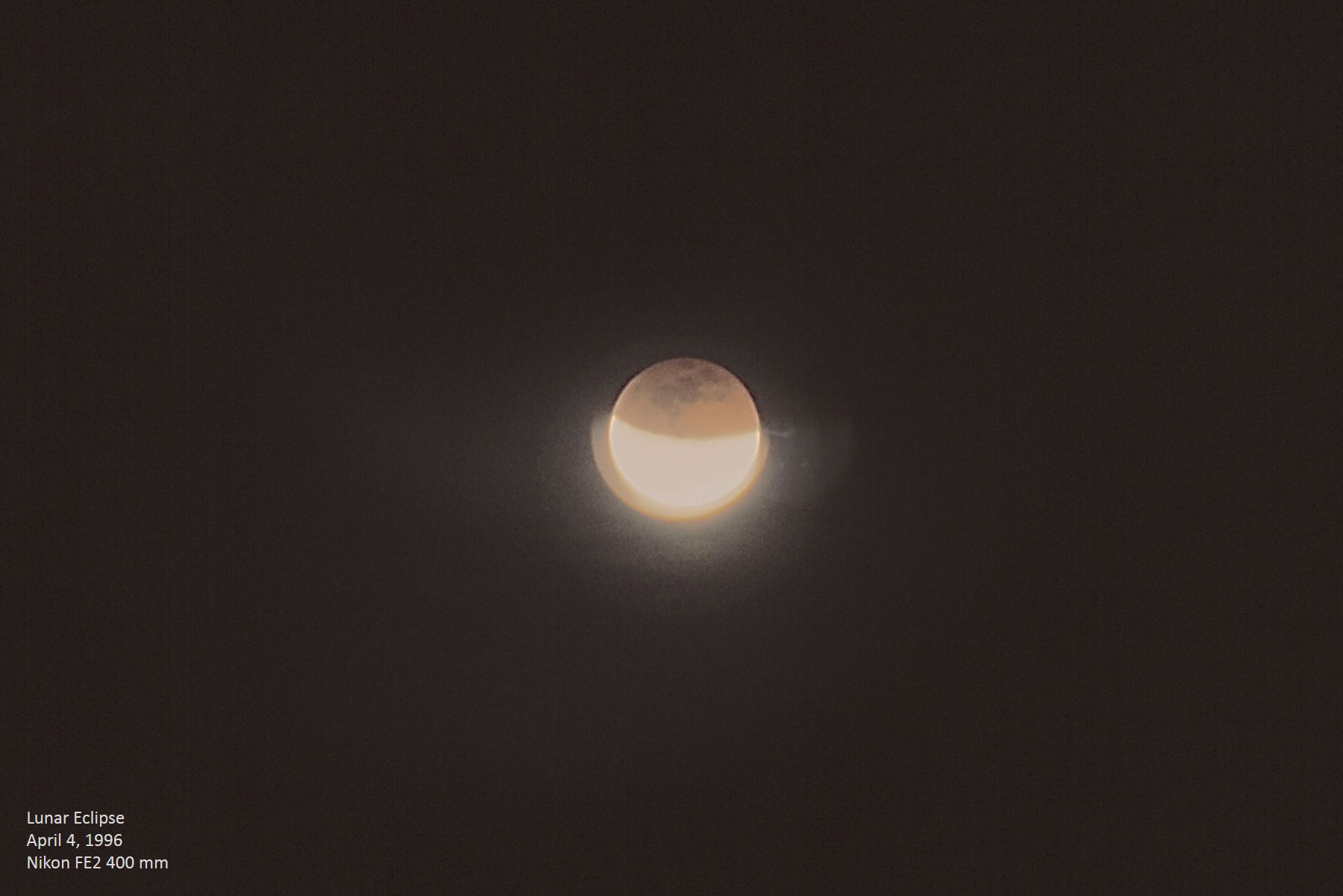
The above image shows the Moon emerging from the Earth's umbra, in other words the partial phase after totality. The edge of the Earth's shadow is the curved line on the Moon.
For this event, I used a Nikon FE2 film camera, a Meade 2045 4" SCT with a clock drive, a 400 mm mirror lens, and several ordinary lenses such as 28 and 55 mm primes. The image of totality was certainly shot with the 1,000 mm SCT at f/10, while the partial phase photo was made using the 400 mm f/5.6 lens. I don't remember where I was for observing and photgraphing the eclipse LOL; I'm sure I was somewhere near my home in Fredericksburg, VA because this was a Thursday, so I would not have driven too far away.
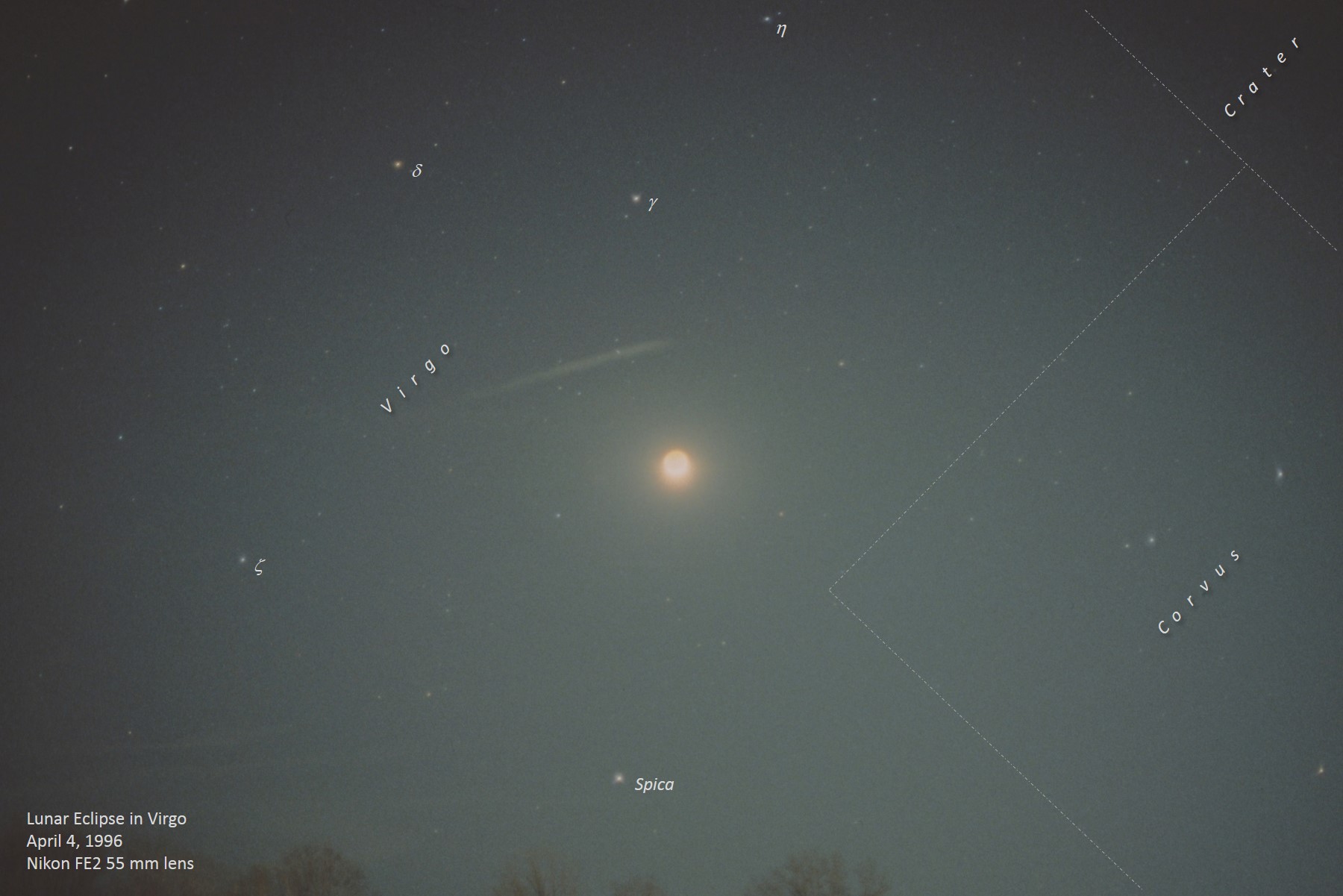
Hovering over the above thumbnail shows the scene with the Moon, now in partial phase after totality, among the stars of Virgo, roughly between the star γ Virginis, also known as Porrima, and the α star of the constellation, Spica. This picture was probably taken right around the same time as the 400 mm shot of the partial phase at upper right.
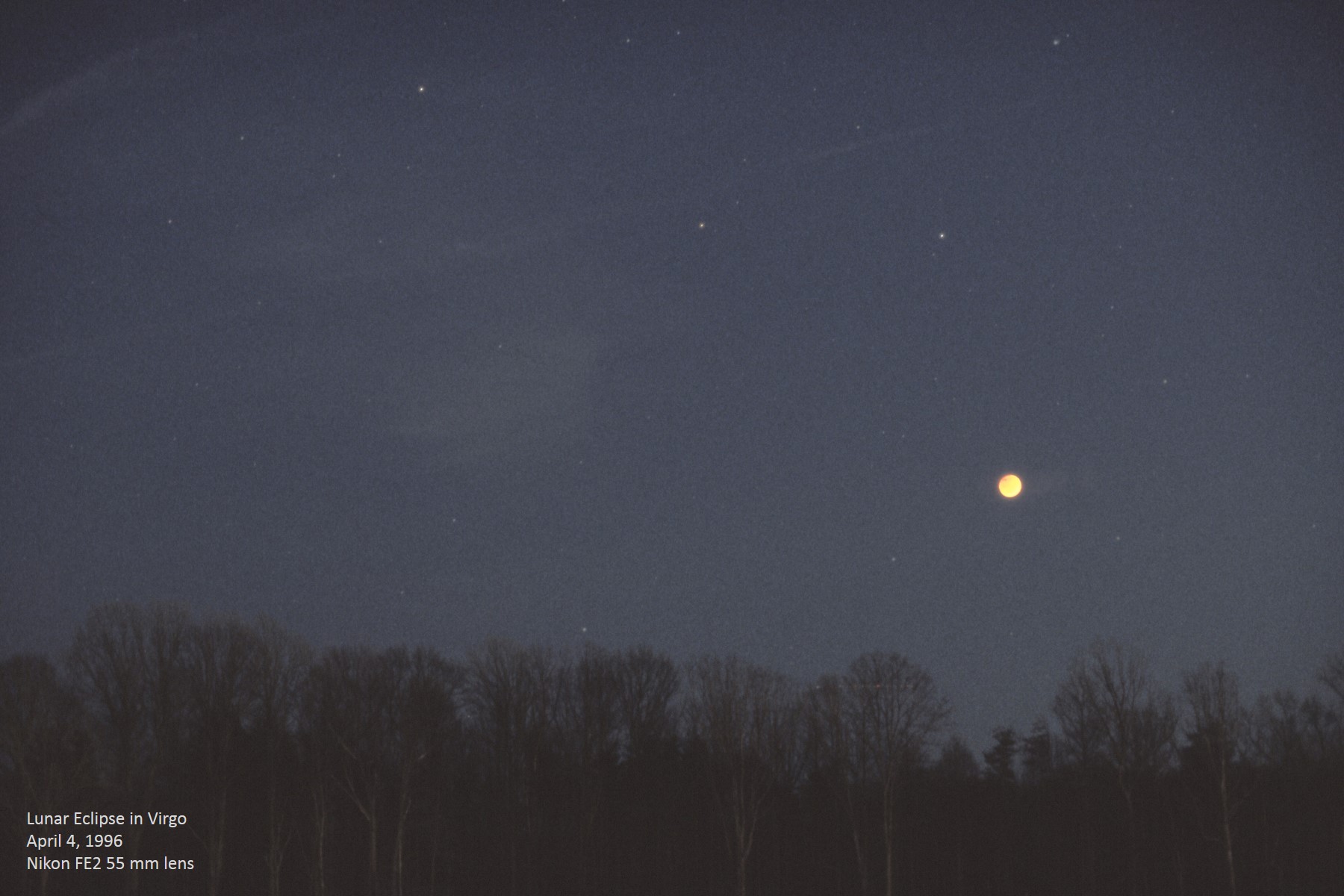
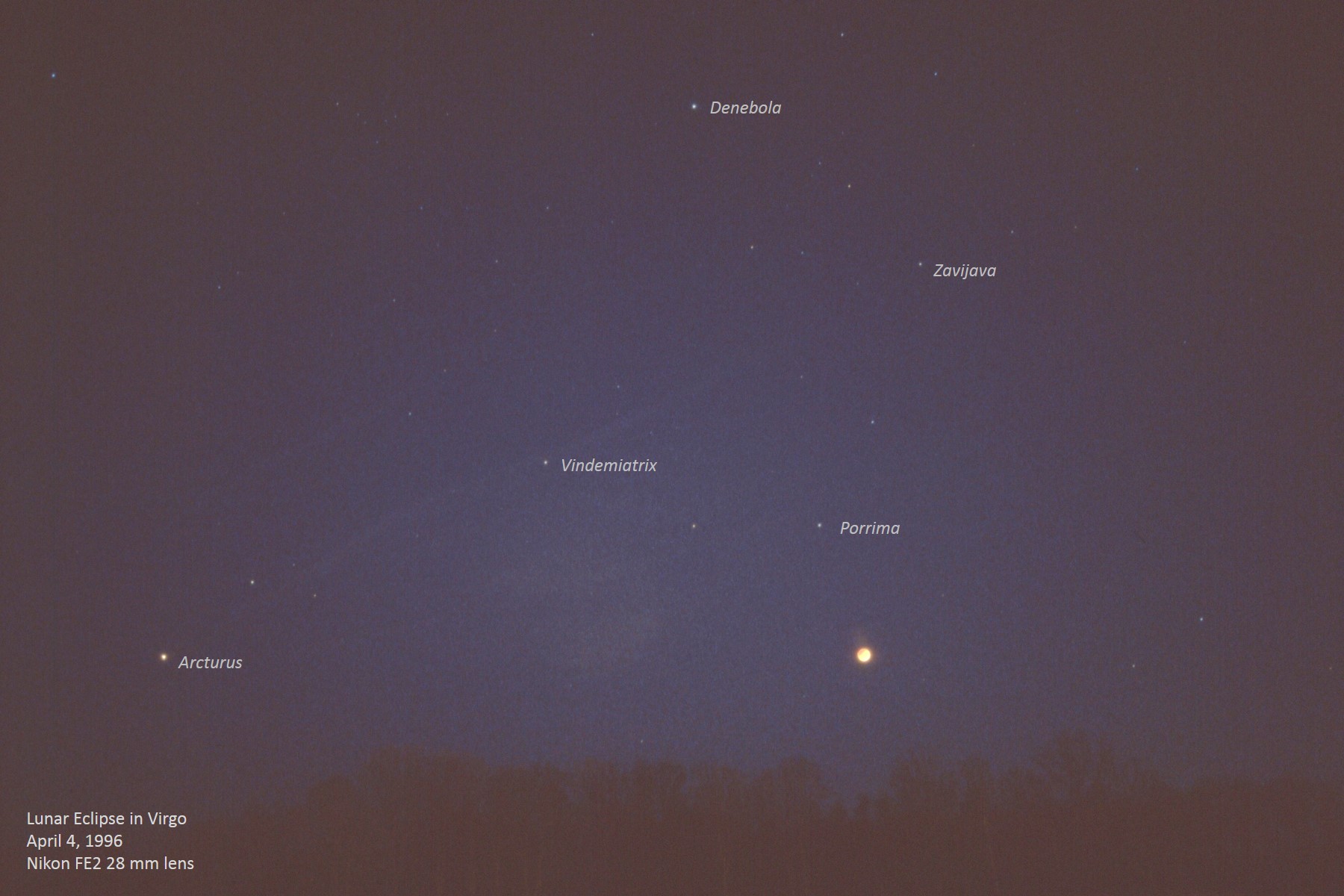
The image below shows a wide-angle view of the scene, from Arcturus at left to the stars of Corvus at lower right, all the way up to Denebola in Leo at the top. Notice that Spica has not cleared the treeline yet, unlike the picture taken later (the 4th one in the series) that does show Spica.
The image above is a normal aspect view (with a 55 mm lens) of totality, which as is usually the case, shows a washed out Moon with the background stars rendered nicely like they would be in a moonless sky. Even though the Moon is bright, you can still see that there is some detail there, which represents the surface features bathed only in refracted light from around the edge of Earth making it to the eclipsed Moon.
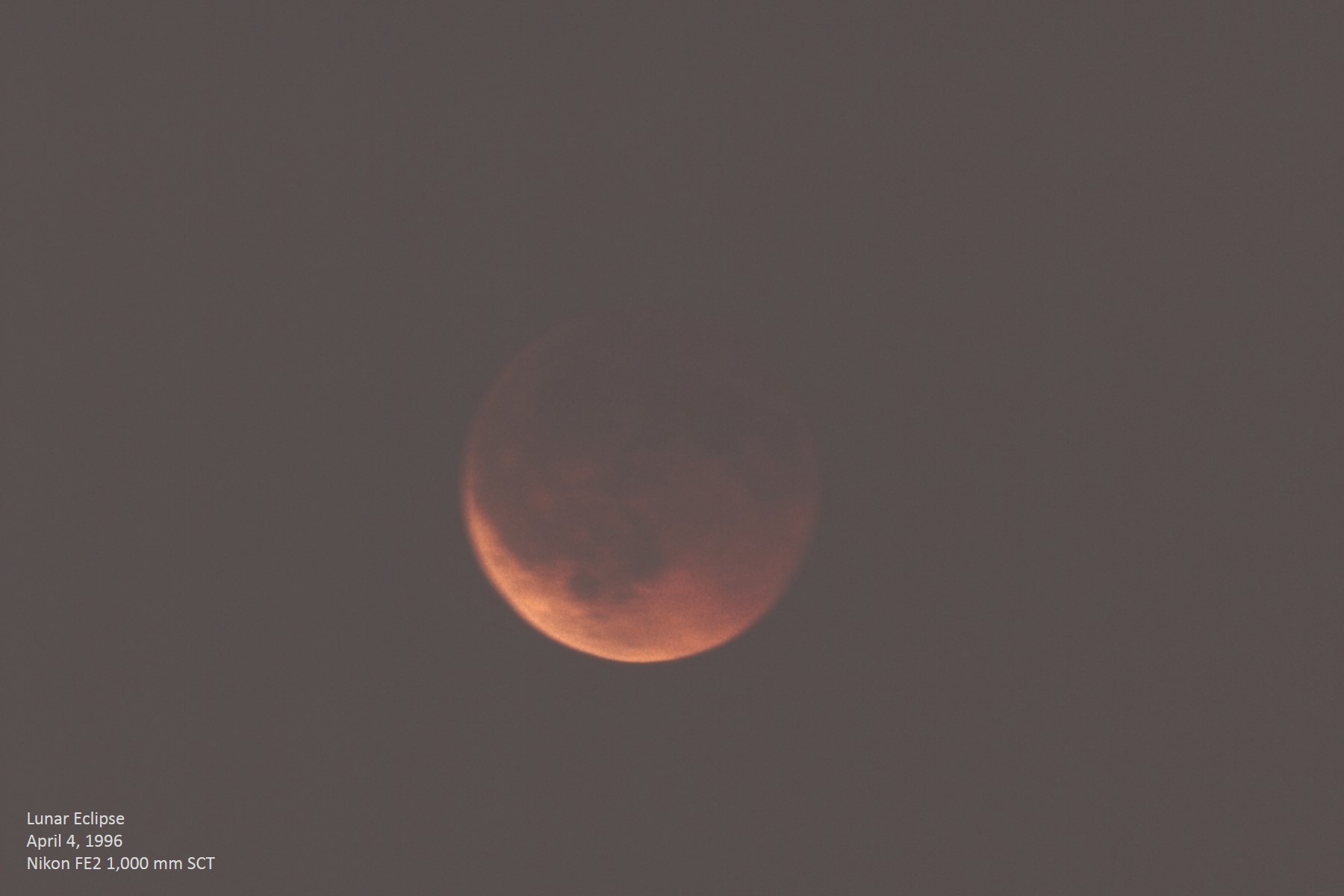
Mouse over the thumbnail above to see my best picture of totality through my telescope. This was
the first time I attempted to take a picture of the total phase of a lunar eclipse through my telescope,
so pardon my poor attempt LOL. I'm sure that I had the clock drive on the scope engaged, but this
eclipse was reportedly quite dark, so I had to stretch the scanned image quite a bit to even be
able to see anything. Unfortunately, that resulted in a very noisy final image.
The reason that the lower part of the Moon is brighter red than the upper portion is because the Moon
moved through the lower part of the Earth's umbra, so the bottom of the Moon is closer to the edge of
the umbra, and therefore receiving more of the refracted light from Earth than the upper part of the
Moon.