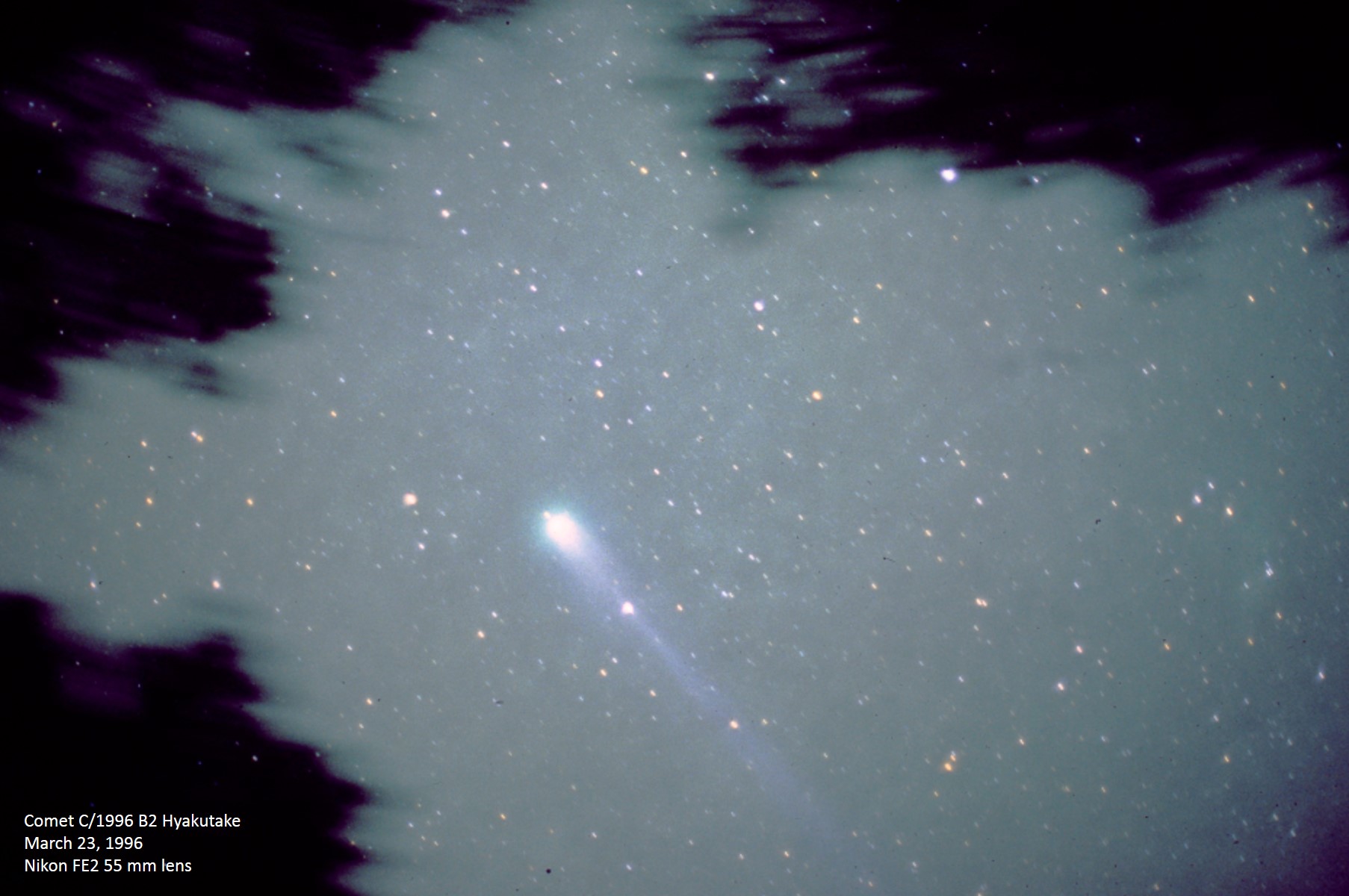
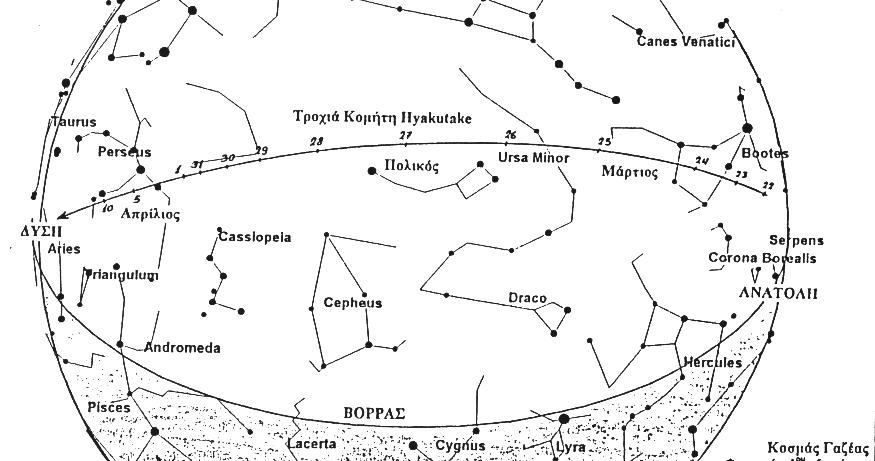
In the late winter and early spring of 1996, Comet Hyakutake exploded onto the astronomical scene and thrilled skywatchers with a brief but spectacular show. It was perfectly placed for northern hemisphere observers, as it raced across dark skies through Boötes and Ursa Major. Four factors combined to make it an unforgettable event: (i) new Moon was on the 19th of March, (ii) Hyakutake was near its brightest on the night of the 23rd and 24th, (iii) it happened to be positioned almost at the zenith those nights, and (iv) the weather was clear in central Virginia. Unannotated image
This picture was taken on the night of March 23 when the comet made an isosceles triangle with the stars beta and gamma Boötis. This image reveals that the tail still completely comprises ionized gas with almost no dust.
I caught Hyakutake just when the head almost merged with a 5.7 magnitude star at the apex of the triangle with beta and gamma, so what we see on the image is indeed a star next to the comet's coma.
The path the comet will take over succeeding nights will be almost straight up toward the top of the image, directly aiming at the gap in the trees to the left of the star labeled theta.