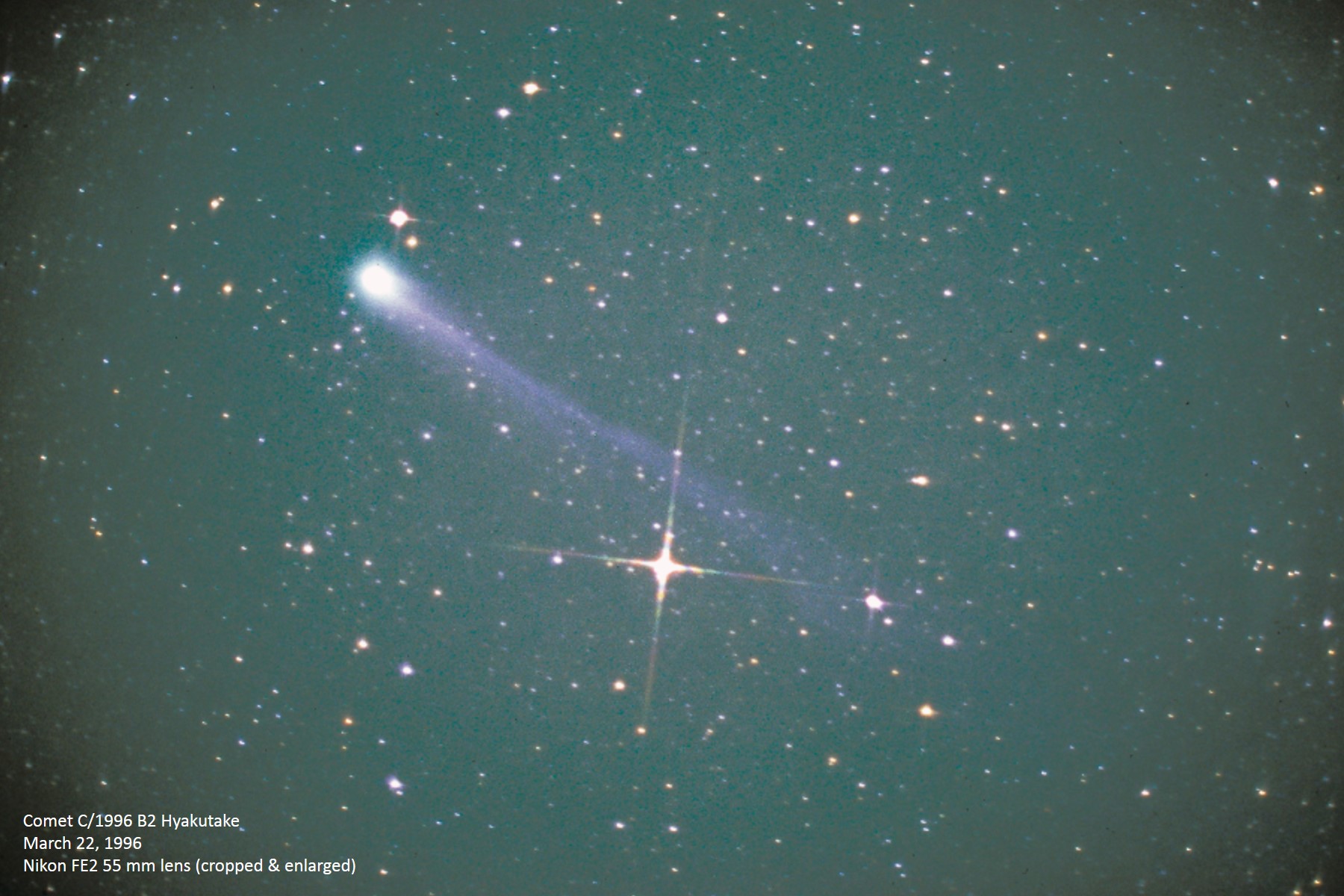
In the late winter and early spring of 1996, Comet Hyakutake exploded onto the astronomical scene and thrilled skywatchers with a brief but spectacular show. It was perfectly placed for northern hemisphere observers, as it raced across dark skies through Boötes and Ursa Major. Four factors combined to make it an unforgettable event: (i) new Moon was on the 19th of March, (ii) Hyakutake was near its brightest on the night of the 23rd and 24th, (iii) it happened to be positioned almost at the zenith those nights, and (iv) the weather was clear in central Virginia. Unannotated image
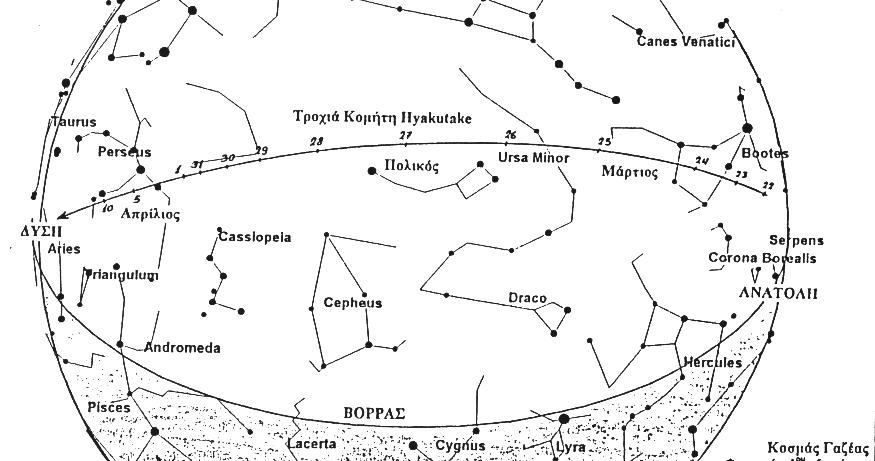
This picture was taken on the night of March 22, given the position of the comet close to Izar; compare to its position on this chart of its path across the sky, noting that its position shown on March 23 would be 0 hours UT, which is early in the evening of Mar 22 in the eastern United States. A photographer in North Carolina took this picture on March 23, which shows the comet much farther along its path than my image (off the top edge of my picture).
The comet was moving so quickly that images taken on the same date can put the comet at different positions relative to the stars, depending on what time zone the picture was taken, and what time of night.
Although my image shows the comet's head as overexposed and featureless, we nonetheless see the blue color of the tail, indicating that it predominantly comprises ionized gas and also that it presents as almost "wavy."
I don't recall that we observed the comet together, but March 22 was my Dad's birth- day, so I'm sure I would have been at his house that evening to celebrate. I can't imagine that he didn't come outside for a quick look at it.