|
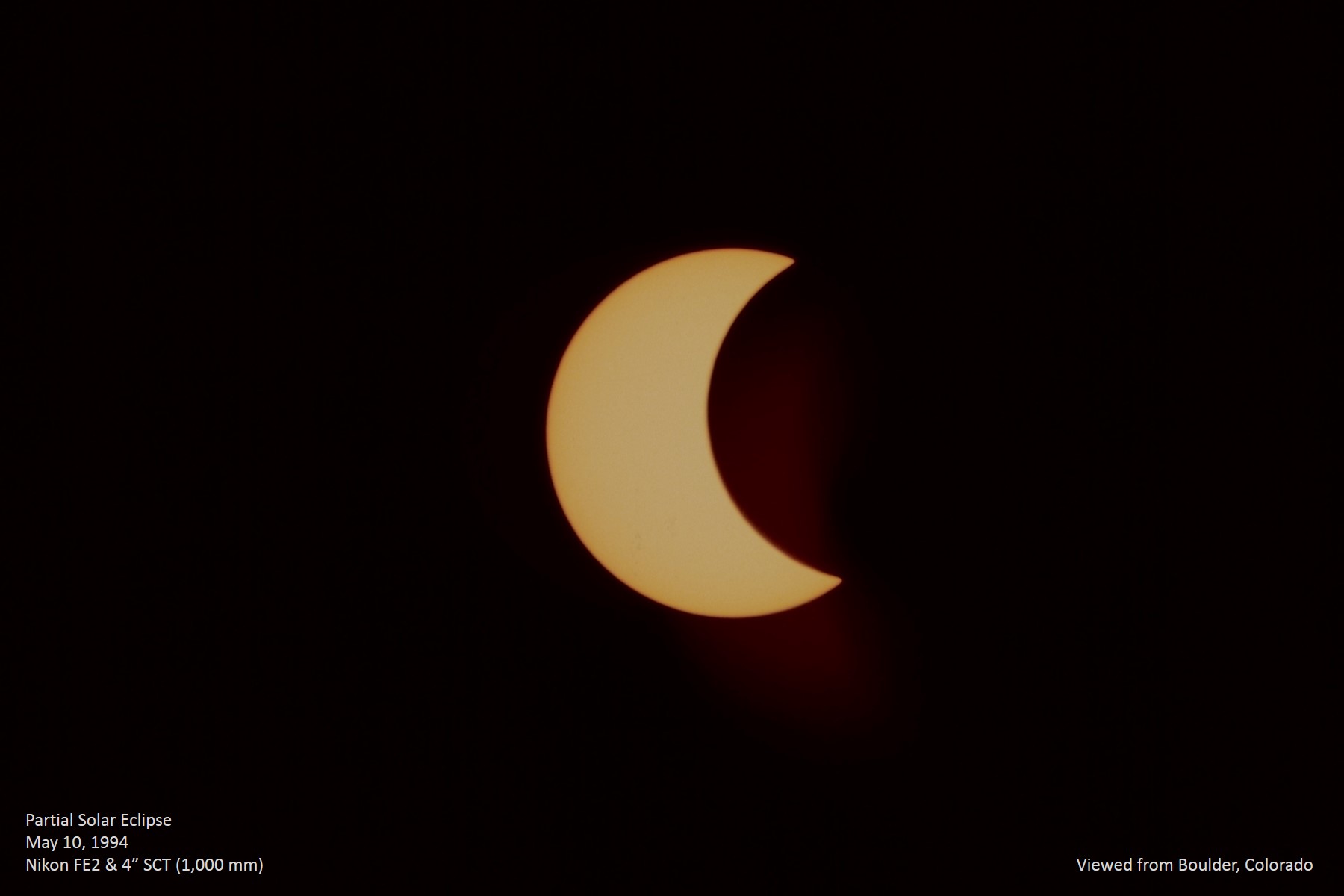
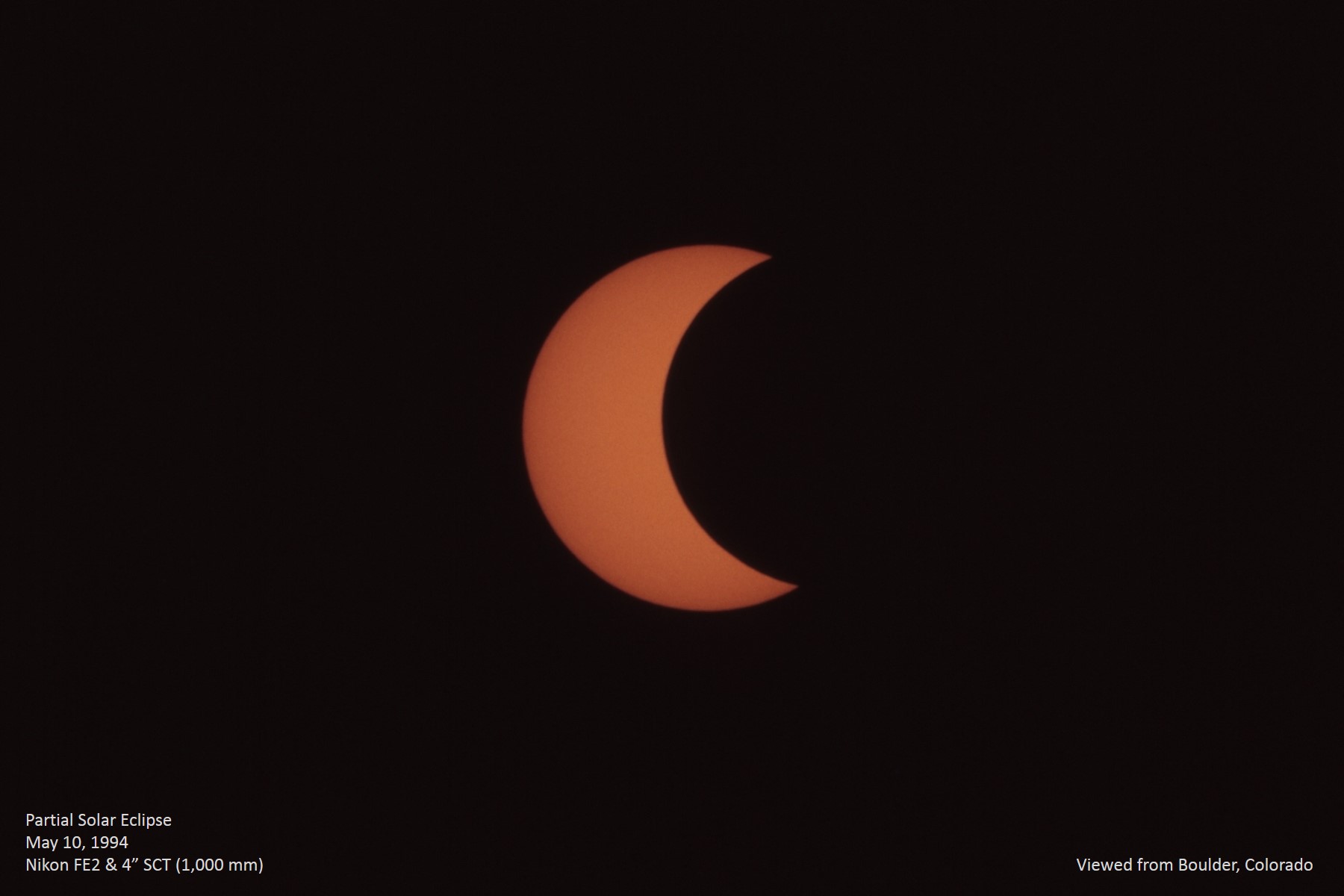
A partial eclipse of the Sun was visible across much of the United States
on May 10, 1994. The eclipse was annular along a narrow track, from Baja
California up to Nova Scotia, which meant that for people observing it in
Boulder, Colorado, we were on the north side of the line of annularity.
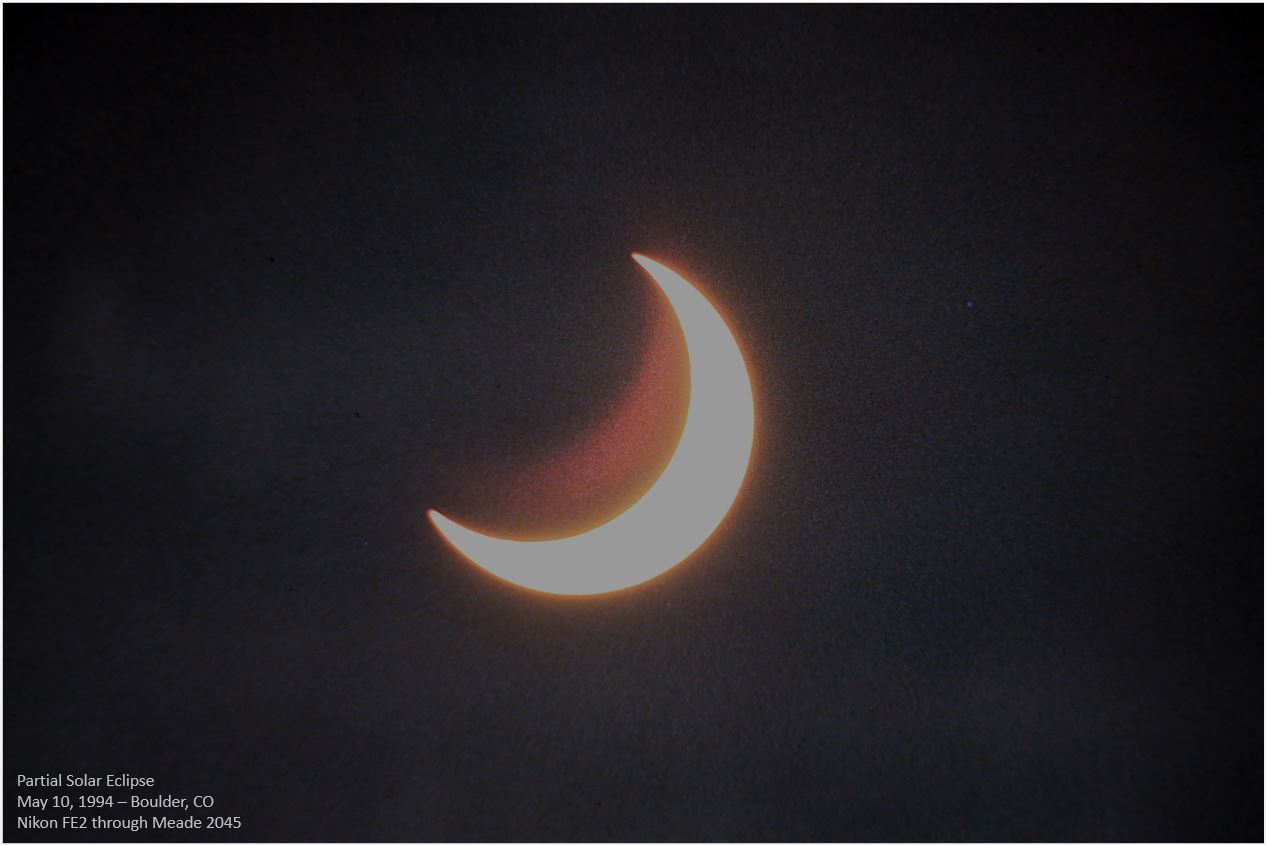
In Boulder, the eclipse maximum occurred just before 10:30 in the morning,
so all of it was visible relatively high in the sky. I observed the event
from the parking lot of my apartment complex. The images below are shown
in sequence from the early partial phase to just after the maximum point,
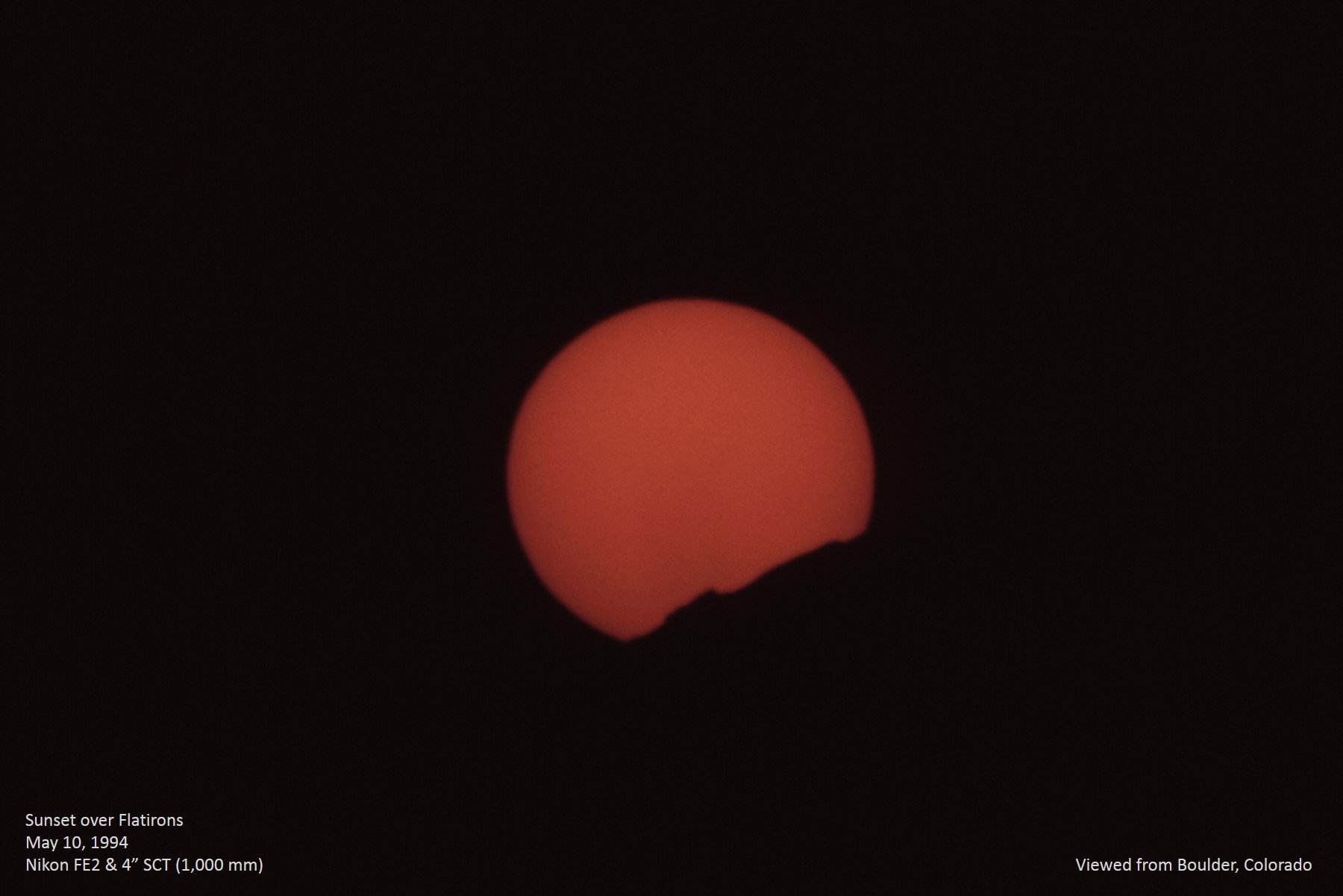
very close to which the third image was taken. As a bonus, I included a
picture of that evening's sunset showing it setting behind the one of the
flatiron mountains west of Boulder.
|
I'm sure that I observed the eclipse with 20 x 80 binoculars and a set of solar filters I made for them at the July 1991 total solar eclipse we saw from Mexico, as well as my Meade 2045 (a 4" Schmidt-Cassegrain telescope) with a very nice full aperture glass solar filter by Orion. My camera at the time was a Nikon FE2, which I could attach to the telescope for prime focus photography. All the pictures shown here were taken with the 4" SCT and its 1,000 mm focal length. I don't seem to have any pictures with any kind of telephoto lens, which probably results from keeping the camera on the telescope for the duration of the eclipse. |
|
|
|
|
|
|
The Moon met the Sun after going through the descending node of its orbit about 7 hours earlier in the day. The eclipse was an annular type because the Moon was farther away from Earth than its average distance, making it appear with a slightly smaller diameter than the Sun. From my vantage point in Boulder, the eclipse occurred during the morning half of the day, so I was seeing the Moon approach the Sun from the upper right, and as the eclipse progressed, it passed south of the Sun's center and moved off to its lower left. All the while, of course, the pair were circling higher in the sky until the end of the eclipse shortly after the noon hour. Unfortunately, this eclipse coincided approximately with solar minimum so there were no sunspots to add interesting details to the sun's disk. The different colors of the three pictures resulted from either underexposing or overexposing the picture. Of course, back then you had no way of know- ing what the correct setting was until you received your slides back from the developer LOL. The video at left shows the Moon and Sun at their relative size and level of obscuration from Boulder, Colorado. |