|
One of the longest eclipses in the 20th century crossed over the western Pacific, directly over Hawaii, and then crossing Baja California and the central portion of Mexico, before continuing through central and northern South America. In the area of Hawaii, totality was about 4 minutes in duration, but by the time the shadow of totality crossed over Mexico, the duration of totality had increased to near seven minutes. My parents and I had never seen a total solar eclipse despite having been only two hours away from the line of totality of the March 7, 1970 eclipse that tracked up the east coast of the United States. My father was inexperienced when it came to observing eclipses and did not appreciate the difference between being in the zone of totality versus seeing it from a location where the magnitude was 99%. We saw the March 1970 eclipse from Richmond instead of driving to Virginia Beach and as a 7 year old, I recall him as a being upset afterwards at having missed such an easy opportunity. So when the eclipse of 1991 came around, he was determined to travel any amount necessary to experience totality. During his research regarding different eclipse tours, he came across material from the chief astronomer from the Naval Observatory, Tom van Flandern. Van Flandern was keen on the idea of observing the eclipse from near the edge because all of the in- teresting edge phenomena would be discernible for a longer time there as opposed to the centerline. These things included shadow bands, Baily's beads, as well as some other minor phenomena. So the tour was called the Eclipse Edge Expedition. We flew to Puerto Vallarta and joined the tour there. ( 20°52'21" N 105°26'14" W ) |
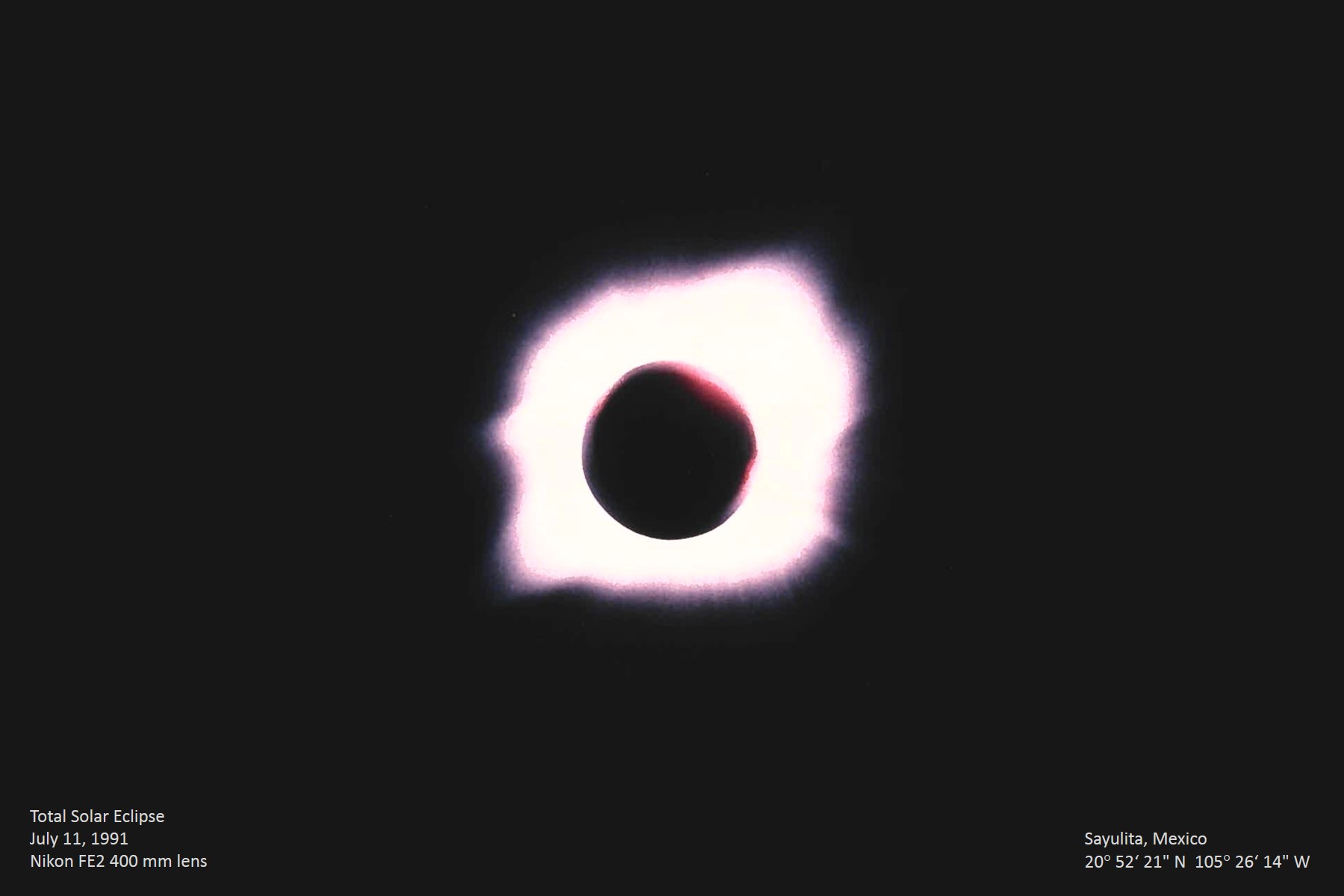
We were bused from the hotel in Puerto Vallarta to the observing site in the small seaside village of Sayulita, where the organizers made arrangements with the local government to utilize the school grounds as our base. As I recall, the area was a large concrete patio, with shrubbery and gardens interspersed across the grounds. Fortunately, shaded places to sit were available around the edges, and there was sufficient room for everyone to set up equipment and move around without any con- gestion. The eclipse was scheduled to occur at our location around the middle of the day. My setup for the eclipse included a Nikon FE2 film SLR and a Meade 2045 4" SCT with a white light solar filter, a 400mm Sigma mirror lens, and a Vivitar 28-200 mm lens with solar filter. I also had a pair of 20 x 80 binoculars with an improvised mylar solar filter for one of the oculars. My Meade telescope came with a set of 3 tripod legs exactly like the Questar scopes come with, so I set it up on some cinderblocks to get it off the ground, but that meant I had to lie down on the ground to aim the camera and focus the scope ~ not very convenient! I did manage to get pictures of the partial phases through the Meade, which is a 4" f/10, giving it a focal length of 1,000 mm, but for some reason, during totality, I switched to the 400 mm lens and snapped one picture, shown here. I also got several pictures of the partial phase after third contact, but none of my partial pictures have survived years of storage and moving ~ I can't locate them anywhere. Some time during the early 1990's, I had an 8x10 print made of my totality picture, which is what I scanned in in 2026 to result in this image. |
|
|