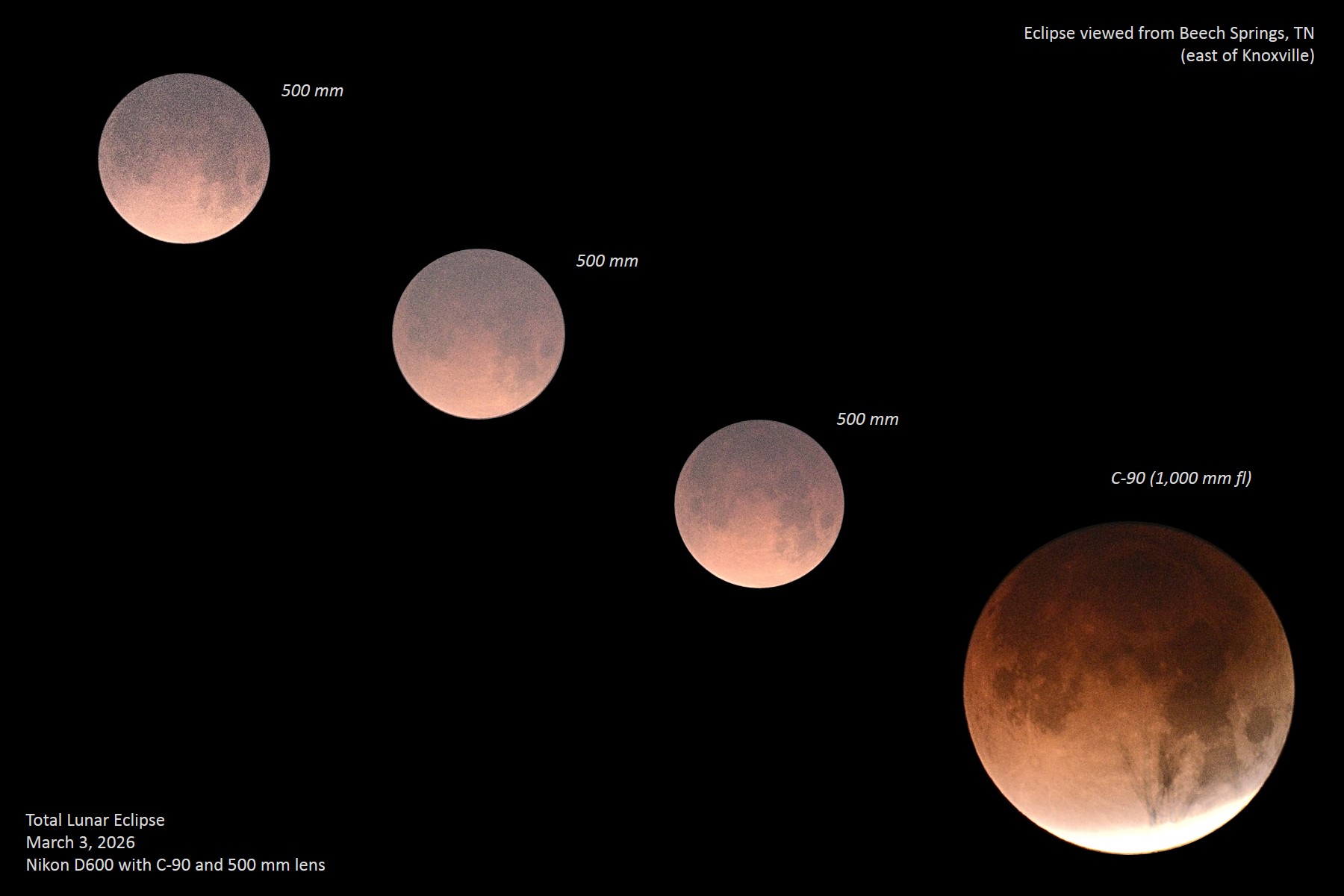
I drove to eastern Tennessee to observe the lunar eclipse because it was the only place within reasonable range with any prospect of clear skies. Even though, the place where I ended up viewing the eclipse experienced low clouds and haze and generally not very satisfactory viewing. The images are arranged in the order I took them from lower right to upper left.
This eclipse occurred in the morning, beginning before twilight started but with moonset occurring around the time of maximum eclipse. Therefore, several challenges in observing and imaging this event arose ~ one needed a very clear, flat western horizon, as well as a cloud free western sky, and preferably a site without lights in the immediate area. Apparently I struck out because the site I ended up selecting had none of these LOL!
The first image I obtained, at lower right, was as the Moon was highest in the sky of the sequence of images, about 10o above the horizon. Unfortunately, I did not realize that the Moon was already partly obscured with the limbs of foreground trees, so I decided to move my setup to another spot. After setting up again, I could not locate the Moon with the 1,000 mm fl telescope, so I switched to a 500 mm lens. The remaining images were taken with that lens, with the last image shown at the top left of the picture. The last picture reveals that the clouds and haze were increasingly worse toward the horizon, since it really just looks more like a blurry muddle than a clear Moon image.
This eclipse is the second one in the current eclipse season, the first of which was a solar eclipse of the annular kind in Antarctica. In this case, the annular eclipse results from the Moon being near apogee, i.e. relatively far from the Earth. Therefore, during this lunar eclipse, the Moon is closer than average to the Earth, therfore larger.
The Moon was near the border between Leo and Sextans, west of the autumnal equinox point. Unfortunately, no bright stars are along the ecliptic in this area, but some of my images did show a magnitude 5.9 star known as 56 Leonis. The Moon had crossed over the ecliptic from north to south, a point which is therefore known as descending node, before encountering the shadow of the Earth, so this eclipse occurred in the lower half of the Earth's umbra. I was driving to the observing location all during the partial phase, so even though I was able to clearly see the Moon entering the umbra, I didn't get a picture of it.