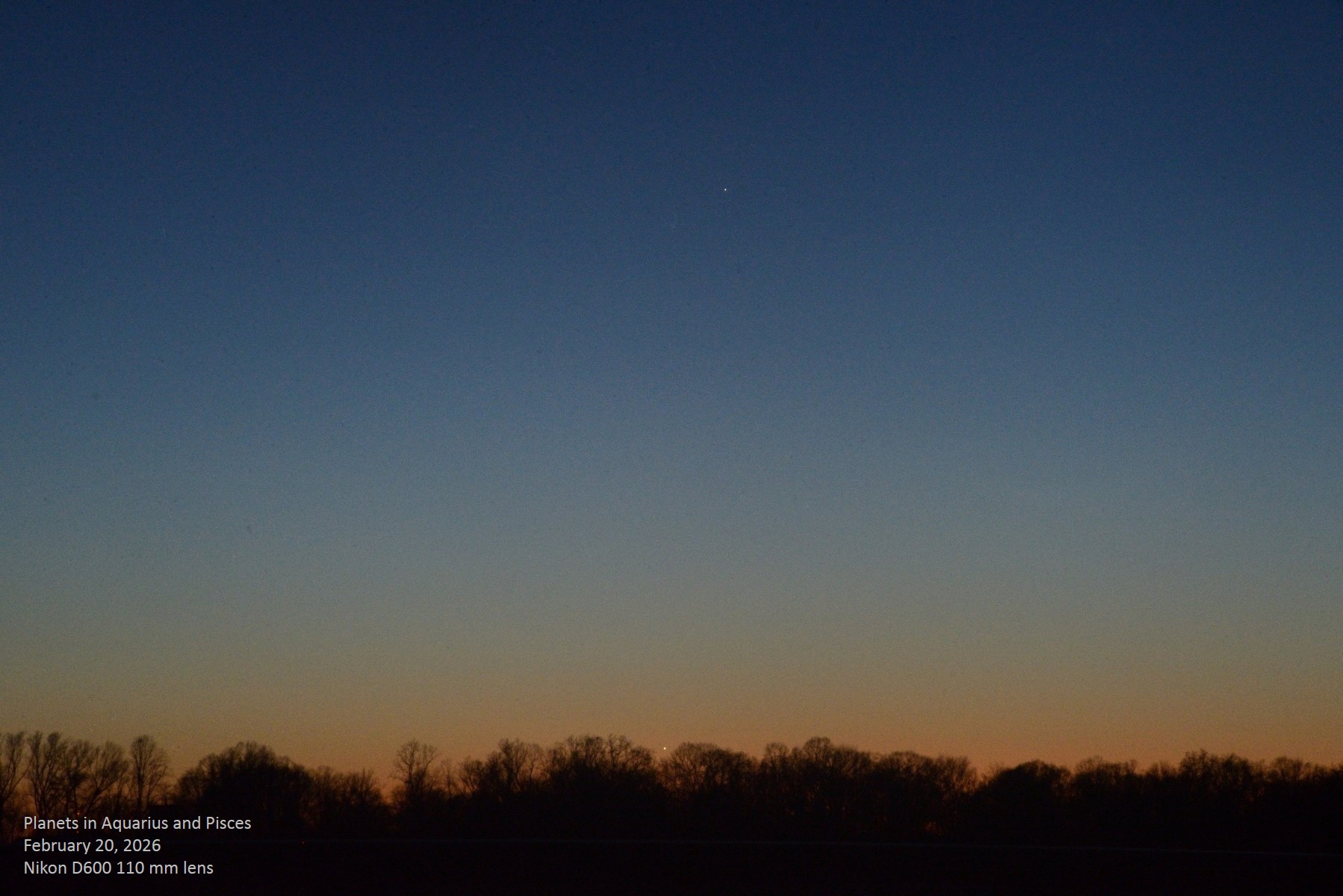
After several days of uncooperative weather, we finally had a beautifully clear evening and as a result finally got a good view of Venus. In this view, Venus is just above the treeline, shining at magnitude -3.91, while Mercury is above and slightly to the right, at magnitude -0.26. The separation between the two is 7°41'09" this evening. Venus is below the ecliptic by 1°24' while Mercury is 1°34' above the ecliptic. Unannotated image.
This is our first view of Venus during its new evening apparition, which began on January 6 after its passage behind the Sun, an event known as superior conjunction. Mirroring very closely its circumstances in 2002, 2010 and 2018, this apparation is marked by a slow climb in the winter and spring to a moderate elevation, then in the summer a decrease in elevation, culminating in its passage between Earth and Sun on October 24.
Each Venus apparition offers a unique set of planetary alignments, and in 2026, probably the highlight is the Venus-Jupiter conjunction that will occur in Gemini on June 8 in the constellation Gemini. This event will be a repeat of their conjunction in 2002 (and before that in 1978) and which they will repeat again in 2050. The pattern repeats (although not exactly) every 24 years due to the harmonic between Jupiter's 12 year pattern of repetition and Venus' 8 year pattern (2 x 12 = 3 x 8 = 24).
Before the conjunction with Jupiter, however, several other pairings will take place. On February 27, Venus and Mercury will be equidistant above the horizon for a very wide conjunction, then on March 7 Venus passes Saturn (and an invisible Neptune) fairly closely. The 23rd of April brings an unusual sight ~ Venus will be lined up almost perfectly between Uranus and the star cluster M45, the Pleiades. They will be 26° away from the Sun and should be visible in a dark sky (although a clear view of the western horizon would be required in order to see them after the end of twilight).
Back to the Venus-Jupiter conjunction of June 8 and 9: it turns out that the evening scene also includes the innermost planet, Mercury. Mercury is well placed for inclusion in photos of the conjunction because of its 23° elongation from the Sun, as well as its magnitude +0.07 brightness.
On June 19, Venus will skim over the northern edge of the Beehive cluster, M44, in Cancer. This should also be visible in a dark sky. On July 9, Venus will scoot by Regulus fairly closely. On September 1, Venus will be just to the south of Spica and will set 90 minutes after the Sun, so despite being south of the ecliptic this event should still be easily visible. After this conjunction, Venus drifts further below the ecliptic with each day as it swings back toward its passage in front of the Sun. These October inferior conjunctions feature Venus passing well south of the Sun, which on this occasion is 6°29'42". Only inferior conjunctions which happen in August are further south; for example the inferior conjunction of August 13, 2023 was south of the Sun by 7°41'59".