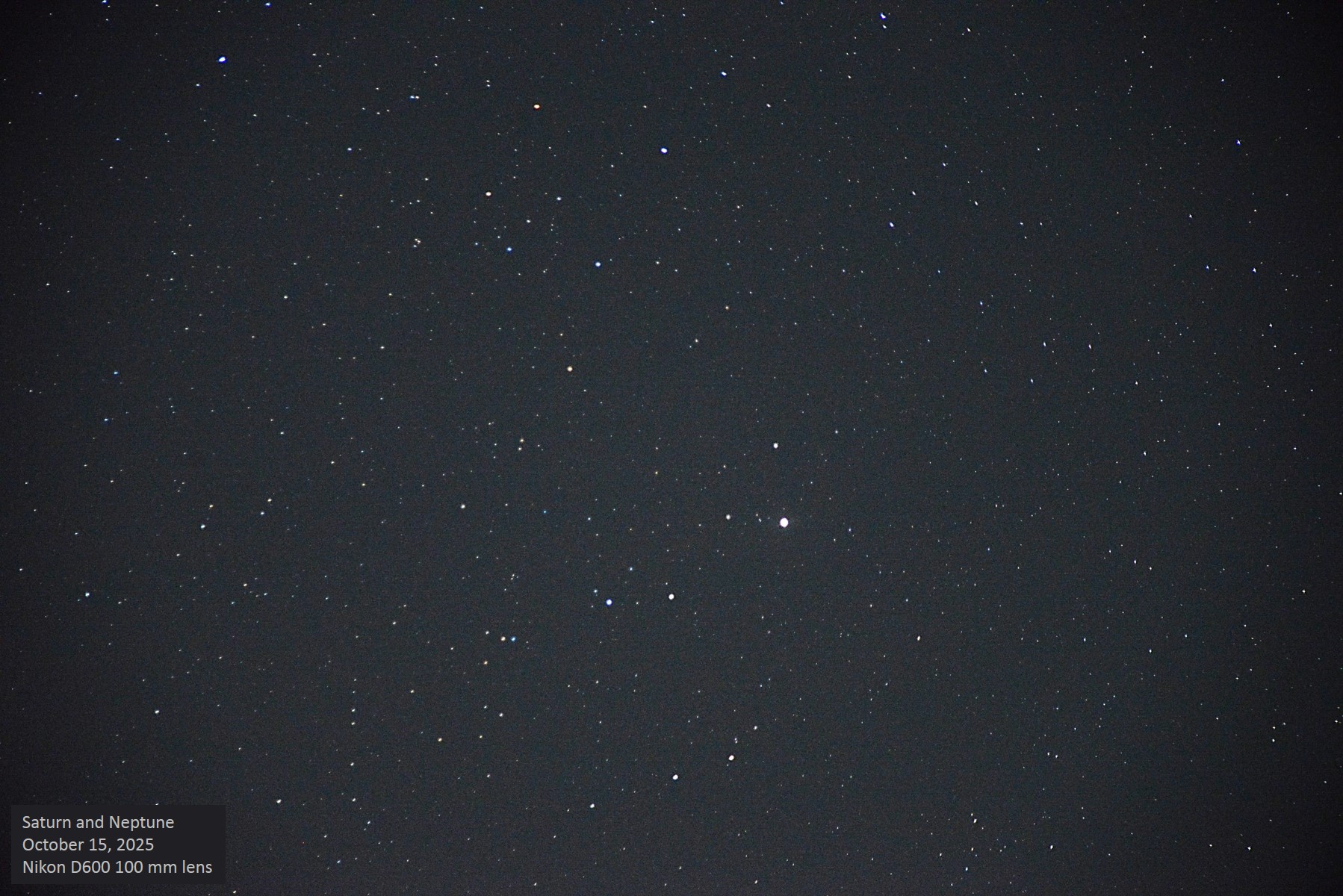
Several times over the past few years I have included
pixellated zoomed-in views of Neptune and Uranus as a
demonstration of how the camera can faithfully record
the colors even with just a 50 or 55 mm lens. Today's
image of October 15, 2025 was made with a zoom lens at
100 mm, so we have plenty of pixels to see what color Neptune really is,
at least according to my camera.
The typical pictures we think of when visualizing the
Uranus is thought of as a light aqua/teal color while
What causes the teal color to begin with? Both of the
two ice giants are most often something like the ones
I pulled from a Bing images search (Uranus at left):
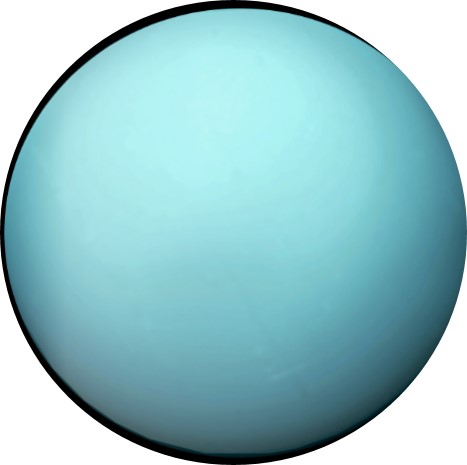
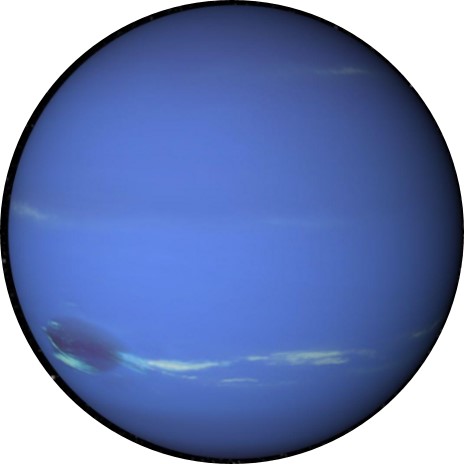
Neptune is typically shown as deep blue; the color of
the central pixel in my Neptune image looks much more
like the Uranus image than the Neptune one, however:
 It turns out that the deep
blue Neptune picture was a
false color image intended
to highlight detail in the
surface clouds. There have
been theories developed as
to why the two planets are
colored
differently, but a
recent analysis of Voyager
data demonstrates that the
actual color of Neptune is
much closer to the teal of
Uranus.
ice giants have atmospheres with large concentrations
of methane, which absorbs red and yellow light. Light
from the blue end of the spectrum is therefore mainly
what is reflected back into space.
Saturn and Neptune are still close but now both several weeks after their oppositions in late September. Saturn is now firmly in Aquarius again while Neptune lingers in Pisces. Note how they are both well south of the ecliptic. Saturn is at magnitude +0.75 and Neptune at +7.82. Unannotated image.