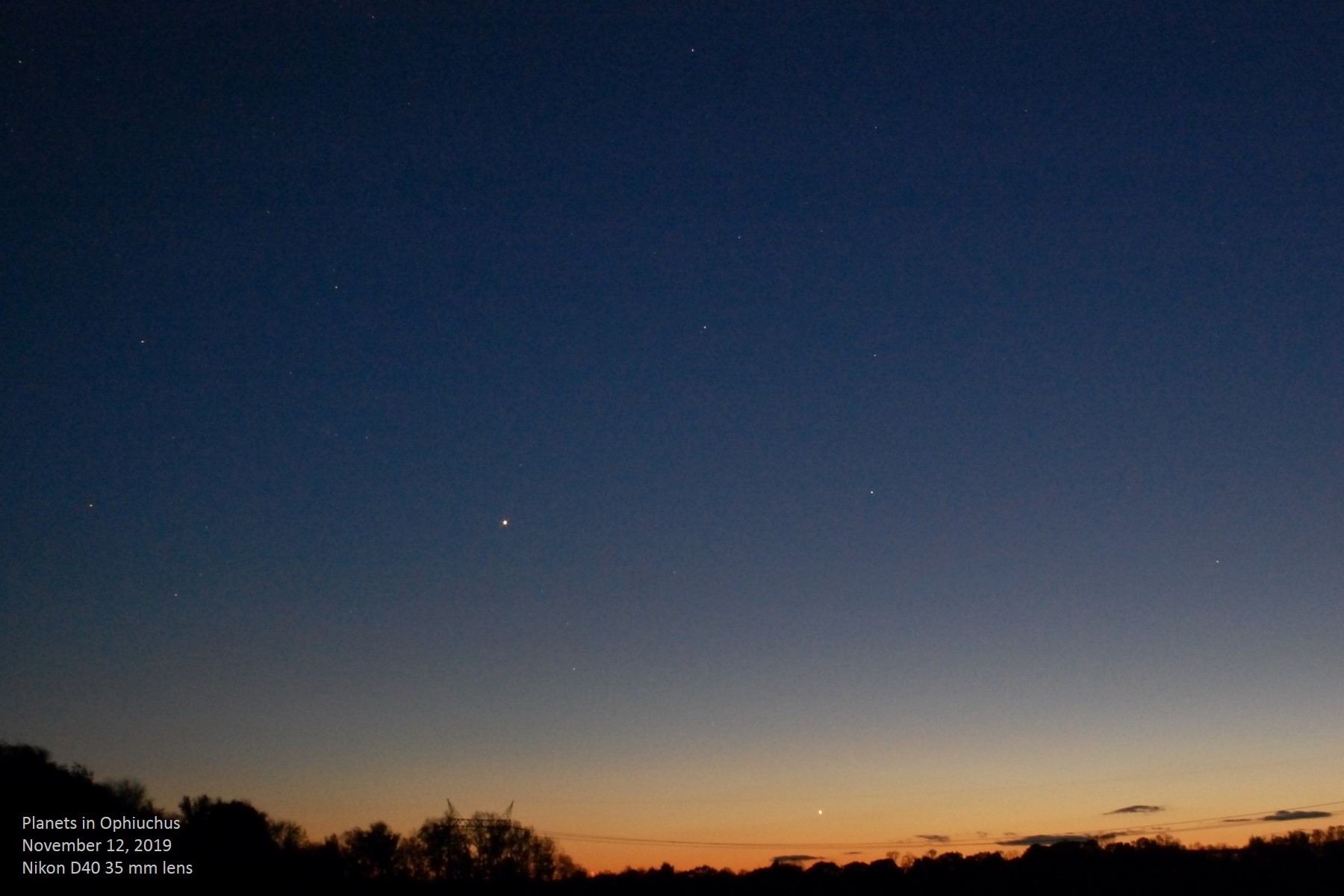
Jupiter has spent the year 2019 in Ophiuchus
in which it reached opposition during summer
on June 10 at a position northwest of (which
on our image means to the right of) the star
theta Ophiuchi. Jupiter will pass behind the
Sun, which is known as superior conjunction,
on December 27, 2019.
Venus is just now emerging from its position
of superior conjunction and climbing up into
the evening sky. This upcoming apparition of
Venus, which will occur mostly in 2020, will
be very similar to those of 1988, 1996, 2004,
2012, and 2028. These apparitions are marked
by a steep ascent into the winter and spring
sky, inferior conjunction in June, followed
by a similarly high appearance as Phosphorus
which is the Greek name for Venus during its
morning apparitions. Venus transited the Sun
during the inferior conjunctions of 2004 and
2012.
But now, the immediate event for skywatchers
is the impending conjunction between Jupiter
and Venus, to occur on November 24. The pair
is closest at 9:00 a.m. EST on the 24th, but
of course this occurs during the daytime, so
it is not easily observable. The two planets
are separated by 1°24'27" at their moment of
conjunction, but by the evening in Virginia,
their separation has grown to 1°29'21".
Although they will be farther apart, Jupiter
and Venus will have nearly equal height over
the western horizon on November 25, which is
potentially a more aesthetically satisfying
view.
The next time Venus and Jupiter will engage
in this type of conjunction will be on Nov
29, 2043. I hope to still be around to see
it!
In early November 2019, we begin to see the impending conjunction of Venus and Jupiter taking shape. On this date, Venus is still very low on the western horizon after sunset, with Jupiter well to its upper left. Saturn is much farther away to the upper left in Capricornus. Venus is magnitude -3.92 while Jupiter shines at magnitude -1.90, with a separation of 11°58'48" between them. My Nikon D40 with its APS-C sensor, paired with this older 35 mm lens, yields a frame equivalent to a full frame sensor with a 52 mm lens. Unannotated image.