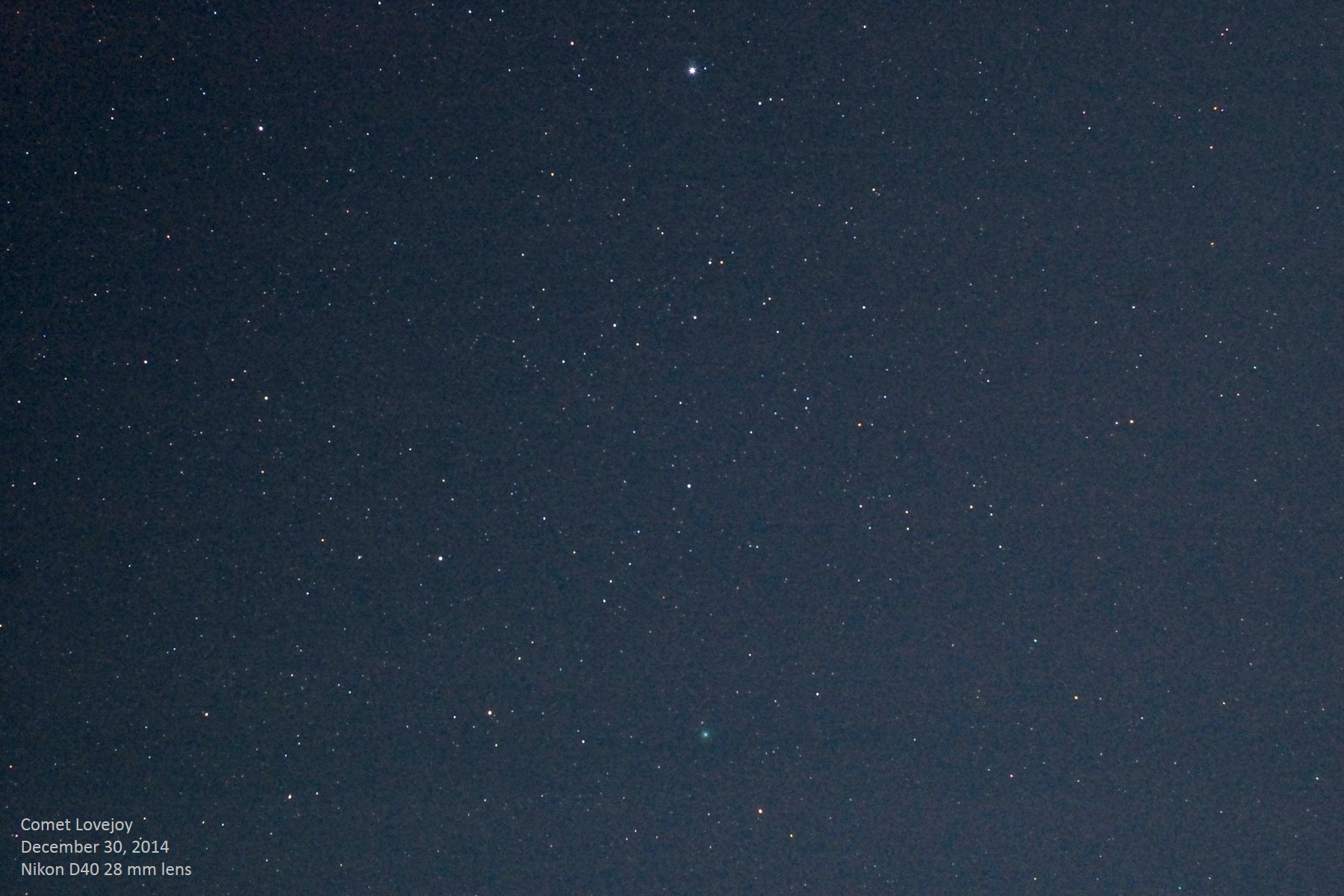
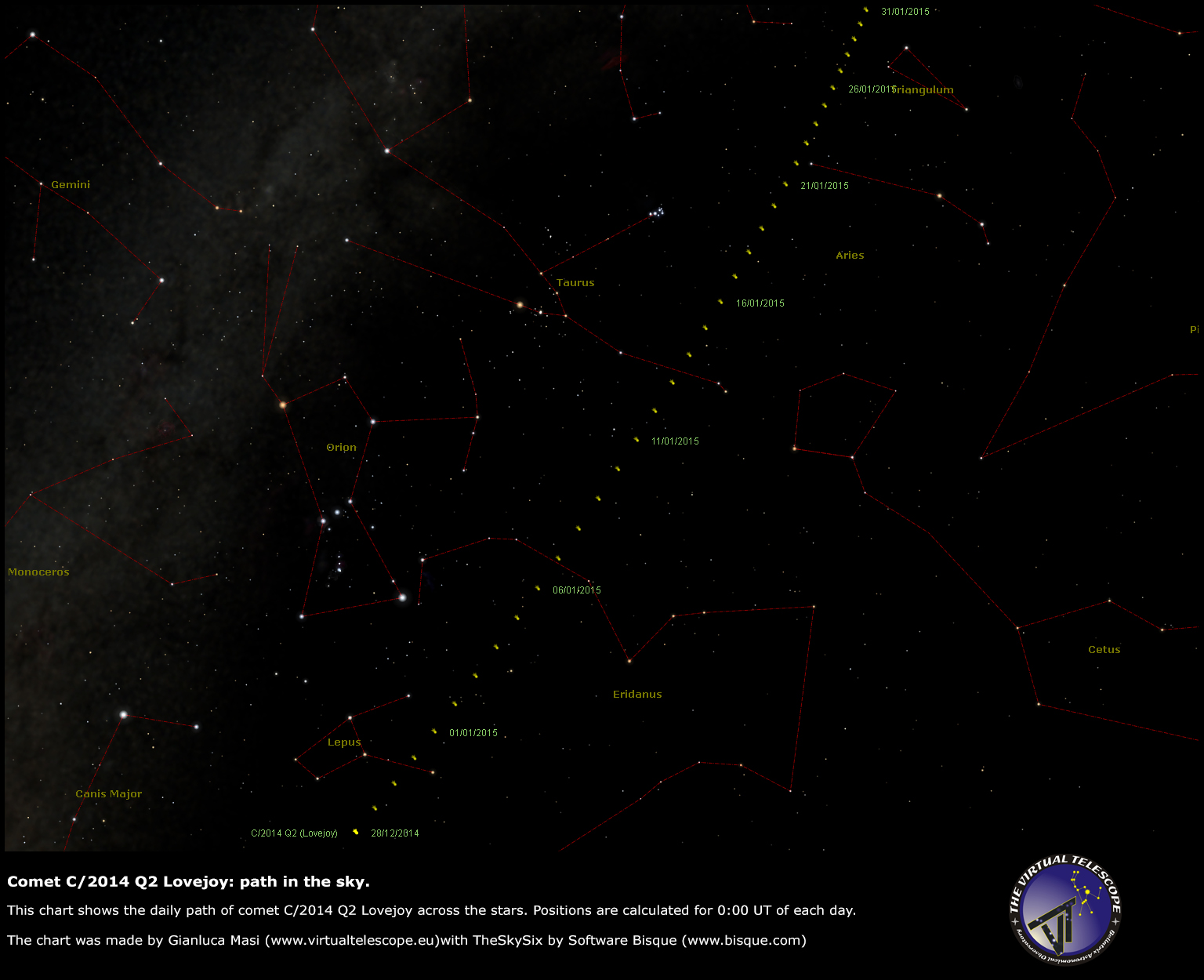
Comet C/2014 Q2 (Lovejoy) became a naked eye object from late December 2014 through January 2015. Its orbital track took it from Puppis through Lepus and then up into Eridanus and Taurus. In this image from December 30, we find the comet in southwestern Lepus, having just passed the globular cluster M79 (just off the bottom edge of my image) and headed for Hind's Crimson Star, R Leporis. From my image, it appears that R Leporis happens to be near maximum. Unannotated image.
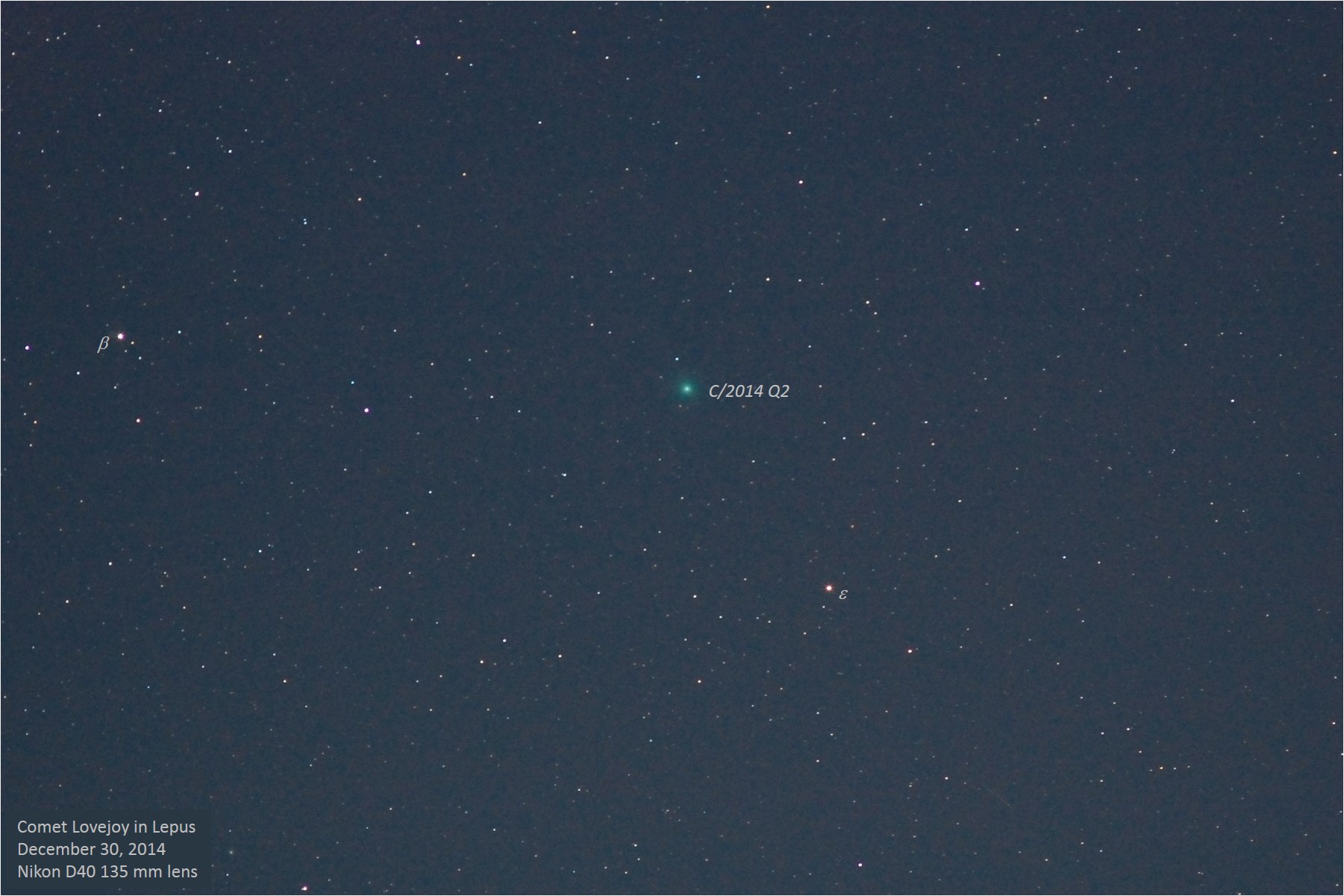
Mouse over the above image to see an enlarged view of Comet Lovejoy taken with a 135 mm lens. That is equivalent to using a full frame camera with a 202 mm lens (the Nikon D40 uses a cropped sensor).
The 135 mm image shows the green color of the head of the comet very nicely. The color results from a molecule of two carbon atoms (C2), called diatomic carbon being excited by ultraviolet radiation, and which then emits the green glow. Comet Wirtanen of 2018 also exhibited this green glow very strongly.
The unusual circumstance of R Leporis being close to maximum deserves mention also. This star is of the long period variable type, with a periodicity ranging from 418 to 441 days (information gleaned from Wikipedia). Extrapolating backwards from the graph of its brightness estimates, it should have been at maximum sometime in the December 2014 and January 2015 time frame.
The star directly above R Leporis, located in the constellation of Eridanus, is magnitude 4.78, and from my image, R appears very comparable to it in terms of brightness, so I would say that R should be at least magnitude 5 at this time.